Best Place to Stake XRP: What the Data Actually Shows
XRP yield ranges from 1% to 12% APR in 2026, depending on platform, lock-up, and risk model. Here's how every option actually stacks up.
XRP cannot be staked. The XRP Ledger has no proof-of-stake mechanism, so every product marketed as "XRP staking" is a lending or yield program in different packaging. The best place to stake XRP — by rate, terms, and risk model — is a dedicated lending platform offering a fixed 12% APR, daily payouts, and no lock-up.
Can You Stake XRP?
No — and the distinction matters more than most platform marketing suggests. The XRP Ledger uses Federated Byzantine Agreement (fBFT), a consensus protocol where trusted validators agree on transaction order through iterative communication rounds. There is no staked capital, no protocol reward, and no lock-up mechanism in the XRP network itself.
This is structurally different from Ethereum or Solana, where validators lock tokens into the base protocol and receive newly minted tokens and fee distributions in return. In Proof-of-Stake systems, yield originates at the consensus layer. On XRPL, the consensus layer generates nothing for holders.
When exchanges advertise "XRP staking," what they're actually offering falls into one of three categories: lending programs (your XRP gets lent to borrowers), liquidity provision (you supply XRP to trading pools), or wrapped-asset products (your XRP moves to another blockchain). A review of XRP staking options across the market confirms this consistently: no platform offering "XRP staking" delivers protocol-level yield, because none exists. The question shifts from can you stake XRP to which of these mechanisms produces the best return on the best terms. For the short version of that gap, see the XRP stake FAQ.
What the Data Shows: XRP Yield Options in 2026
Here's how the main options compare as of September 2026:
| Platform / Method | APR / APY | Lock-up | Rate Type | Risk |
|---|---|---|---|---|
| Binance Earn (flexible) | 1–3% | None | Variable | Custodial |
| OKX | ~3.65% | Varies | Variable | Custodial |
| Kraken | ~3.8% | None to 30 days | Variable | Custodial |
| Nexo (base rate) | 4.25% | 90 days | Variable | Custodial + token |
| Nexo (max tier) | 8.25% | 6 months + 2M NEXO | Variable | Custodial + token |
| YouHodler | up to 11% | Varies | Variable | Custodial |
| XRPL AMM (liquidity provision) | Variable | None | Variable | Impermanent loss |
| Wrapped XRP / wXRP DeFi | 2–8% | None | Variable | Smart contract, bridge |
| LendProtocol | 12% APR (fixed) | None | Fixed | Platform guarantee |
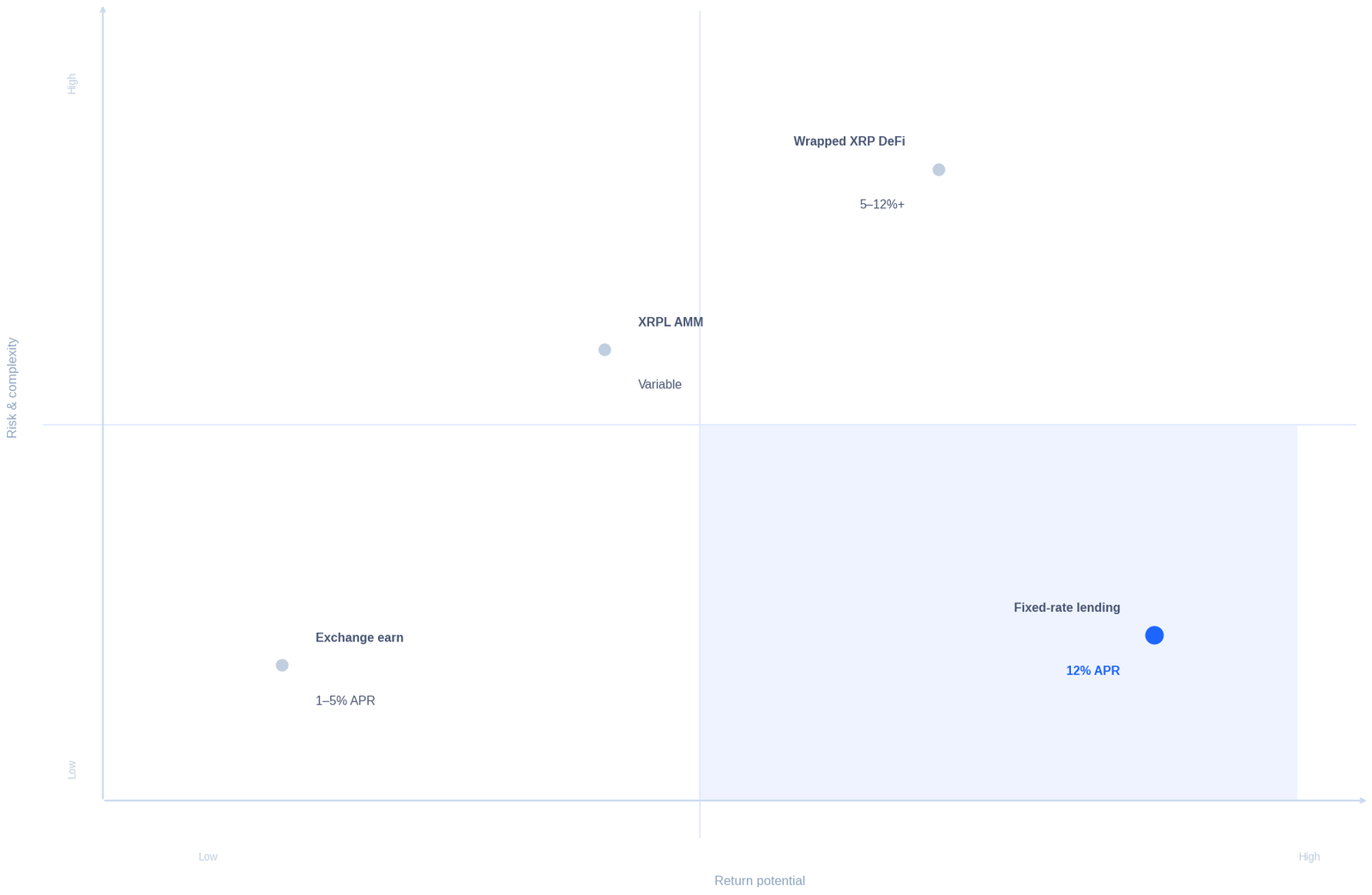
Most exchange programs cluster between 1% and 5% on flexible terms. Harvest Finance, which tracks XRP yield products on-chain, recorded a median vault rate of just 1.88% as of July 2026, with the best vault at 3.04%. For a live view of XRP lending rates across platforms, Bitcompare publishes up-to-date figures including base rates and lock-up conditions that headline APYs typically obscure. Our own XRP lending rates guide maps the same landscape by product type.
Nexo's 8.25% max APY on XRP looks competitive until you read the conditions: a six-month lock-up, holding at least 2 million NEXO tokens, and interest paid in NEXO rather than XRP. Strip those away and the accessible base rate is 4.25% with a 90-day lockup. YouHodler's 11% sits closer to the top end of the CeFi range but comes with the opacity typical of custodial platforms.
Why Fixed-Rate Lending Outperforms Exchange Programs
Exchange yield programs are side products on trading platforms. Rates fluctuate with borrower demand and can compress from 4% to 1% without notice. Variable rates make multi-month return projections unreliable.
Dedicated lending platforms work differently. LendProtocol, built natively on the XRP Ledger, connects depositors to overcollateralized borrowers — individuals and institutions that post 120% of the loan value in BTC, ETH, SOL, XRP, RLUSD, or USDT to borrow XRP or RLUSD. Lenders earn a stated 12% APR, paid daily. With daily compounding, that works out to approximately 12.75% effective annual yield. The full mechanics of how XRP lending works — including the collateral flow, daily crediting, and platform risk model — are covered in detail on the LendProtocol blog.
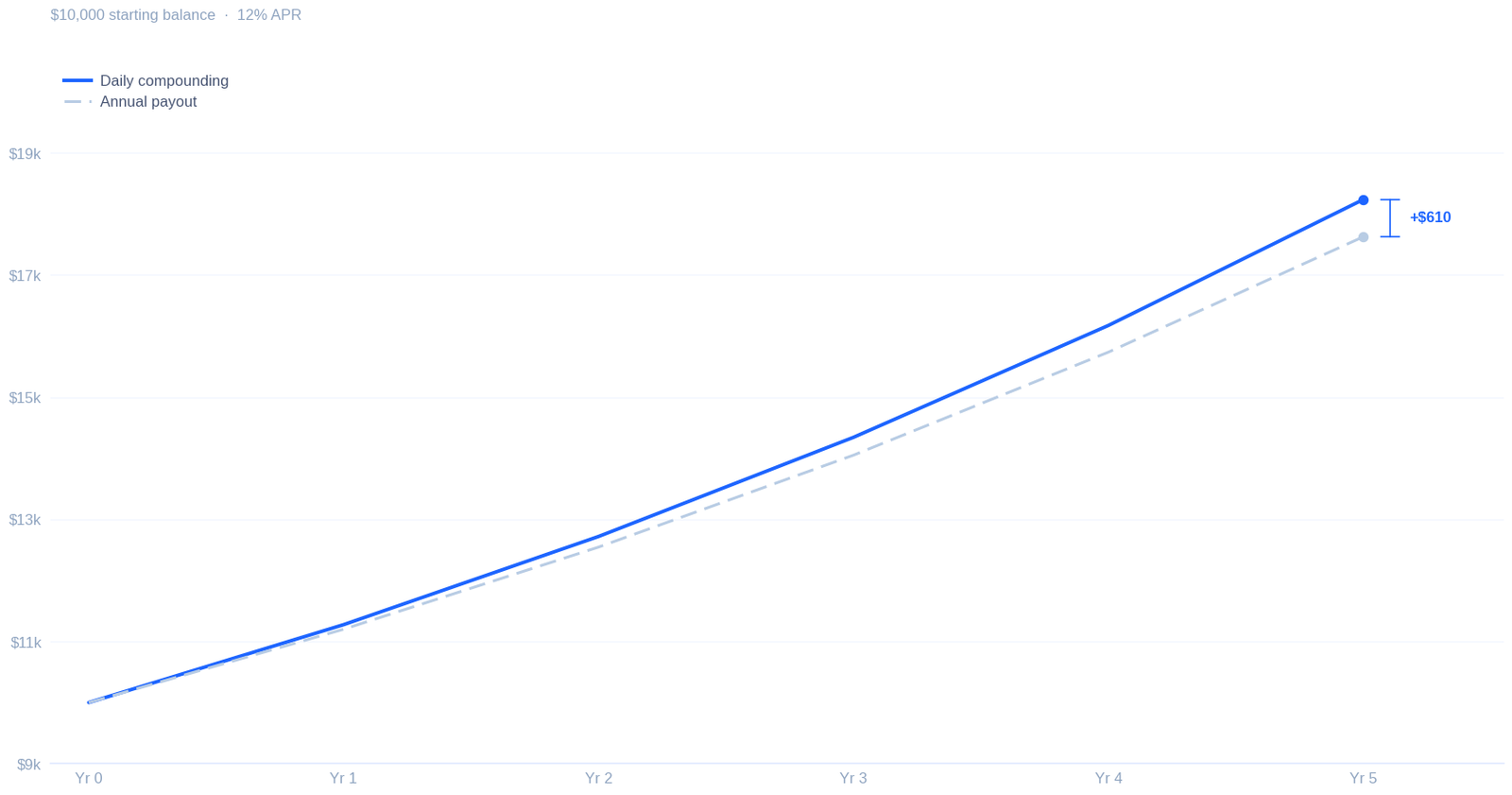
The structural differentiator is who absorbs losses if a borrower defaults. On most pooled lending products, a default reduces the pool and depositors share the impact. The platform acts as principal between lenders and borrowers, absorbing default risk rather than passing it to depositors. The 0.7% spread between borrower rate (12.7%) and lender rate (12%) funds this protection, alongside the 20% collateral buffer that cushions against collateral price volatility.
The On-Chain Alternatives: AMM and Wrapped XRP
For holders who prefer non-custodial options, two paths exist — both with meaningful trade-offs.
XRPL AMM — The XRP Ledger's native automated market maker launched in 2024. Supplying liquidity earns a share of trading fees but requires depositing two assets simultaneously. If XRP's price moves sharply against the paired asset (say, RLUSD), you receive back a different ratio than you deposited — potentially underperforming a simple hold. Yield is entirely variable and tied to pool volume.
Wrapped XRP on other chains — Bridging XRP to Ethereum or BNB Chain opens access to DeFi lending markets at 2–8% APY. The setup requires new wallets, bridge fees, and exposure to smart-contract risk on a different network — several added failure points in exchange for rates that dedicated lending platforms already exceed. Sidechain-style products are covered in XRP liquid staking explained.
How to Find the Best Place to Stake XRP
The best place to stake XRP isn't always the one with the highest headline number. Run any platform through four criteria before depositing.
- Fixed or variable rate? Variable rates on exchange programs can compress from 4% to 1% overnight with no notice. A fixed rate removes that uncertainty entirely. This distinction typically affects actual annualized return more than the quoted APR difference between platforms.
- Lock-up terms. Many of the highest-yielding options lock capital for 90 days to six months. Nexo's 8.25% max, for example, requires a six-month commitment. If XRP's price moves and you want to exit, a lock-up becomes costly. Look for a competitive rate with penalty-free withdrawals at any time.
- Who absorbs defaults? In exchange programs and most DeFi pools, depositors share pool-level exposure to bad loans. A platform that absorbs borrower defaults itself — backed by a 120% collateral requirement — materially limits the scenarios where depositor principal is at risk.
- Security and real borrower demand. Cold storage, AES-256 GCM encryption, and 2FA are the baseline to verify. Platform scale is equally telling: over 13,713 active lenders and 743 million XRP lent signal sustained loan activity rather than a temporary promotional rate. If you're comparing options for how to earn yield on XRP without bridging assets or accepting lock-ups, the LendProtocol blog covers the current yield landscape in depth.
FAQ
Can you stake XRP and earn passive income?
XRP cannot be staked natively — the XRP Ledger uses fBFT consensus with no protocol-level reward for holding. You can earn passive income through lending. The highest fixed rate currently available without a lock-up is LendProtocol's stated 12% APR, paid daily.
What is the best place to stake XRP in 2026?
By rate and terms: dedicated XRP lending platforms with a fixed rate, no lock-up, and platform-backed default protection outperform exchange programs that typically offer 1–5% on flexible terms. Higher exchange rates are generally gated behind lock-ups or loyalty-token requirements.
How do I earn yield on XRP without native staking?
Deposit XRP into a collateral-backed lending platform. The mechanics: you lend XRP to borrowers who post 120% collateral; you earn interest daily; the platform manages collateral and absorbs default risk. No bridging, no loyalty tokens, no lock-up required.
Does XRP have staking like Ethereum?
No. Ethereum validators lock ETH to participate in consensus and earn protocol-level rewards. The XRP Ledger's validators are trusted entities with no staking requirement and no protocol reward — there is no functional equivalent of PoS staking on the XRP Ledger.
What is the difference between XRP staking and XRP lending?
Staking secures a PoS blockchain and earns protocol-issued rewards. XRP lending means depositing XRP so it can be lent to borrowers who pay interest in return. Because the XRP Ledger doesn't support staking, lending is the functional substitute that generates yield on XRP holdings. See also XRP lending vs staking.