XRP Stake FAQ: Every Question Answered
"XRP staking" is all over the internet — exchange products, yield programs, and outright scams using the term loosely. This FAQ answers why staking XRP is impossible, what real alternatives exist, and what red flags to watch for.
XRP cannot be staked — and the internet is full of products that exploit the confusion. The XRP Ledger runs on Federated Byzantine Agreement, not Proof-of-Stake: no validator rewards, no protocol yield. The real question is how to lend it.
The main question - can you stake XRP?
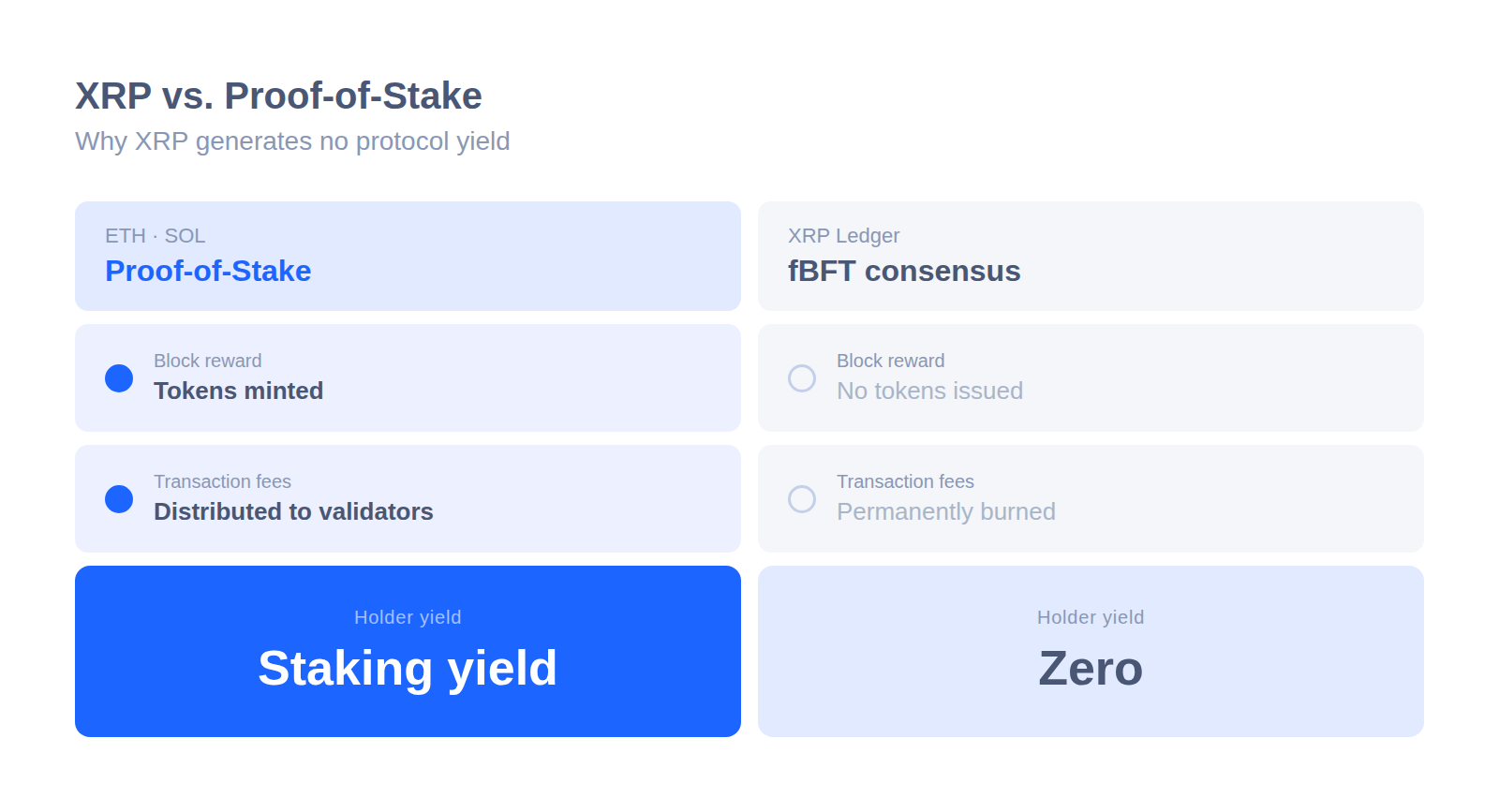
No — XRP staking does not exist at the protocol level. The XRP Ledger's validators receive no token rewards for participating in consensus. Transaction fees are burned — permanently destroyed — rather than redistributed to participants or holders.
This is structurally different from Proof-of-Stake blockchains like Ethereum or Solana, where validators earn newly issued tokens and pass a share to delegators. On the XRP Ledger, total supply is fixed at issuance. There is no emission schedule, no validator reward pool, and no yield mechanism built into the network.
The confusion is widespread. Searching "how to stake XRP" or "XRP stake" returns exchange products and third-party platforms that use the term loosely. What they actually offer is a custodial yield account or a lending program — the label "staking" is marketing shorthand, not a technical description of what happens to your tokens. For the longer version of that answer, see can you stake XRP.
Why doesn't XRP support staking?
The XRP Ledger was built for one job: fast, cheap payment settlement. It achieves 3–5 second transaction finality with near-zero fees through Federated Byzantine Agreement (fBFT) — a consensus model in which a network of trusted validators agree on transaction order through iterative communication rounds, with no mining competition and no token lockup required.
That design choice made XRP one of the most efficient value-transfer protocols in crypto. The trade-off is a simpler economic model: XRP stake, in the native protocol sense, was never part of the architecture. No new XRP is issued as a network reward. Every transaction burns a small amount, slowly contracting supply.
What do platforms mean by "XRP staking"?
When a platform advertises XRP staking, it almost certainly describes one of three things: a custodial lending account, a liquidity provision program, or an outright fraud.
The structural difference matters:
- True protocol staking (ETH, SOL): tokens are delegated to a validator; yield comes from newly issued tokens; risk includes slashing and smart contract exposure.
- XRP "staking" products: funds are deposited with a platform that lends them or provides liquidity; yield comes from borrower interest or trading fees; risk is counterparty or smart contract risk.
Staking XRP at the protocol level is not possible. When the term appears in product copy, treat it as shorthand for a yield-bearing deposit — and look closely at the mechanics, the disclosed rate, and who bears default risk before committing funds.
What are the real alternatives to an XRP stake?
XRP holders have three primary paths to passive income, each with a different risk and return profile. A platform-by-platform map is in where can you stake XRP.
| Method | Typical APR | Rate type | Key risk |
|---|---|---|---|
| CeFi lending platforms | 1–12% | Fixed or variable | Counterparty risk |
| XRPL native AMM | Variable | Variable | Impermanent loss |
| Wrapped XRP (wXRP) on EVM chains | 2–8% | Variable | Bridge + smart contract risk |
CeFi lending is the most direct route. A platform lends your deposited XRP to overcollateralized borrowers and pays you interest daily. Most established CeFi platforms offer 1–5% APR on XRP; LendProtocol — purpose-built for XRPL assets — offers fixed-rate XRP yield at 12% APR, no lock-up, and the platform absorbing all default risk on behalf of depositors.
XRPL native AMM, live since 2024, lets holders deposit XRP into on-ledger liquidity pools and earn trading fees without bridging or wrapping. Returns vary with pool volume and carry impermanent loss risk.
Wrapped XRP on Ethereum or other EVM chains unlocks higher-variable DeFi yields but adds bridge risk, gas fees, and smart contract exposure — and requires managing a separate wallet infrastructure.
How does XRP lending work on LendProtocol?
LendProtocol is a CeFi lending platform built on the XRP Ledger, designed specifically for XRP and RLUSD holders who want the closest functional equivalent to staking XRP: predictable yield, daily payouts, no lock-up. Depositors earn 12% APR. With daily compounding, the effective annual yield is approximately 12.75%. The full mechanics are in XRP lending explained.
The mechanics are straightforward:
- Deposit XRP or RLUSD.
- The platform matches the deposit with borrowers who post 120% collateral — accepted assets include BTC, ETH, SOL, XRP, RLUSD, and USDT.
- Borrowers pay 12.7% APR; depositors receive 12% APR, credited daily.
- If a borrower defaults, the platform absorbs the loss — depositor principal is not at risk from borrower credit events.
The 0.7% spread between borrower and lender rates funds operations and builds credit reserves. The platform currently has more than 13,700 active lenders and 743 million XRP lent.
Security: deposits are held in cold storage for the majority of assets, encrypted with AES-256 GCM, with 2FA enforced on all accounts.
How do I recognize a fake XRP staking site?
In October 2025, Seoul police arrested operators of a fraudulent XRP stake platform that ran for eight days and stole 3.4 million XRP — roughly $8.5 million from 71 investors, promising annual returns of 18–22%.
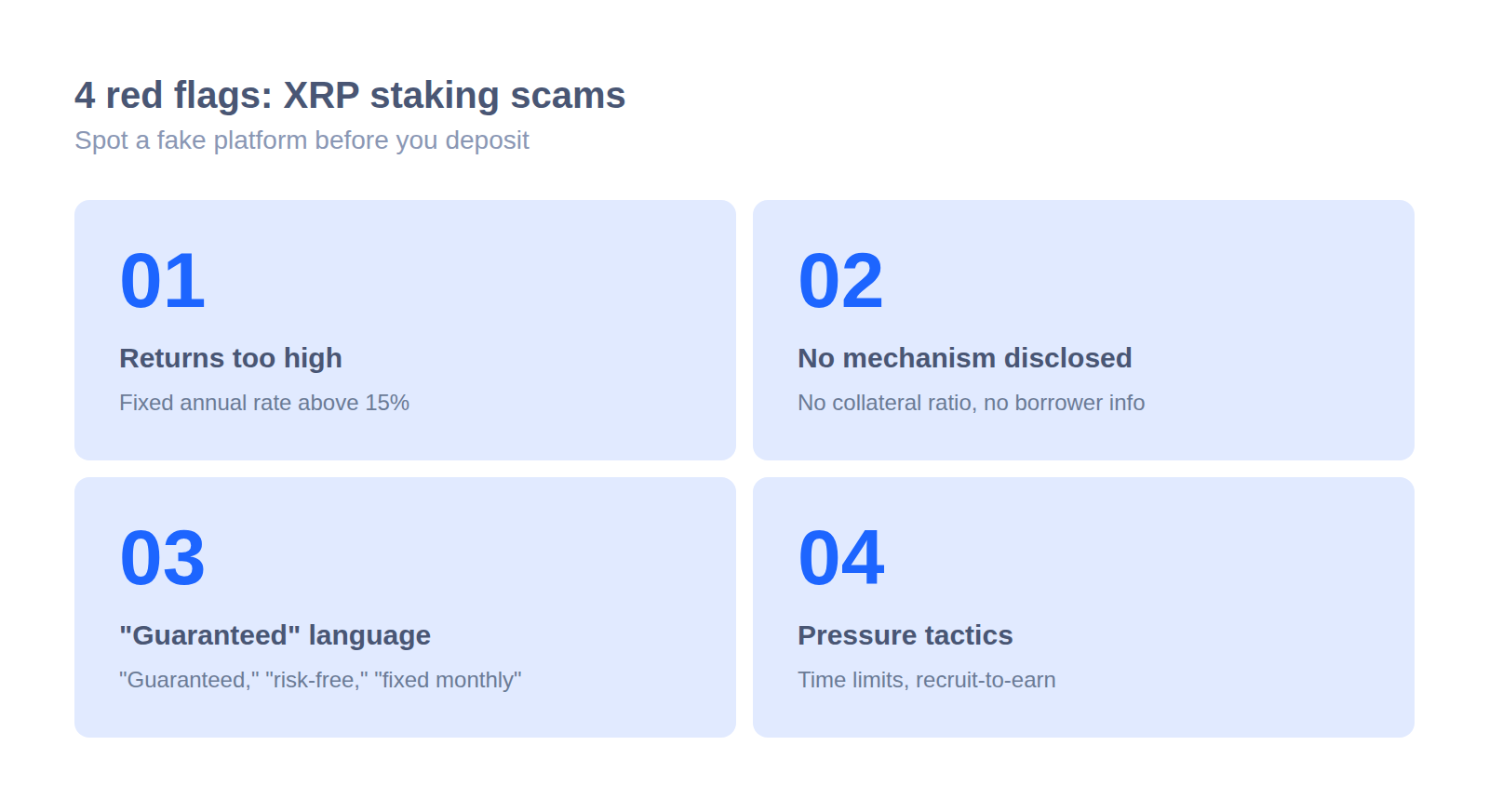
The warning pattern is consistent across scams:
- Returns advertised well above the ceiling of credible, collateralized CeFi products
- No disclosed borrower model, collateral ratio, or risk mechanism
- "Guaranteed" language on returns — no legitimate yield product can guarantee returns
- Urgency to deposit quickly or recruit others
Legitimate platforms disclose their stated APR, collateral requirements, who bears default risk, and how assets are stored. If any of those details are absent or vague, it is a signal to stop.
The Bottom Line
XRP's design was never about yield — it was about settlement. The XRP Ledger moves value faster and cheaper than almost any payment network on the planet, and it does that without staking, without inflation, and without validator rewards.
That leaves holders with a genuine income gap. The practical answer is lending: deposit XRP with a collateralized platform, earn daily XRP interest, and keep full access to your principal. The mechanics differ from Proof-of-Stake staking, but the outcome for a depositor is functionally the same — yield on a held asset, paid on a regular schedule.
What matters when choosing a platform: fixed vs. variable rate, lock-up terms, who absorbs default risk, and how assets are stored. Those four questions separate the products worth using from the ones worth avoiding — and they apply whether the product calls itself staking, lending, or anything else.