Stake XRP & Earn 12% APR — Complete 2026 Guide
No native staking on XRP — but lending pays up to 12% APR daily. We break down every yield option, the risks, and which is worth your time.
Most people searching for "XRP staking" are really asking one question: can my XRP earn anything while I hold it? The answer is yes — but not through staking. Here is what is actually happening inside the XRP Ledger, what your real yield options are in 2026, how the returns compare, and which routes are worth your time.
Can You Stake XRP? The Short Answer
No — XRP cannot be staked natively, and no change to the XRP Ledger is expected to make that possible. The network does not use Proof-of-Stake consensus, which means there is no protocol-level staking mechanism and no validator rewards to distribute to holders. Any platform advertising "XRP staking" is offering a yield product — lending, liquidity provision, or a custodial earn program — not network staking in any technical sense.
That distinction matters more than it might seem. With genuine staking on Ethereum or Solana, you lock tokens to help secure the blockchain and receive newly minted coins as a reward — the yield is a protocol function built into the chain itself. With XRP yield products, the return comes from a financial arrangement: borrowers paying interest, trading fees generated by a liquidity pool, or a platform operating its own yield strategy. The underlying risk profile is different. The source of the return is different. And the regulatory treatment may be different depending on your jurisdiction. Calling it "staking" is a marketing shortcut that obscures all of that.
This is not a flaw unique to XRP. The ledger's consensus design — Federated Byzantine Agreement (fBFT) — is precisely why XRP settles in 3–5 seconds at near-zero cost. That speed and efficiency came from a deliberate architectural choice that also eliminates native yield. Understanding that trade-off is the foundation of everything else in this article.
Why XRP Cannot Be Staked: The Technical Reason
The XRP Ledger confirms transactions through a network of validators who reach consensus by agreement, not by economic competition. Validators do not lock up XRP to participate. They do not receive newly minted tokens as compensation for their work. The XRP consumed in transaction fees is not redistributed to anyone — it is permanently destroyed.
This is structurally opposite to how a Proof-of-Stake blockchain works. On Ethereum, validators post 32 ETH as a security deposit and earn issuance rewards proportional to their stake. Delegators earn yield by backing those validators. On Solana and Cardano, similar mechanics produce a steady stream of rewards funded by controlled inflation or fee redistribution.
The XRP Ledger produces neither. XRP has a fixed total supply of 100 billion tokens, all created at genesis. Nothing new is ever minted. No one is compensated for running a validator. The network's incentive structure was built entirely differently from the ground up — which is why native XRP staking does not exist today, and why waiting for it is not a viable yield strategy for anyone holding XRP in 2026.
Ripple's own documentation confirms that the transaction cost on XRPL "is not paid to any party." The XRP is destroyed. This is not a temporary limitation awaiting a fix — it is a feature of the protocol's economic design.
What "XRP Staking" Actually Means in 2026
When you encounter "XRP staking" advertised on an exchange or yield platform today, you are looking at one of four distinct product types. They share a marketing label but differ significantly in mechanics and risk.
Custodial earn programs. Centralized platforms — exchanges like Binance and Kraken, or dedicated services like Nexo — let you deposit XRP and receive periodic rewards. The platform deploys your assets through its own lending or market-making operations and passes a portion of the return to you. Typical rates run between 1% and 5% APY. The primary risk is custodial: your XRP is held by the platform, and your exposure includes platform solvency, regulatory action, and operational security.
Wrapped XRP in DeFi. Some protocols allow you to bridge XRP to another blockchain — most commonly Ethereum or BNB Chain — as a wrapped token (wXRP or similar), then deploy it in DeFi lending markets or liquidity pools. Rates vary widely and can be higher than CeFi alternatives during periods of demand. However, these strategies layer on additional risks: smart contract vulnerabilities, bridge exploits, liquidity crises, and impermanent loss. You also need a separate wallet, pay destination-chain gas fees, and manage the bridging process yourself.
XRPL native AMMs. The XRP Ledger's automated market maker went live in 2024. Liquidity providers deposit two assets into an on-ledger pool and earn a share of the trading fees the pool generates. This keeps assets on XRPL without bridging, which removes smart contract and bridge risk. The trade-off is that returns are variable and depend entirely on trading volume — in low-activity periods, yields can be negligible.
XRP lending platforms. You deposit XRP with a CeFi platform that lends it to overcollateralized borrowers, and you earn fixed interest. This is the most direct structural equivalent to what most holders imagine when they ask can you stake XRP and mean "earn a reliable, predictable return on idle holdings." The yield mechanism is transparent, the rate is fixed, and the risk centers on the platform operator rather than protocol dynamics.
Each category has a different risk architecture, and knowing which one you are using is not optional due diligence — it is the minimum information you need to evaluate whether a yield is worth taking.
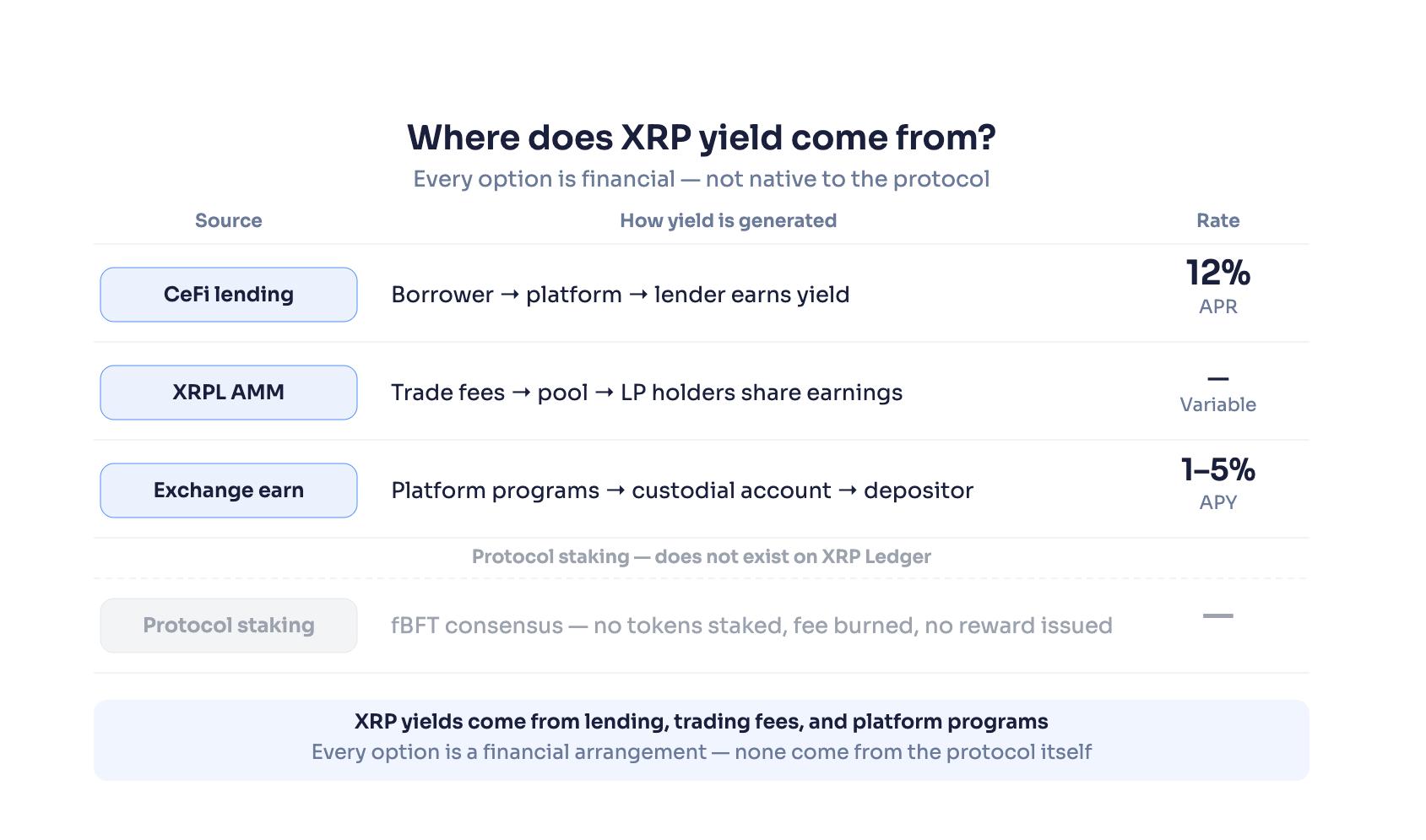
Your Real Options: A Comparison
| Method | Typical APY | Custody Model | Lock-up | Primary Risk |
|---|---|---|---|---|
| Exchange earn programs | 1–5% | Centralized | Flexible or fixed term | Counterparty / platform |
| Wrapped XRP in DeFi | Variable | Non-custodial | None | Smart contract, bridge exploit |
| XRPL native AMMs | Variable | Non-custodial (on-ledger) | None | Impermanent loss, low volume |
| CeFi XRP lending | Up to 12% | Centralized | None (varies by platform) | Platform / counterparty |
The range is wide. Exchange earn programs are the simplest entry point but tend to pay the least. Wrapped DeFi routes offer flexibility and sometimes higher yields, but they add layers of technical risk that most retail holders are not positioned to monitor or manage. XRPL AMMs are elegant in theory — entirely on-ledger, no wrapping — but yield is unpredictable. CeFi lending platforms sit in the middle ground: centralized (you are trusting an operator), but structured — fixed rates, predictable payouts, no bridging required, and no impermanent loss.
Why Lending Is the Practical Answer to "Can I Stake XRP"
If your real question when you ask can I stake XRP is "how do I earn a reliable return without selling my position," lending is the most structurally honest answer available today. Here is why:
- The return mechanism is transparent. Borrowers pay interest. Lenders receive a share. There is no inflation subsidy, no algorithmic rate that resets every block, no trading volume dependency, and no impermanent loss exposure.
- The rates are fixed. Unlike algorithmic DeFi rates that can swing dramatically within hours, CeFi lending platforms set borrower contract rates upfront — which means lender rates can also be fixed and guaranteed.
- You stay in the XRPL ecosystem. No wrapping, no new wallet address, no bridge fees, no gas on a foreign chain.
- Risk is defined and evaluable. The key variable is platform risk — whether the operator is solvent, properly collateralized, and honest. That is a business risk you can research and evaluate, not a protocol risk that can drain a liquidity pool in a single transaction.
This is why XRP lending has grown into the dominant practical answer to the yield question for XRPL holders. The phrase can you stake XRP has functionally become shorthand for "where do I earn yield on XRP" — and the fixed-rate lending category currently offers the most competitive returns in that space.
LendProtocol: 12% APR on XRP and RLUSD
LendProtocol is a CeFi lending platform built natively on the XRP Ledger, designed specifically for XRP and RLUSD holders who want yield without complexity. The platform pays 12% APR on deposits, distributed daily. With daily compounding, that translates to approximately 12.75% effective annual yield.
The mechanics are clear:
- You deposit XRP or RLUSD into the platform
- Deposits are matched with borrowers who post 120% overcollateralized collateral — accepted assets include BTC, ETH, SOL, XRP, RLUSD, and USDT
- Loans are issued at 12.7% APR — the 0.7% spread is the platform's operating revenue
- You earn 12% APR, paid daily, with no lock-up period
- If a borrower defaults, the platform absorbs the loss — your deposited capital is not at risk from individual borrower failures
That last point separates this from most DeFi lending protocols, where default risk is distributed across the depositor pool. The platform operates as the principal counterparty in the transaction, assuming lending risk so depositors do not have to. It is a meaningfully different risk structure, closer to a fixed-income instrument than an algorithmic pool — and a direct answer to one of the most common complaints about DeFi: that the fine print transfers loss to the user.
One clarification before going further: LendProtocol is not the XRP Ledger's own XLS-66 native lending protocol. XLS-66 is open XRPL infrastructure for institutional, uncollateralized lending with off-chain credit underwriting, developed by the Ripple and XRPL community. LendProtocol is a separate, consumer-facing CeFi product — fixed rates, overcollateralized borrowing, platform-backed risk model, open to any user. The two run on the same blockchain; that is where the overlap ends.
Security infrastructure includes cold storage for the majority of assets, AES-256 GCM encryption for data at rest, and mandatory two-factor authentication on all accounts. As of publication, over 13,713 active lenders have deposited more than 743 million XRP on the platform.
For RLUSD holders, the platform is equally relevant: 12% APR on a USD-pegged stablecoin eliminates price exposure while maintaining yield, making it an option for risk-averse depositors and institutional treasury teams that hold idle RLUSD balances between settlements.
How to Start Earning on XRP: Step by Step
Whether you use a dedicated XRP lending platform or an exchange earn program, the practical onboarding steps are consistent:
Step 1: Choose your platform and verify current terms. Rates change. Confirm the current APR, whether it is fixed or variable, whether there is a minimum deposit or lock-up, and how the platform handles borrower defaults — that last point matters more than most people check.
Step 2: Complete identity verification. All legitimate CeFi platforms require KYC. Have your government-issued ID and proof of address ready.
Step 3: Set up an XRP wallet if required. Platforms operating directly on XRPL may require an XRPL-compatible wallet. Some handle custody directly. Confirm the process before sending any funds.
Step 4: Deposit XRP or RLUSD. Always include the correct destination tag when sending XRP. A missing or incorrect destination tag can result in permanently lost funds — this is not recoverable.
Step 5: Confirm your transaction on-chain. XRPL transactions settle in 3–5 seconds. Verify your deposit is confirmed before considering it received.
Step 6: Track your yield and tax obligations. Yield payments are taxable income in most jurisdictions at the time of receipt, valued at the fair market price of XRP on that date. A later sale of XRP at a different price may create a separate capital gains event. Maintain records. Consult a tax professional familiar with cryptocurrency in your jurisdiction.
The Bottom Line
XRP staking — in the genuine sense of locking tokens to secure a Proof-of-Stake network and receive protocol-issued rewards — does not exist and is not on the roadmap. The XRP Ledger was designed for speed and efficiency, not for token-incentivized consensus. That design is stable.
What does exist is a mature ecosystem of yield products: exchange earn programs paying 1–5% APY, wrapped DeFi strategies with variable returns and added risk, XRPL native AMMs with volume-dependent fees, and CeFi lending platforms offering fixed rates up to 12% with daily payouts and no lock-up. For holders who want predictable yield without leaving the XRPL ecosystem, fixed-rate lending is the most direct answer available today.
The real question was never whether you can stake XRP in a technical sense. It was always whether XRP can earn. The answer to that is yes — and the options are better than most holders realize.
FAQ
Can I stake XRP on Coinbase?
No. Coinbase does not currently offer XRP staking or any XRP yield product. Because XRP has no native staking mechanism, there is no protocol-level product for an exchange to facilitate. If Coinbase offers XRP yield in the future, it would be a custodial earn program — not staking.
Can you stake XRP on Kraken?
Kraken has offered custodial XRP earn programs at various points, but availability varies by region and changes frequently. These products are lending or yield programs, not native staking. Check Kraken's current product listings for live rates and country eligibility.
Is XRP staking income taxable?
In most jurisdictions, yes. Yield payments received — whether from lending, AMM fees, or custodial earn programs — are typically treated as ordinary income at the time of receipt, valued at the fair market price of XRP when the payment arrives. Selling XRP later at a different price may trigger a separate capital gains event. Tax rules differ by country. This article is not tax advice; consult a qualified tax professional for your specific situation.
What is the difference between XRP staking and XRP lending?
Native staking involves locking tokens on a Proof-of-Stake blockchain to participate in network consensus and earn protocol-issued rewards funded by inflation or fee redistribution. XRP lending involves depositing XRP with a platform that loans it to borrowers; yield comes from borrower interest payments. The XRP Ledger does not support native staking. What is called "XRP staking" in most product listings is lending, liquidity provision, or a custodial yield program.
What is the highest APR available on XRP right now?
As of publication, LendProtocol offers 12% APR with daily payouts and no lock-up period. Exchange earn programs typically pay 1–5% APY. Wrapped DeFi strategies are variable and carry additional risk layers.
Do XRP yield products require a lock-up?
Some exchange earn products lock funds for a fixed term to offer higher rates. Fixed-rate CeFi lending platforms like LendProtocol typically have no lock-up — deposits can be withdrawn at any time, which is a meaningful advantage for holders who may need liquidity. XRPL AMM liquidity positions can also be removed at any time, though impermanent loss may affect the value of the position at the point of withdrawal.
Will XRP ever support native staking?
There is no official roadmap for native XRP staking, and no confirmed proposal to change the XRP Ledger's consensus model. The fBFT design is a core architectural choice, not a transitional phase. Any protocol-level change would require amendment passage through the XRPL governance process and broad validator adoption — a high coordination threshold with no current timeline.