Where Can You Stake XRP? The Short List (And Why It's Short)
Each product marketed as "XRP staking" is lending, liquidity provision, or a custodial yield program in disguise. This guide maps the three underlying engines behind all XRP yield products, compares current rates across platforms, and walks through the failure modes most holders skip before depositing.
You cannot stake XRP in any protocol-native sense. The XRP Ledger has no staking rewards, no validator yield pool, and no lock-up mechanism tied to network security. Every product marketed as "XRP staking" is something else — and knowing which something else matters.
The Terminology Problem
"XRP staking" is technically a misnomer — but that doesn't make the underlying question wrong. People searching where can you stake XRP are really asking: how do I earn yield on XRP without selling it? That's a legitimate question with real answers. The confusion is just borrowed language from Ethereum, where "staking" has a precise meaning: you lock tokens to help validate the network, and the network pays you back.
The XRP Ledger works differently. It runs on Federated Byzantine Agreement (fBFT) — a consensus model designed around trusted validators, not token holders competing for block rewards. The XRP used for transaction fees isn't paid to validators; it's burned permanently. There is no protocol-level incentive to hold XRP at all.
That design makes XRPL extremely fast and cheap to use. It also means the word "staking" simply doesn't apply. Every product that calls itself XRP staking is operating outside the ledger's native mechanics. What these products actually use to generate a return:
- Custodial lending — the platform lends your XRP to borrowers and pays you the interest
- AMM liquidity provision — you deposit into on-chain pools and earn a share of trading fees
- Cross-chain DeFi — your XRP is bridged to another network and deployed in DeFi protocols
Understanding which mechanism sits underneath a product tells you more about its real risk profile than the name it's sold under. For a shorter Q&A walkthrough of the same gap, see the XRP stake FAQ.
Three Engines Underneath Every "XRP Staking" Product
Every XRP yield product runs on one of three underlying engines: custodial lending, AMM fee income, or wrapping and cross-chain DeFi. The platform name changes; the engine underneath rarely does — and understanding which one you're using tells you more than any headline rate.
Engine 1: Custodial lending. A platform takes your XRP, lends it to borrowers, collects interest, and passes most of it back to you. You bear custody risk — the platform holds your assets — but not necessarily credit risk, depending on whether the platform guarantees depositor capital. This engine powers exchange earn programs (Nexo, Binance) and dedicated CeFi lending products.
Engine 2: AMM fee income. You deposit two assets into a liquidity pool on the XRP Ledger's native AMM — which launched as a protocol upgrade in 2024 — and earn a share of trading fees from every swap that flows through your pool. No custodian holds your assets; the ledger itself manages the pool. Returns are entirely variable, depending on trading volume. The main risk is impermanent loss: if the price ratio between your two pooled assets shifts significantly, you can end up with less value than if you'd held them separately.
Engine 3: Wrapping and cross-chain DeFi. You bridge XRP to another blockchain — as wrapped XRP on Ethereum or as FXRP on Flare — and deploy it in DeFi protocols there. Products like mXRP (launched in 2025 by Midas and Interop Labs) offer 6–8% APY from yield-bearing wrapped XRP strategies. The yield ceiling is higher than on-chain options, but the risk stack is also taller: bridge failure, smart contract exploits, gas fees, and multi-chain position management all enter the picture. That sidechain-style product is covered in more detail in XRP liquid staking explained.
Every product you'll encounter fits one of these three engines. Knowing which one you're using before you deposit is more informative than any headline APY.
The Rate Landscape
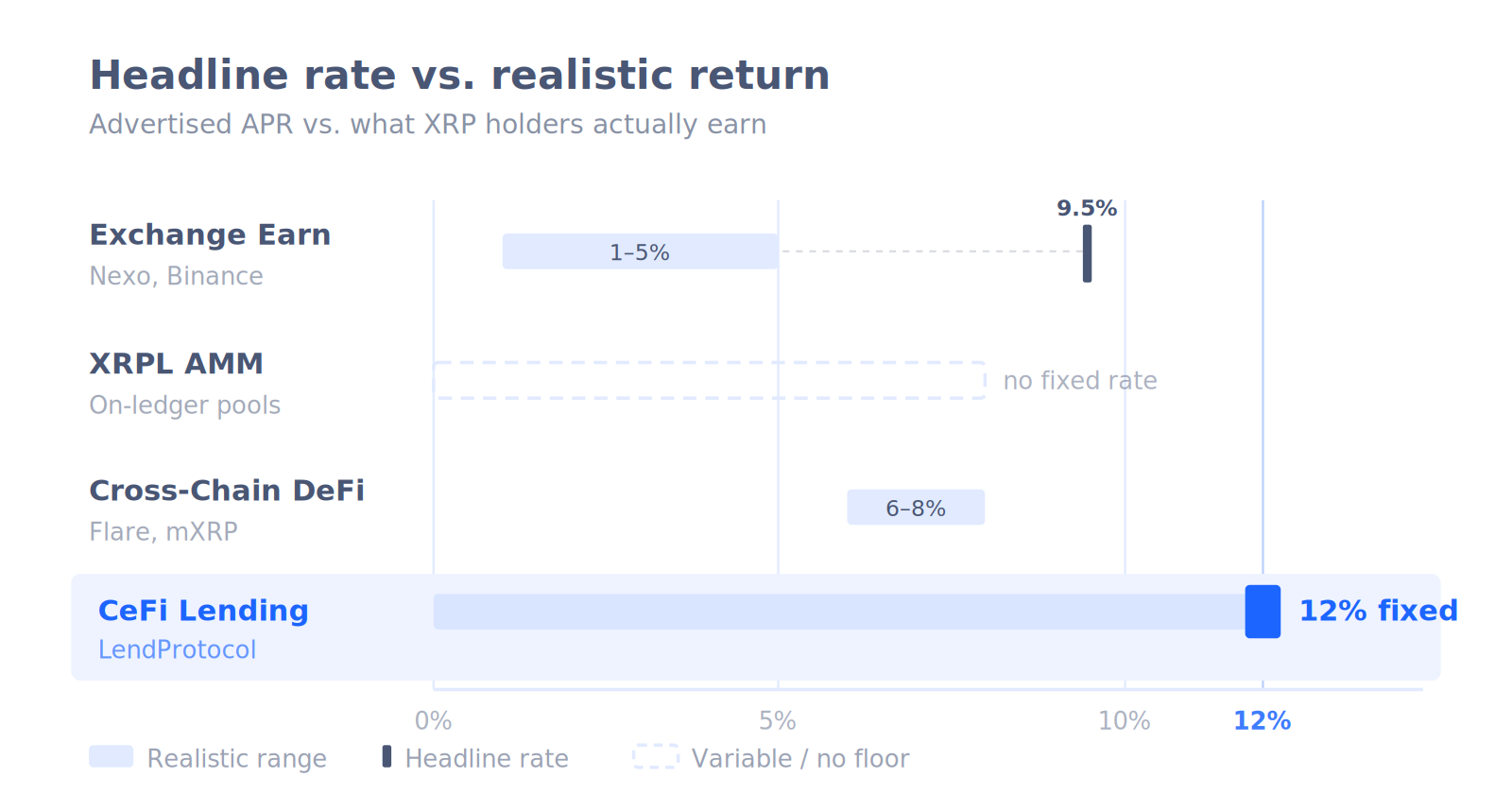
Across all three engines, XRP staking alternatives in 2026 span a wide range — but the spread between the headline rate and what most holders realistically earn is significant. A full market snapshot lives in the XRP lending rates guide.
| Mechanism | Platform examples | Rate | Rate type | Lock-up |
|---|---|---|---|---|
| Exchange earn | Nexo, Binance | 1–9.5% APY | Variable | Flexible or fixed |
| XRPL native AMM | On-ledger pools | Variable | Variable | None |
| Cross-chain DeFi | Flare (FXRP), mXRP | 6–8%+ APY | Variable | Varies |
| CeFi lending | LendProtocol | 12% APR | Fixed | None |
Rates as of publication. Variable rates change with market conditions; verify current figures directly with each platform.
A few things this table doesn't show:
- Nexo's 9.5% figure requires fixed-term deposits and NEXO token holdings; the flexible rate without bonuses sits closer to 4–5%
- Binance flexible XRP savings typically run under 3% and shift with market conditions without notice
- The AMM row has no rate figure because returns depend entirely on pool trading volume — which can fall to near-zero in quiet markets
- The fixed-rate CeFi row is short because absorbing credit risk across market cycles is infrastructure most operators don't build; they pass that risk back to depositors instead
The Risk Nobody Reads
Each XRP yield mechanism fails differently — and which failure scenario you're signed up for depends entirely on which engine powers your chosen product. The answers vary sharply by mechanism.
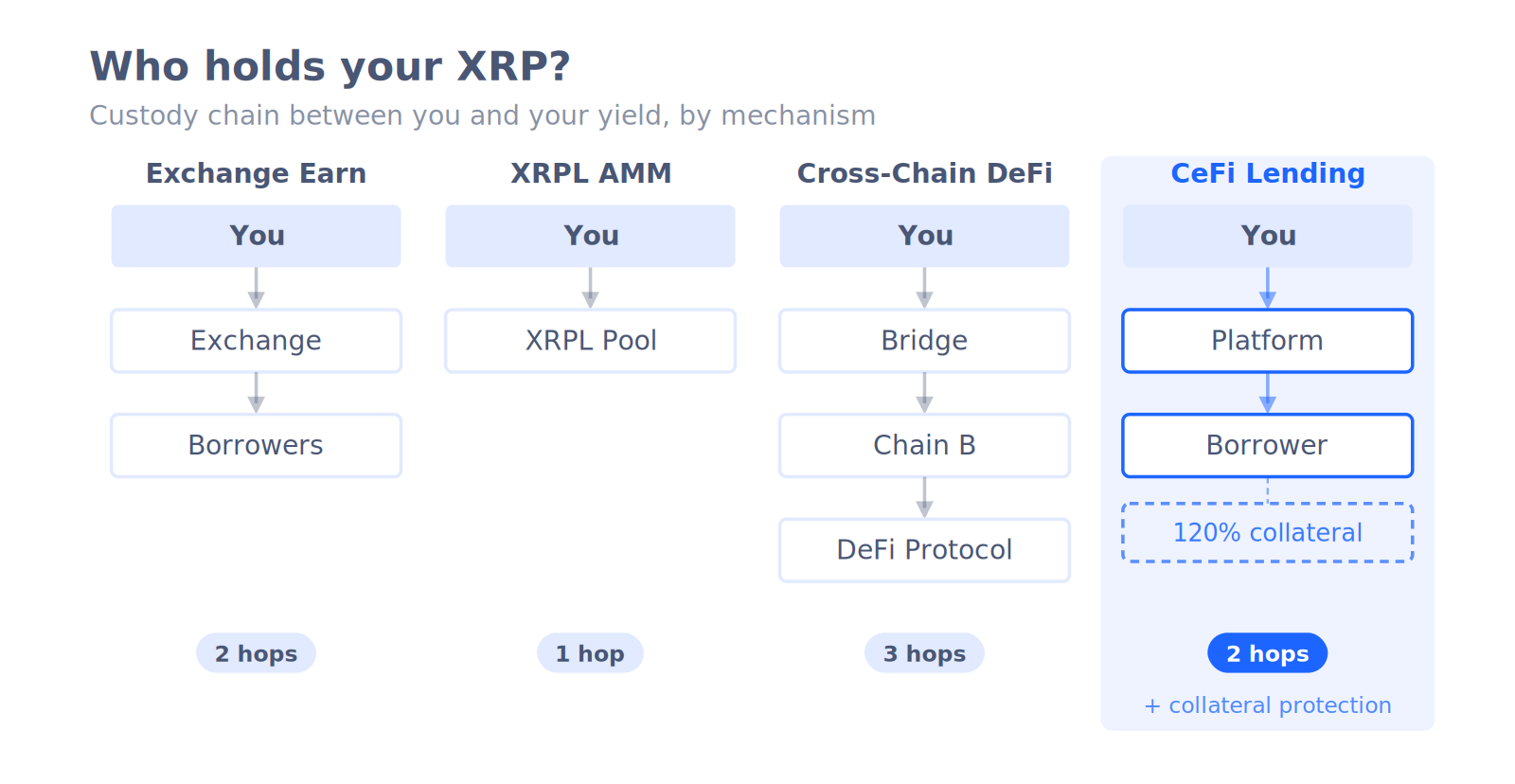
On exchanges, the risk is platform insolvency or a withdrawal freeze. Your XRP sits in exchange custody, pooled with other users' assets, and the exchange's financial health is your direct exposure. Specific failure modes to know:
- Withdrawal freezes during market stress — your XRP is accessible until suddenly it isn't
- Rate cuts without notice when market demand for borrowed XRP falls
- Custodial exposure to the exchange's broader balance sheet, not just its XRP book
In XRPL AMM pools, the primary risk is impermanent loss — gradual and often invisible until you withdraw. The ledger-level security of XRPL's native AMM reduces smart-contract exploit risk compared to Ethereum-based AMMs, but it doesn't eliminate economic exposure. The two scenarios that hurt most:
- Significant price divergence between your two pooled assets, locking in a loss when you exit
- Near-zero fee income during low-volume periods, with no floor on returns
In cross-chain DeFi, the attack surface is wider than any other option on this list. Bridges have been among the most frequently exploited infrastructure in crypto history. The additional failure modes beyond standard DeFi risk:
- Bridge exploit or failure during transit — funds lost with no recourse
- Smart contract vulnerability on the destination chain
- Liquidity evaporation in stress conditions, stranding positions at unfavorable exit rates
In CeFi lending, the relevant risk is borrower default — and whether that loss falls on the platform or on depositors. On pooled DeFi protocols, a wave of defaults typically affects all depositors proportionally. On platforms that operate as the principal counterparty — absorbing default risk themselves — the depositor's exposure is to the platform's solvency, not to individual borrower behavior. LendProtocol runs on a fixed-rate XRP lending model: borrowers post 120% collateral before any loan is issued, and if a borrower defaults, the platform absorbs the loss. Depositors do not.
Understanding which failure scenario you're signed up for is the most useful pre-deposit checklist item.
XRP or RLUSD? The Parallel Question
Once you've chosen a mechanism, there's a second decision most guides skip: which asset are you actually depositing?
On platforms like LendProtocol, both XRP and RLUSD earn the same 12% APR — paid daily, with no lock-up on either. The choice isn't about yield. It's about what happens to the value of your principal.
XRP deposits earn 12% APR, but the value of that principal fluctuates with XRP's price. In a strong XRP market, you're compounding gains on an appreciating asset. In a weak one, you're earning yield on a declining one.
RLUSD is Ripple's fully-backed USD stablecoin, regulated and pegged to the dollar. Depositing RLUSD earns the same 12% APR on a stable principal — no price volatility, just the fixed return on top. For holders managing treasury balances, institutional XRP positions, or anyone who wants yield without exposure to crypto price swings, RLUSD at 12% APR is a structurally cleaner answer than most alternatives across all asset classes.
The availability of both assets on the same platform, at the same rate, with the same daily payout structure, is a less-discussed aspect of where can you stake XRP that changes the decision for a meaningful subset of depositors. In brief:
- Deposit XRP if you're long on XRP's price and want to compound yield on top of potential appreciation
- Deposit RLUSD if you want the 12% APR without price exposure — fixed income on a dollar-pegged principal
FAQ
Can you stake XRP?
Not natively. The XRP Ledger doesn't use Proof-of-Stake, so there are no protocol staking rewards. Products advertised as XRP staking are lending programs, liquidity provision, or custodial yield accounts — not network staking.
Where can you stake XRP for the highest fixed return?
The highest fixed rate currently available on XRP without a lock-up period is 12% APR with daily payouts on LendProtocol. Exchange earn programs (Nexo, Binance) offer lower and variable rates.
Is XRP staking safe?
Every XRP yield product introduces third-party risk. The nature of that risk depends on the mechanism: custodial risk on exchanges, impermanent loss in AMMs, bridge and smart contract risk in cross-chain DeFi, and platform credit risk in CeFi lending. The safest structure for depositors is one where the platform absorbs borrower default risk rather than passing it through to pooled depositors.
How do I stake XRP on Binance?
Binance Earn offers XRP flexible savings under Simple Earn. Rates are variable and typically under 3% on flexible products; availability varies by region.
Does Coinbase offer XRP staking?
No. Coinbase does not offer XRP yield because XRP has no native staking mechanism. For XRP yield, you need a dedicated lending or earn platform.
Where can you stake XRP without a lock-up period?
No-lock-up options include Nexo flexible savings (variable rate), XRPL native AMM liquidity provision (variable, impermanent loss exposure), and CeFi lending platforms that offer daily payouts with no withdrawal restrictions.