Does XRP Have Liquid Staking? Explained
XRP ledger produces no rewards by design. This guide maps every real yield option in 2026, from mXRP's 6–8% variable APY to fixed-rate lending at 12% APR, with risks clearly compared.
XRP has no native liquid staking. The XRP Ledger's consensus model produces no protocol rewards — what holders have instead are lending platforms, on-ledger liquidity pools, and one sidechain-based token that approximates the concept.
The Missing Yield: Why XRP Holders Have a Problem Other Crypto Holders Don't
XRP earns nothing by default — and that's a design choice, not a bug. The XRP Ledger runs on Federated Byzantine Agreement (fBFT) consensus, not proof-of-stake. Validators confirm transactions through cryptographic agreement, not by collateralizing tokens. No collateral, no slashing, no staking rewards.
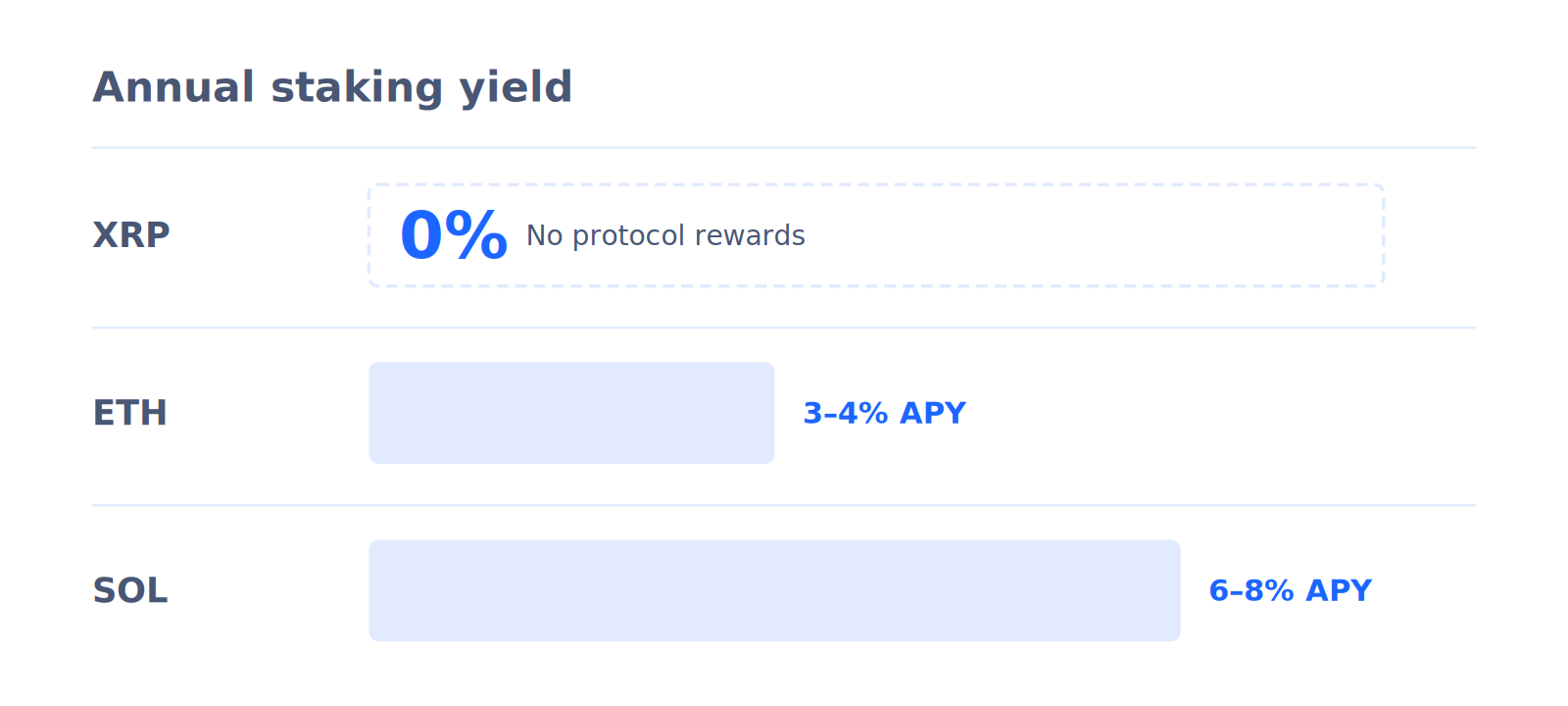
The result, across the three largest non-BTC assets:
- Ethereum — 3–4% APY through Lido or native validators
- Solana — 6–8% during strong network periods
- XRP — 0% on-chain, by design
With XRP regularly sitting among the top five cryptocurrencies by market cap — representing hundreds of billions in idle capital — that gap compounds quickly.
It's why XRP yield platforms have attracted serious adoption. Over 13,713 lenders have deployed more than 743 million XRP through CeFi lending rather than let it sit dormant. XRP can't be staked, so holders look for the next best thing — and the demand is structural, not speculative.
Liquid Staking vs. Lending: Two Very Different Things
XRP liquid staking and XRP lending are not the same product, though most platforms blur the line. Understanding the difference determines what risks you're actually taking on. For the broader comparison, see XRP lending vs staking.
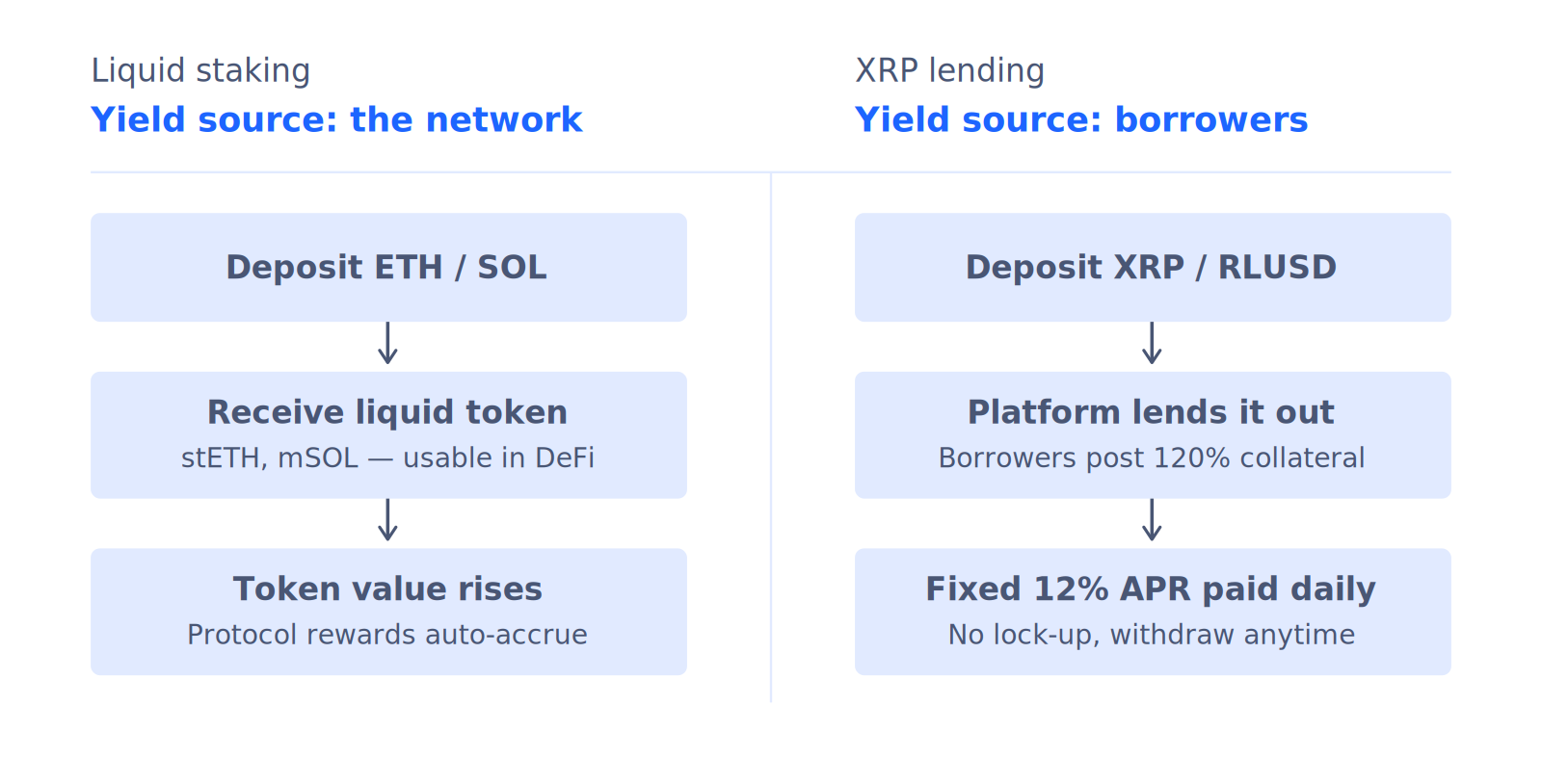
True liquid staking works like this: you deposit a proof-of-stake asset (ETH, SOL, ADA), receive a liquid derivative token (stETH, mSOL) that accrues protocol rewards in real time, and can use that token across DeFi while your original asset continues earning. The yield source is the network itself — block rewards and transaction fees distributed by the protocol.
XRP has no such mechanism. The XRP Ledger simply doesn't distribute rewards. Any product that calls itself XRP liquid staking is generating yield through a different engine: lending to borrowers, providing liquidity to AMM pools, or deploying capital through off-chain trading strategies. The "staking" label is marketing convenience — the underlying structure is a financial intermediary, not a protocol.
This matters because the risks differ completely. With true liquid staking, the main risks are validator downtime and smart contract bugs in the liquid token. With XRP "staking" products, the risk depends entirely on the product's structure:
- Borrower default risk — lending platforms (the borrower fails to repay)
- Custodial risk — centralized exchange programs (the platform holds your assets)
- Bridge and smart contract risk — sidechain tokens like mXRP (assets cross to another chain)
- Trading strategy risk — yield generated by off-chain market-making (returns fluctuate with performance)
mXRP: When the XRP Ecosystem Tried to Build Liquid Staking
The closest thing to true XRP liquid staking arrived in September 2025 at XRPL Seoul. Midas and Interop Labs launched mXRP — a liquid-staking token built on the XRPL's EVM sidechain via Axelar — targeting returns of 6–8% APY through institutional market-making and delta-neutral trading strategies.
The mechanics, step by step:
- Deposit XRP via the Axelar bridge into the XRPL EVM sidechain
- Receive mXRP — a 1:1 representative token that accrues yield over time
- Hold or deploy it across DeFi protocols as collateral or in liquidity pools
- Redeem for XRP at the appreciated rate (100 mXRP held for a year at 10% yield returns roughly 110 XRP)
Asset managers like Hyperithm run the underlying strategies; custody is handled by Fordefi and Fireblocks.
It's a technically sophisticated product. But the yield is variable and contingent on strategy performance, not guaranteed by protocol mechanics. Bridge reliance is a real risk: XRP must leave the main ledger to enter the XRPL EVM ecosystem via Axelar, creating smart contract exposure at the crossing point. Geographic availability was also limited at launch — mXRP was accessible only to customers in Europe and Asia.
The mXRP launch marked a milestone for the XRP ecosystem's DeFi ambitions — but it didn't resolve the fundamental issue: XRP liquid staking still doesn't exist at the protocol level. The yield comes from people, not the network.
Every XRPL Yield Mechanism, Ranked by Certainty
Certainty of yield — not headline rate — is the useful dimension to compare. A 10% target that depends on trading conditions is a different product from a 12% fixed rate paid daily.
| Mechanism | Yield Range | Certainty | Where Risk Lives | Lock-up |
|---|---|---|---|---|
| CeFi lending on XRP (fixed rate) | 12% APR | High — fixed, daily | Platform absorbs default risk | None |
| mXRP (liquid staking token) | 6–8% APY target | Low — strategy-dependent | Bridge, smart contract, variable returns | None |
| XRPL AMM liquidity provision | Variable | Low — pool and volume dependent | Impermanent loss, fee income variability | None |
| CeFi exchange programs (Nexo, YouHodler) | 4–8% APY | Medium — published but variable | Custodial, opaque terms | Varies |
| Binance Earn (flexible) | Under 3% APY | Medium | Exchange custodial risk | None |
| XLS-66 native lending (XRPL) | Negotiated | N/A — institutional only | Underwriting, counterparty | Per vault |
The XRP Ledger's native infrastructure — AMM (live since 2024) and XLS-66 (advancing through governance) — covers institutional and DeFi-native users reasonably well. The gap is retail: fixed-rate, daily-payout yield that doesn't require bridging, active strategy monitoring, or navigating institutional governance.
Fixed or Variable? A Simple Framework for XRP Holders
The right yield product depends on what you're optimizing for — not just the headline number. Here's how to think through the choice.
Choose variable yield (mXRP, AMM) if: you're comfortable monitoring performance, accept that returns may come in below the headline target, and want DeFi composability — the ability to use a yield-bearing token as collateral elsewhere in on-chain markets.
Choose fixed-rate lending if: you want a known daily return, don't want to track strategy performance or pool utilization, and prefer that default risk sits with the operator rather than with you.
LendProtocol is built for the second group. It pays a stated 12% APR on XRP and RLUSD deposits, compounded daily to an effective annual yield of ~12.75%. Borrowers post 120% overcollateralized collateral — BTC, ETH, SOL, XRP, RLUSD, or USDT — to access loans. If a borrower defaults, LendProtocol absorbs the loss. Depositors don't share in the downside.
The security infrastructure is built to match:
- Cold storage for the majority of deposited assets
- AES-256 GCM encryption — the standard used by banks and government institutions
- Mandatory 2FA on all accounts
For RLUSD depositors, the calculation is cleaner still: 12% on a USD-pegged stablecoin, no XRP price exposure, no bridge, daily payouts — without active management or variable returns tied to market conditions.
FAQ
Can you stake XRP?
No. The XRP Ledger uses Federated Byzantine Agreement consensus, not proof-of-stake. There are no protocol-level staking rewards. Products marketing "XRP staking" are running lending programs, liquidity products, or trading strategies — not network validation.
Does XRP have liquid staking?
XRP liquid staking doesn't exist at the protocol level. mXRP, launched in September 2025 on the XRPL EVM sidechain, is the closest product available: it targets 6–8% APY through institutional trading strategies but requires bridging off the main ledger and carries smart contract and variable-yield risk.
How do XRP holders earn yield in 2026?
Four routes: fixed-rate CeFi lending (up to 12% APR, no lock-up), exchange programs like Binance or Nexo (1–8%, variable), XRPL AMM liquidity provision (variable, impermanent loss risk), or mXRP (6–8% target, sidechain-based). Each carries different risks.
What is the XRP staking ledger?
The XRP Ledger has no native staking mechanism. Its consensus protocol (fBFT) doesn't distribute rewards to token holders. When people reference the "XRP staking ledger," they usually mean on-ledger yield products like the XRPL AMM or the XLS-66 lending protocol — neither of which is traditional staking.
What is mXRP and how does it work?
mXRP is a liquid-staking token issued by Midas on the XRPL EVM sidechain via Axelar. Users deposit XRP, receive mXRP, and earn yield from institutional market-making strategies. The token appreciates against XRP over time rather than distributing separate reward tokens. Available to customers in Europe and Asia at launch.
Is XRP liquid staking safe?
Any XRP liquid staking product carries bridge risk, smart contract exposure, and variable yield tied to strategy performance. Fixed-rate XRP lending platforms carry platform counterparty risk. Products where the operator explicitly absorbs default risk shift that exposure away from the depositor — but neither structure is without trade-offs.