XRP Lending vs Staking: Why Lending Is the Only Way to Actually Earn Yield
What exchanges call "XRP staking" is lending or liquidity provision rebranded. Here's what those search results were really offering, and how XRP lending at 12% APR fills the actual yield gap.
You searched "how to stake XRP," got a wall of contradictory results, and still don't have a clear answer. Here's why: XRP staking doesn't exist. The XRP Ledger has no Proof-of-Stake mechanism — so every result you found was selling you something else entirely.
Why the Search for "How to Stake XRP" Leads to a Dead End
XRP cannot be staked because the XRP Ledger doesn't use Proof-of-Stake consensus — the mechanism that makes staking possible on Ethereum and Solana in the first place.
On Ethereum and Solana, validators lock tokens to secure the blockchain and the protocol rewards them with newly minted coins or transaction fees. That exchange — capital at risk in return for protocol rewards — is the engine behind staking yield. Remove it, and there's no staking. Just a name applied to something different.
The XRP Ledger runs on Federated Byzantine Agreement (fBFT). Trusted validators reach consensus through communication and reputation, not staked capital. No token rewards flow to anyone for holding or validating, and there's no protocol-level yield mechanism of any kind.
This wasn't an oversight. XRP settles in 3–5 seconds with near-zero fees because its consensus model doesn't rely on token inflation or staked capital incentives. The trade-off: XRP holders earn nothing from the protocol by simply holding.
What Those "XRP Staking" Results Were Actually Selling You
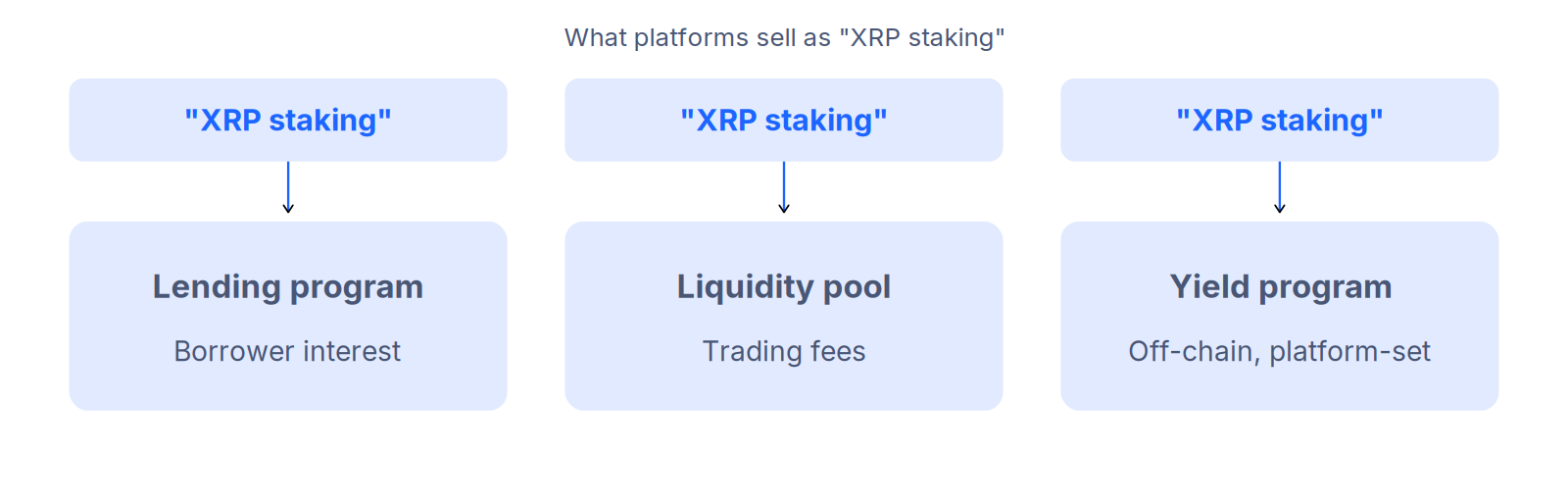
When a search for XRP staking surfaces a list of platforms offering "staking rewards," none of them are offering staking. What they're offering is one of three things:
- Lending programs: your XRP is lent to borrowers; you receive a share of the interest paid back
- AMM liquidity provision: your XRP goes into an automated market maker pool and earns trading fees from transaction volume
- Proprietary yield programs: off-chain strategies built around the platform's own business model, with yield sourced from wherever the platform finds it
The gap between label and product matters because the risk profiles are completely different. CeFi exchange "staking" programs on XRP typically pay 1–5% APR — adjustable, often contingent on holding the platform's own token, and rarely explained transparently. Nexo's headline XRP rate, for example, requires holding 2,000,000 NEXO tokens and locking the asset for six months to access it.
That's not staking. It's a yield product with strings attached and a borrowed label. Products that wrap XRP and call it liquid staking sit in the same bucket — see XRP liquid staking explained.
The Yield Option That Does Exist: XRP Lending
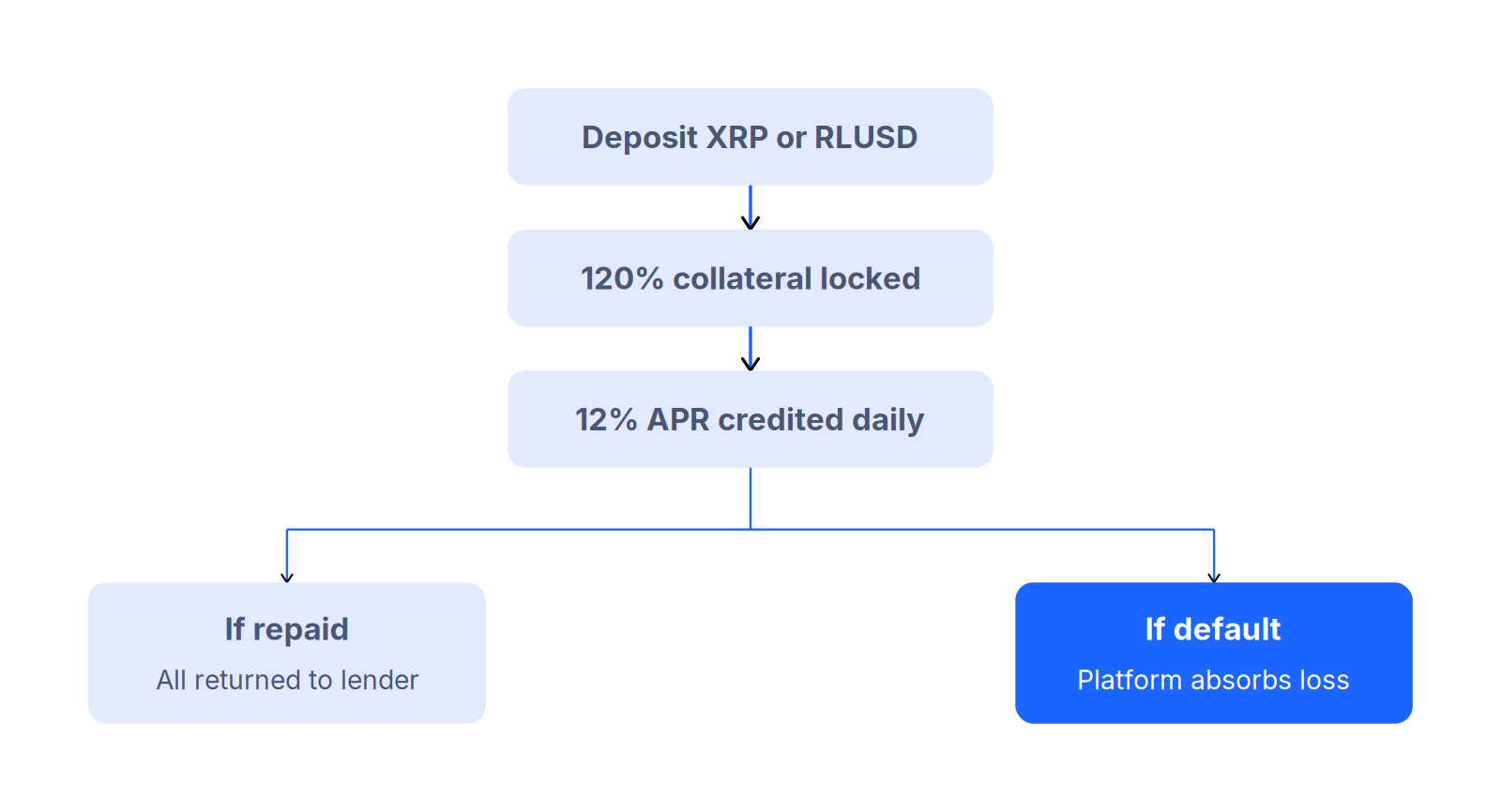
XRP lending is what most of those results were actually pointing toward — they just weren't honest about it. The mechanism, stated plainly: you deposit XRP or RLUSD, a platform lends it to borrowers who post collateral, and you earn interest from their repayments. The yield is real. It comes from borrower demand, not from the XRP Ledger protocol.
Two decisions shape what XRP lending looks like in practice.
Fixed vs. variable rates. Variable-rate platforms tie your yield to borrower utilization and market demand — when activity slows, your rate drops, sometimes without warning. Fixed-rate platforms set your yield at the moment of deposit and hold it there regardless of market conditions. For holders who want to build around predictable passive income, that distinction is the difference between a plan and a guess.
Who absorbs default risk. This is the most consequential structural question across all XRP lending platforms. In pooled DeFi protocols — Aave, Compound — depositors collectively absorb the loss when a borrower defaults and collateral falls short. In a platform-guarantee model, the operator absorbs those losses instead, and depositor capital stays separated from borrower performance.
LendProtocol is built on the platform-guarantee model. Borrowers must post 120% collateral before receiving any loan — accepted assets include BTC, ETH, SOL, XRP, RLUSD, and USDT. If a loan defaults, the platform covers the loss, not the depositor. The 0.7% spread between borrower and lender rates, combined with the collateral buffer, sustains this structure over time.
XRP Lending vs. PoS Staking: What the Numbers Say
The right comparison isn't "XRP lending vs. XRP staking" — one side of that doesn't exist. The honest question is how XRP lending measures up against staking on the networks where it's real.
| Factor | PoS Staking (ETH / SOL) | XRP Lending |
|---|---|---|
| Yield source | Protocol inflation + tx fees | Borrower interest payments |
| Rate type | Variable, protocol-determined | Fixed or variable (platform-set) |
| Current APR range | ~2.78–4% (ETH) / ~6–8% (SOL) | 1–12% depending on platform |
| Lock-up | Often required (ETH: days to exit queue) | None, on no-lock-up platforms |
| Default risk | N/A (protocol-backed) | Platform or depositor (model-dependent) |
| Asset required | Native chain token only | XRP or RLUSD |
| Yield certainty | Adjusts with validator count | Fixed rate holds from deposit date |
Ethereum's native staking APR has compressed to roughly 2.78% in 2026, diluted across nearly 900,000 active validators competing for the same issuance pool. Solana pays 6–8% APY on native staking, though accelerating disinflation is projected to push that lower over the next few years. XRP lending on fixed-rate platforms offers a stated 12% APR with daily compounding — approximately 12.75% effective annual yield. Current market ranges are in the XRP lending rates table.
For XRP holders, the table isn't about choosing between options — it's about understanding which ones apply to your asset. You can't stake XRP. Lending isn't a consolation prize. It's the mechanism.
Five Things to Check Before You Deposit
Not all XRP lending platforms carry the same terms, and the differences are financially meaningful. Before committing capital, verify:
- Rate type: fixed rates give you yield you can plan around; variable rates can decline without notice and without explanation
- Collateral ratio: 120% or above provides a meaningful buffer against collateral price swings before a default becomes a net loss
- Who bears default risk: the most consequential difference — platform guarantee vs. depositor pooling changes your entire downside picture
- Lock-up terms: no lock-up is the strongest depositor-friendly position; know the exact withdrawal conditions before depositing
- Custody and security: cold storage for the majority of assets, AES-256 GCM encryption, and 2FA are the operational minimums worth confirming
LendProtocol meets all five. It offers fixed-rate XRP lending at a stated 12% APR on XRP and RLUSD deposits, paid daily, with no lock-up, platform-assumed default risk, cold storage, AES-256 GCM encryption, and 2FA enforced on every account. More than 13,713 active lenders have deposited a combined 743 million XRP through the platform — operational history that can be evaluated, not just promised.
FAQ
Can you stake XRP?
No. The XRP Ledger uses Federated Byzantine Agreement consensus, not Proof-of-Stake, and has no native staking mechanism. Validators receive no token rewards. What platforms market as "XRP staking" is typically a lending program, a liquidity pool position, or a proprietary yield product — not staking in any technical sense.
How do I stake XRP?
You cannot stake XRP on the XRP Ledger. To earn yield on XRP, your practical options are XRP lending platforms (fixed or variable interest from borrower demand), AMM liquidity pools on XRPL (variable, fee-based returns), or exchange earn programs (typically 1–5% APR with conditions attached).
What is the best way to earn yield on XRP?
Fixed-rate XRP lending through a platform with no lock-up and a platform-guaranteed risk model offers the most predictable return available to XRP holders. The current ceiling for fixed-rate XRP lending is 12% APR with daily payouts.
What is XRP lending?
XRP lending is a collateralized loan arrangement: you deposit XRP or RLUSD, a platform lends it to overcollateralized borrowers, and you collect interest from their repayments. The yield comes from borrower activity, not from the XRP Ledger protocol.
Why do so many platforms advertise XRP staking if it doesn't exist?
Because "staking" is a familiar term in crypto that carries implied credibility. Platforms apply it to lending programs, liquidity pools, and earn products that use your XRP — even when none of those involve Proof-of-Stake validation. The label is designed to attract searchers. The underlying product is usually something different.