XRP Lending Rates: 1% to 12% APR Compared
Lending is the only way to earn yield on XRP. This rates guide covers the 2026 market: exchange earn, AMM liquidity, and fixed-rate CeFi ranging from 1% to 12% APR, plus what actually determines the rate you receive.
XRP lending rates in 2026 range from roughly 1% to 12% APR, depending on the platform and rate structure. Fixed-rate products sit at the high end. Variable-rate exchange products and DeFi alternatives typically pay less — and often attach conditions that make headline numbers unreachable for most users. Here's what the market actually pays, and what drives the differences.
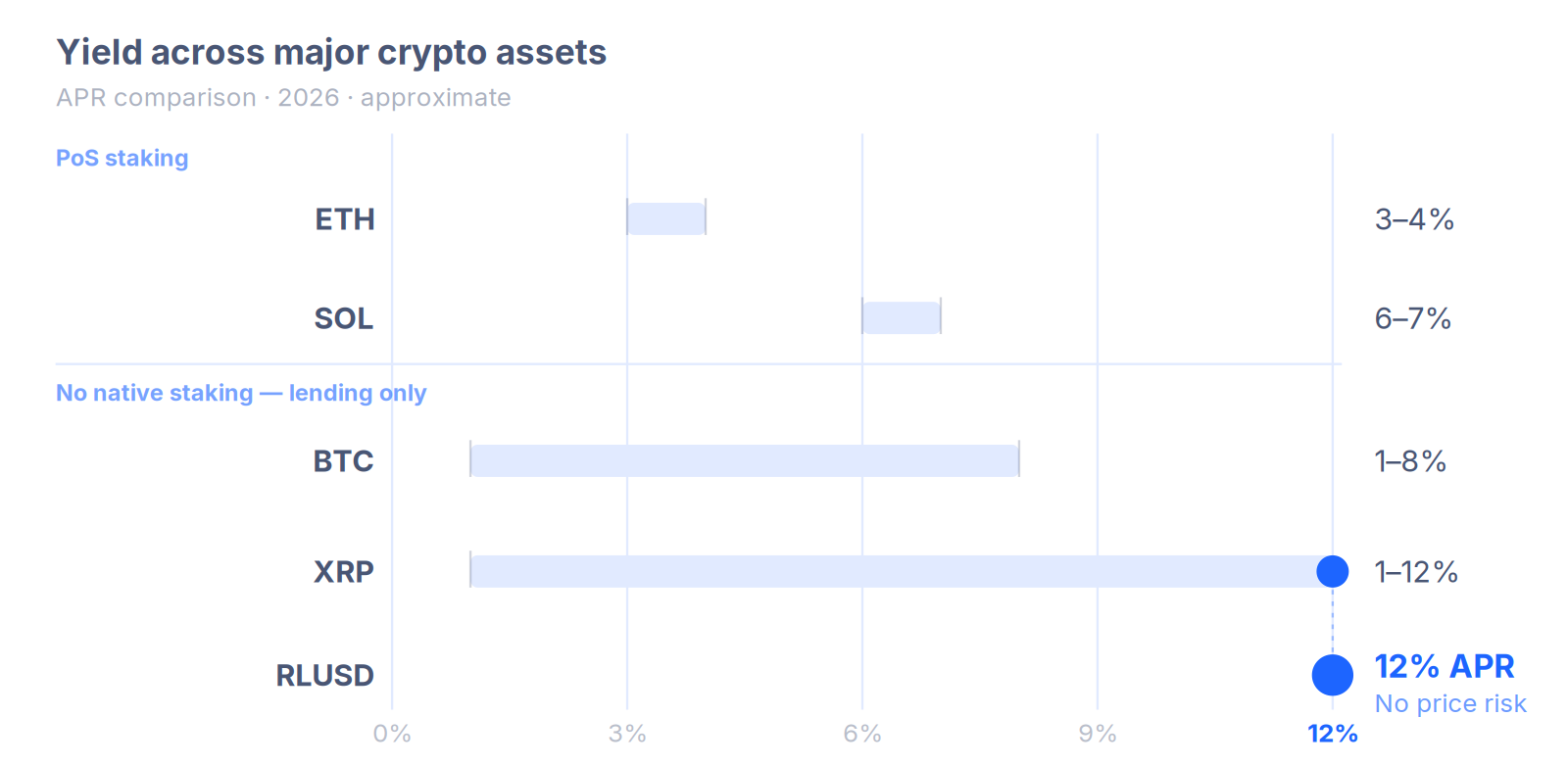
Why XRP Has No Native Staking Yield
XRP cannot be staked — every product marketed as "XRP staking" is a lending or managed yield product operating under a different label. That distinction is covered in more depth in this comparison of XRP staking vs lending yield.
The XRP Ledger runs on Federated Byzantine Agreement (fBFT) consensus, not Proof-of-Stake. Unlike Ethereum or Solana, there's no protocol-level mechanism to delegate XRP to validators and earn rewards. Yield has to come from somewhere real: borrowers paying interest.
That structural difference shapes the entire XRP yield landscape in two ways:
- On PoS networks, staking yield is essentially new token issuance — the protocol creates tokens to reward validators. The APY has no ceiling other than inflation policy.
- On XRPL, yield comes from borrowers. That creates a rate floor (low enough to attract borrowers) and a ceiling set by what the lending market can sustain.
The practical upshot: there's no passive, protocol-native XRP yield. To earn on XRP, you deposit it somewhere — and that somewhere lends it to someone else. Who that borrower is, what collateral protects the loan, and who absorbs the loss if they default — those are the questions that determine the quality of the yield.
XRP Lending Rates in 2026: What the Market Pays
XRP lending rates vary significantly by platform type, rate structure, and the conditions attached to advertised returns. The table below maps the landscape.
| Platform type | Rate type | Typical APR range | Key conditions |
|---|---|---|---|
| Fixed-rate CeFi (LendProtocol) | Fixed | 12% APR (~12.75% effective annual) | No lock-up; daily payout; platform absorbs default risk |
| CeFi exchange earn products | Variable | 1–8% | Fluctuates with market; often tier-gated or term-locked |
| XRPL AMM liquidity provision | Variable | Variable | Impermanent loss risk; depends on pool volume and pair |
| Wrapped DeFi (cross-chain) | Variable | 2–8% | Requires bridging XRP off XRPL; smart contract risk |
| Traditional savings accounts | Variable | 0.5–4.5% | USD benchmark; no crypto risk |
Rates reflect general market ranges as of mid-2026. Verify current figures directly with each platform before depositing.
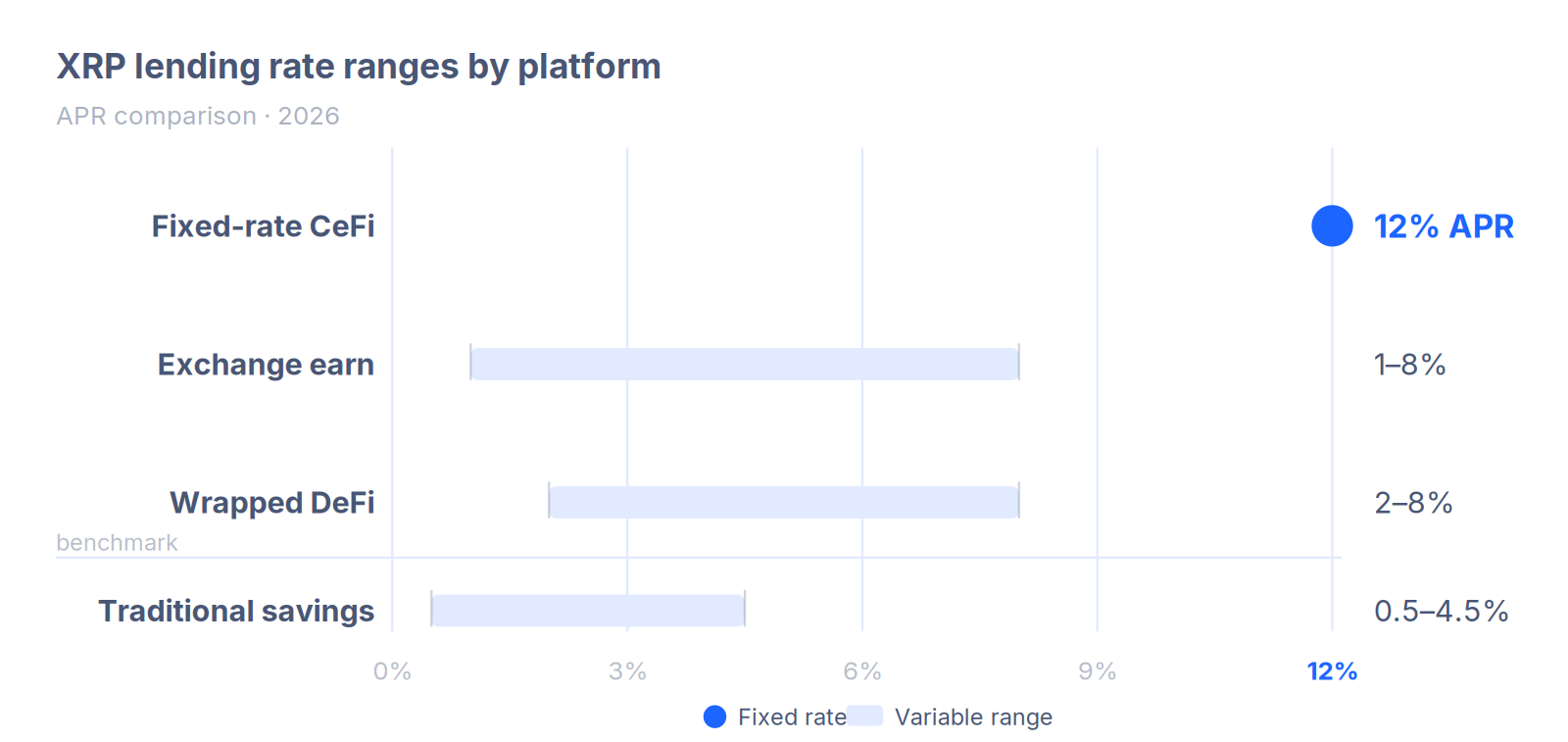
Three patterns matter in this data:
Exchange rates often aren't what they appear. Published headline rates on major platforms typically require holding the platform's native token, locking XRP for 6–12 months, or maintaining minimum portfolio balances. The effective rate for a new depositor without those conditions is usually at the lower end of the advertised range.
AMM returns carry a hidden cost. The XRPL native AMM launched in 2024 and has grown steadily since, with liquidity providers earning trading fees across more than 40 active pairs. But providing liquidity also creates impermanent loss exposure — the risk that the ratio between your pooled assets shifts unfavorably. This is not the same risk profile as straightforward XRP lending.
Fixed rates don't follow the market down. When lending demand drops, variable-rate yields follow. A fixed-rate commitment doesn't move with market conditions — in either direction.
Fixed vs. Variable: The Rate Difference That Actually Matters
Fixed rates lock your yield at the stated rate from day one. Variable rates track borrower demand, platform liquidity, and broader market conditions — and move accordingly.
For XRP holders, this distinction is more material than it might look. Variable rates on exchange earn products rose with lending demand in 2025, then pulled back as conditions normalized. Depositors who moved in expecting sustained high yields saw rates compress without warning. A fixed rate doesn't do that.
The mechanics that make fixed rates sustainable: a platform paying lenders 12% and charging borrowers 12.7% earns a 0.7% spread across the full loan book. That spread funds operations, builds reserves, and — critically — covers the cost of absorbing default risk on the lender's behalf. The fixed rate is a business commitment, not a promotional figure with an expiry date.
One honest tradeoff worth naming: fixed-rate CeFi products shift counterparty risk from the loan book to the platform. In variable-rate DeFi, lenders bear default exposure through pooled liquidity. In a fixed-rate CeFi structure, the platform absorbs it. Neither model is inherently safer — the risk is in a different place, not eliminated. The due diligence question changes from "how healthy is this loan pool?" to "how healthy is this platform?"
How XRP Lending Works
XRP lending follows the same basic structure across CeFi platforms: a depositor provides XRP, a borrower posts collateral, the loan is issued, and the lender earns interest until repayment or default.
The most important variable is the collateral ratio. Responsible XRP lending requires borrowers to post more value in collateral than they receive in the loan. At a 120% collateral ratio — the standard at serious platforms — a $10,000 loan requires $12,000 in accepted collateral. That buffer provides a cushion against collateral price volatility before a default becomes a net loss.
Commonly accepted collateral in XRP lending: BTC, ETH, SOL, XRP, RLUSD, and USDT.
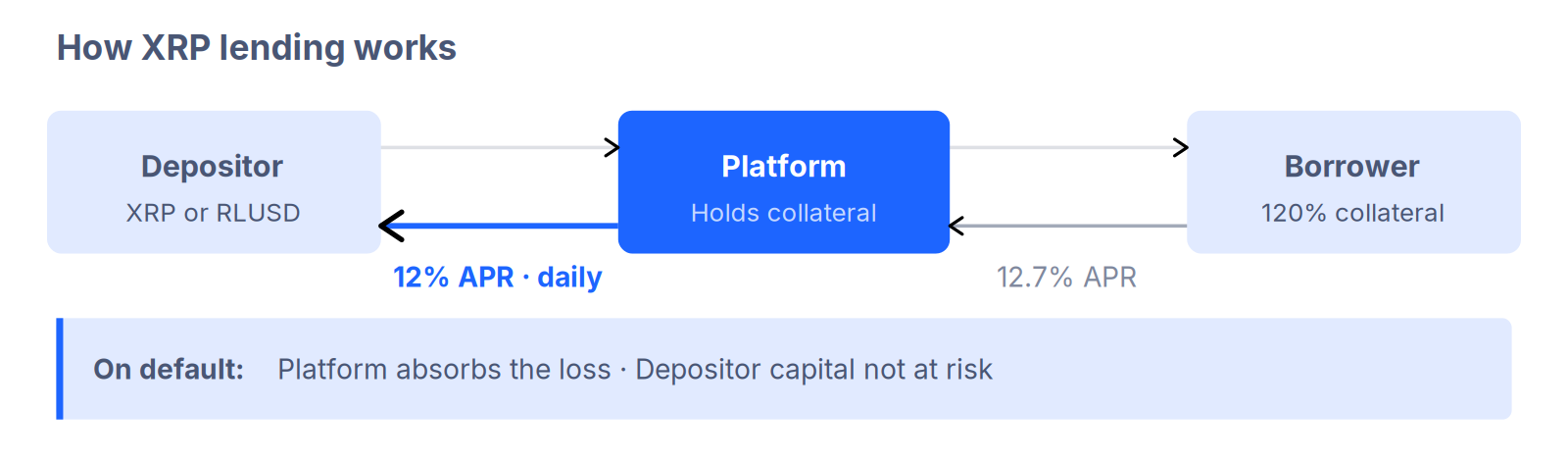
Before depositing on any platform, three things to verify:
- Custody model — are assets held primarily in cold storage, or on hot wallets with exchange exposure?
- Default risk allocation — does the platform absorb borrower defaults, or are they distributed across the depositor pool?
- Withdrawal terms — can you exit at any time, or are funds locked for a defined term?
These three factors determine the actual risk profile behind any published APR. The rate number alone tells you very little. For a full breakdown of how the mechanics work end-to-end, see the fixed-rate XRP lending guide on the LendProtocol blog.
RLUSD: Yield Without XRP Price Exposure
RLUSD earns the same 12% APR as XRP on LendProtocol — without any exposure to XRP price movements.
RLUSD is Ripple's fully-backed, regulated USD stablecoin on the XRP Ledger. For depositors who want XRPL-native yield but don't want to carry XRP price volatility, depositing RLUSD is the direct answer. Returns accrue in USD terms, paid daily, on an asset pegged to the dollar.
A 12% APR on a USD-stable asset sits materially above traditional savings accounts (0.5–4.5%) and most CeFi exchange products — without requiring the depositor to accept crypto price risk on the underlying asset.
For institutional treasury teams — organizations holding RLUSD between operational payments on XRPL — this is a practical yield-on-idle-capital option. Balances remain liquid with no lock-up, and return in the same asset they were deposited in.
FAQ
Can you stake XRP?
No. XRP cannot be staked. The XRP Ledger uses Federated Byzantine Agreement consensus, not Proof-of-Stake, so there is no protocol mechanism to delegate XRP to validators and earn staking rewards. If a platform describes its product as "XRP staking," read the fine print — it's almost always a lending product, a managed yield account, or an AMM liquidity position. The yield source is borrower interest, not protocol issuance. For a comparison of what's actually available, see this overview of XRP staking alternatives and how to earn yield on XRP.
What is the highest XRP lending rate available?
The highest fixed XRP lending rate currently available is 12% APR, offered by LendProtocol with daily payouts and no lock-up period. Variable-rate platforms may publish higher headline numbers, but those typically require holding a platform token, locking XRP for months, or maintaining minimum balances that most depositors don't meet. The effective rate is usually lower than the number on the landing page.
How do XRP lending rates compare to traditional savings?
Traditional USD savings accounts pay 0.5–4.5% APR depending on the institution and rate environment. Fixed XRP lending rates at 12% APR are two to three times higher. That gap reflects a different risk profile — counterparty risk, platform risk, and crypto market exposure that bank savings don't carry. The yield is higher because the risk is different, not because it's free.
Is XRP lending safe?
No lending product is risk-free. The relevant questions are: how assets are held (custody model), who absorbs borrower defaults (risk structure), and what collateral protects the loan book (collateral ratio and accepted assets). Platforms using cold storage, enforcing overcollateralized borrowing at 120% or above, and absorbing default risk internally offer a more conservative structure than DeFi protocols where depositors share default exposure through pooled liquidity.
Does RLUSD earn the same rate as XRP?
On platforms that support both, yes. RLUSD earns the same stated 12% APR as XRP — with the same daily payouts and no lock-up requirement — but returns accrue in dollar terms, removing XRP price exposure from the equation entirely.