XRP Staking vs Lending Yield: Key Differences
XRP staking yield doesn't exist at the protocol level. What does exist is a spectrum of earn products marketed under that label, ranging from 1% exchange programs to 12% fixed-rate lending — with very different risks attached.
Every platform advertising XRP staking yield is technically mislabeling its product. The XRP Ledger has no staking mechanism — validators earn nothing, token holders earn nothing. What fills that gap ranges from 1–5% exchange earn programs to 12% fixed-rate collateralized lending. Same label, different mechanics, different risk.
All You Need To Know About XRP Staking Yield
What XRP Staking Yield Actually Is
XRP staking yield from the protocol level does not exist. The XRP Ledger uses Federated Byzantine Agreement (fBFT) — a consensus mechanism in which a network of trusted validators agrees on transaction order through iterative communication rounds, not competitive token-locking. Validators earn nothing for participating. Token holders earn nothing for holding.
This separates XRP from Ethereum and Solana, where validators post collateral and receive newly-minted tokens for securing the network. On the XRP Ledger, validators run to protect their reputation, not for payment. For holders, idle XRP earns nothing.
The phrase "staking XRP" appears across exchange product pages and search results. What they actually deliver falls into two categories.
Exchange Earn Programs
Exchange earn programs are the most accessible form of XRP yield. Platforms including Binance, Nexo, and Bitrue offer accounts where XRP depositors receive interest funded by the exchange's own lending book or treasury.
Rates typically sit between 1% and 5% APY. Nexo advertises up to 8.5% APY on XRP — but that headline requires holding a large NEXO position and taking interest in that same token. Most holders will see 4–5% at best.
The risk is structural. Deposited XRP sits in the exchange's custody. The depositor becomes an unsecured creditor if the exchange becomes insolvent — the FTX collapse in 2022 demonstrated exactly how that resolves. A 4% APY carry-trade with full custodial exposure is a different product than the marketing implies.
Wrapped DeFi and XRPL AMM Yield
The second category involves bridging XRP to Ethereum or BNB Chain and deploying it into DeFi lending pools or AMM liquidity positions. Rates run 2–8%, variable.
XRPL's own native AMM went live in 2024, creating on-ledger liquidity options that don't require bridging — but even there, fees fluctuate with pool volume and trading activity. There is no fixed return.
Higher rates carry more risk:
- Bridge contracts — the mechanism moving XRP to another chain — are the most-exploited attack surface in crypto history
- Smart contract vulnerabilities affect both lending pools and AMMs on any chain
- Impermanent loss applies to AMM positions when pooled asset prices diverge
- Bad debt socialization — DeFi lending pools distribute defaulted loan losses across all depositors
The variable rate is not just a moving number. It reflects the risk model behind it.
All You Need To Know About XRP Lending Yield
What XRP Lending Yield Is
XRP lending yield comes from matching depositors with borrowers who post overcollateralized crypto as loan security. The depositor earns interest; the platform manages credit and default risk.
This is structurally different from exchange earn programs or DeFi pools. There is a real borrower, real collateral exceeding the loan value, and a platform standing between the depositor and any default. The depositor's capital is not held by an exchange or deployed into a smart contract they don't control.
How It Works
The process is the same across platforms:
- A depositor puts XRP (or RLUSD) into the lending platform
- The platform matches that deposit with a borrower who posts collateral worth at least 120% of the loan value
- The borrower pays interest; the depositor receives a share of it, credited daily
- If the borrower defaults, the risk lands either on the depositor (typical in DeFi) or on the platform itself (in CeFi models with an explicit guarantee)
The 20% overcollateralization buffer absorbs collateral price moves before any loss materializes. On platforms where the operator absorbs default risk, lenders sit outside that chain — their capital isn't tied to individual loan outcomes.
On LendProtocol — a fixed-rate XRP lending platform built on the XRP Ledger — borrowers post BTC, ETH, SOL, XRP, RLUSD, or USDT at 120% of the borrowed amount. When a borrower defaults, LendProtocol absorbs the loss, not the depositor.
Rates and Compounding
Fixed-rate CeFi lending delivers a predictable return regardless of market conditions. The stated lender APR is 12%, paid daily, with no lock-up period. With daily compounding, the effective annual yield works out to approximately 12.75% — the difference between APR and APY that accumulates quietly over a full year.
That compounding is not cosmetic. Interest added to principal each day earns interest itself the next day. Holders can model exact projections with the daily XRP yield calculator before committing. Current XRP lending rates across platform types sit on a wide spectrum — the rate you actually receive depends on structure, not just the headline.
Variable rates — on DeFi protocols or exchange programs — compress when borrowing demand is low and dilute when pools attract more liquidity than they can deploy. A fixed rate removes that volatility.
Risk and Security
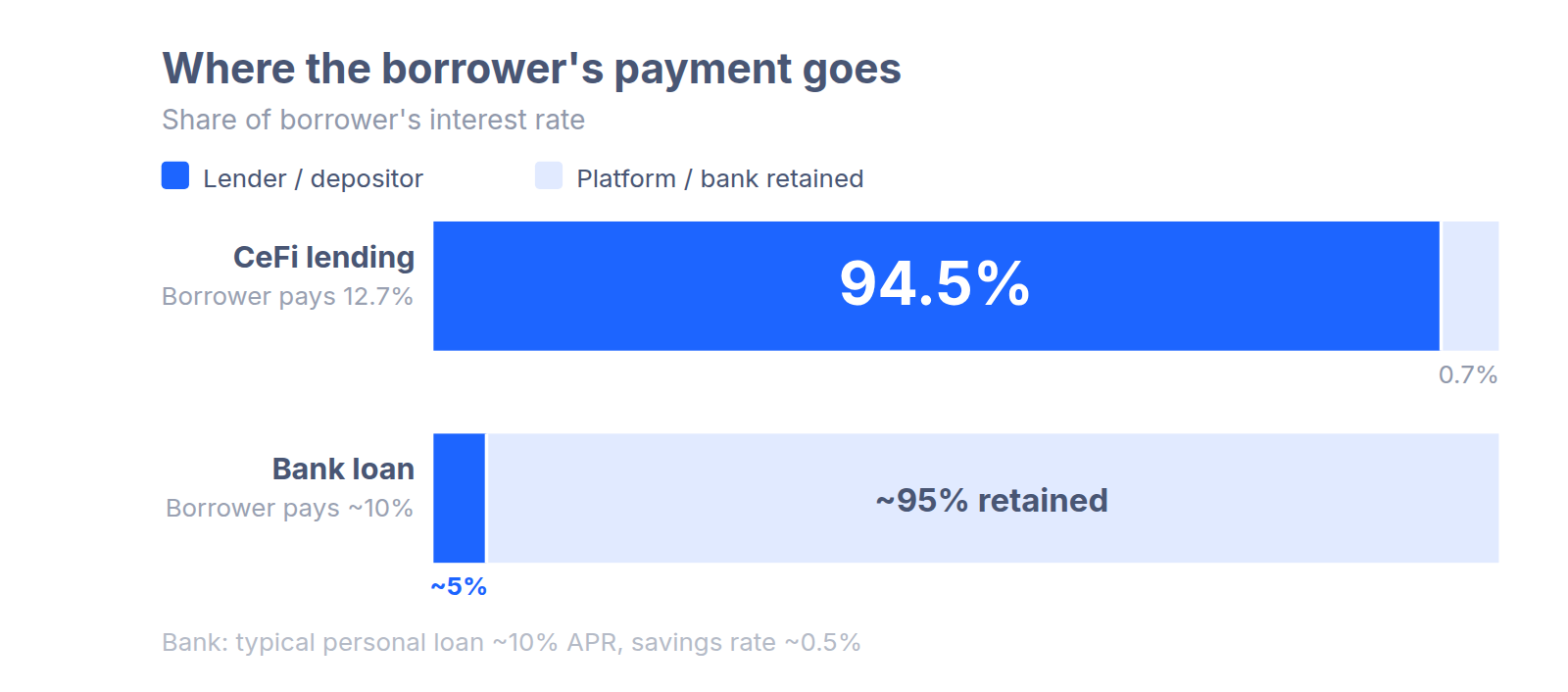
The yield comes from the spread between borrower and lender rates. On LendProtocol, borrowers pay 12.7% APR and lenders receive 12% APR — the 0.7% difference is operating revenue, not a subsidy or token incentive. Assets sit in cold storage, encrypted with AES-256 GCM, with 2FA enforced on all accounts. The platform has 13,713+ active lenders and has lent over 743 million XRP.
Staking vs Lending: Side-by-Side
| XRP "staking" (exchange / DeFi) | XRP lending yield (CeFi) | |
|---|---|---|
| Protocol-level yield? | No | No |
| Typical rate | 1–8% variable | 12% APR fixed |
| Rate certainty | Fluctuates with market | Fixed at deposit |
| Payout frequency | Weekly / monthly (varies) | Daily |
| Lock-up | Often required | None |
| Default risk | Depositor (DeFi) or exchange (CeFi) | Platform-absorbed |
| Asset custody | Exchange or smart contract | Cold storage |
| Bridge required? | Sometimes (wrapped DeFi) | No |
The Bottom Line
XRP staking yield at the protocol level does not exist. What the market offers instead is two categories: exchange earn programs and DeFi positions marketed loosely as "staking XRP," paying 1–8% variable with custodial or smart-contract risk attached; and fixed-rate CeFi lending paying 12% APR daily, with platform-absorbed default risk, cold storage custody, and no lock-up.
The right choice depends on how a holder weighs rate certainty against operational complexity, and how much counterparty risk they're prepared to carry in exchange for yield.
FAQ
Can you stake XRP to earn rewards?
No. The XRP Ledger uses Federated Byzantine Agreement, not Proof-of-Stake. The protocol distributes no rewards to XRP holders. Products marketed as "XRP staking" deliver lending income, exchange earn programs, or liquidity fees — not network-level validation rewards.
What is the typical XRP staking yield on exchanges?
Exchange XRP yield programs generally pay between 1% and 5% APY, with some platforms reaching higher rates when users hold the exchange's native token or lock funds for a fixed period. All rates are variable and can change at any time.
What is the difference between APR and APY on XRP lending?
APR is the stated annual rate before compounding. APY reflects the actual annual return once compounding is factored in. At 12% APR compounded daily, the effective APY is approximately 12.75%. The gap is real money over a twelve-month holding period.
What collateral do XRP borrowers post?
On fixed-rate CeFi lending platforms, accepted collateral typically includes BTC, ETH, SOL, XRP, RLUSD, and USDT, posted at 120% of the loan value. The overcollateralization creates a buffer before any default risk reaches the platform.
Is yield from XRP lending taxable?
In most jurisdictions, lending income is treated as ordinary income at the time it is received. Tax treatment varies by country and individual circumstance — consult a qualified tax professional.