Where To Stake XRP: Best Options 2026
Looking for where to stake XRP in 2026? XRP can't be staked natively, but there are four real ways to earn yield, each with different rates, risks, and lock-up terms. Here's the honest comparison.
You can't stake XRP natively. The XRP Ledger has no Proof-of-Stake mechanism and pays no protocol rewards. But the question of where to stake XRP in 2026 has a cleaner structure than most guides suggest: exchange yield programs, wrapped DeFi, native AMM liquidity provision, and fixed-rate lending. Here's what each option actually involves.
Can You Stake XRP? Not the Way You're Thinking
You cannot stake XRP on the XRP Ledger. The network runs on Federated Byzantine Agreement, where validators reach consensus without locking tokens and earn nothing for their participation. There are no staking rewards at the protocol level.
This is a technical constraint, not a policy choice. Ethereum, Solana, and Cardano are all Proof-of-Stake: locking tokens is how those networks stay secure, and validators earn yield in return. XRP's design runs differently. Settlement finishes in 3–5 seconds, fees are near-zero, and none of it requires token holders to put up collateral for the network to function.
The consequence: anyone marketing "XRP staking" is describing something else: lending, liquidity provision, or a custodial interest program. That's not a criticism; it's just accurate. Knowing the difference matters when you're evaluating where to stake XRP and comparing rates.
Your Four Real Options for XRP Yield in 2026
Here's where to stake XRP, in plain language:
1. Centralized Exchange Yield Programs
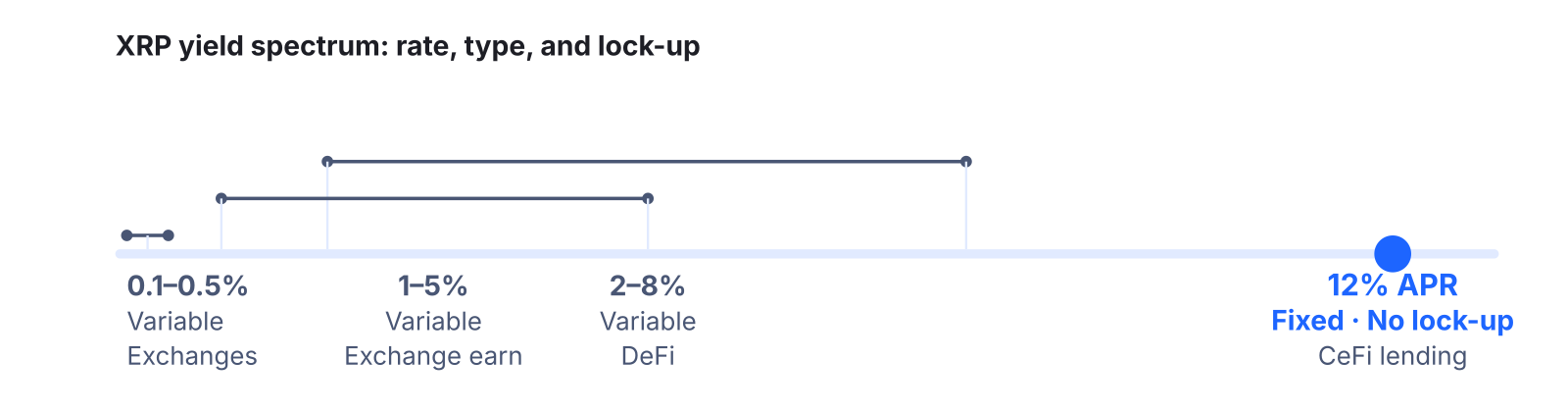
Platforms like Binance Earn, Nexo, and YouHodler accept XRP deposits and pay interest funded by their internal lending operations. Base rates for flexible (no lock-up) XRP positions typically run 1–5% APR for most users. Some platforms advertise higher headline figures, but those usually require locking funds for fixed terms, holding significant amounts of the platform's native token, and accepting rewards in that token rather than XRP. The rate the average user actually receives is lower.
The risk here is custodial. Your XRP lives on someone else's platform. If that platform runs into trouble (regulatory, operational, or financial), your position is exposed. The opacity is also real: most platforms don't disclose exactly where your yield comes from or how it's generated.
Exchange programs make sense if convenience matters more than rate and you already hold XRP on an exchange.
2. Wrapped DeFi (wXRP on Other Networks)
If you're willing to leave the XRP Ledger entirely, you can convert XRP into a wrapped token and deploy it on Ethereum, BNB Chain, or Flare Network. DeFi protocols on those chains use it in liquidity pools or lending markets. Yields range from 2–8% variable, depending on protocol demand and incentive programs at any given time.
The risk stack is real, though: bridge risk when moving XRP off XRPL, smart contract risk on the destination chain, and impermanent loss if you're providing paired liquidity. This path also means managing a separate wallet, paying gas fees on a different network, and keeping up with protocol changes.
This option suits users who already operate across multiple chains. For someone whose entire crypto setup lives on XRPL, the added complexity rarely justifies the variable yield.
3. XRPL Native AMM Liquidity
The XRP Ledger launched its native automated market maker (AMM) in 2024. XRP holders can deposit into liquidity pools directly on XRPL without bridging to another chain, earning a share of swap fees paid by traders.
The yield is fully variable. It depends on trading volume through the specific pool you join and the fee tier selected. There is no floor rate to quote. Active monitoring of pool performance is part of the deal. This is the most "native" on-ledger approach available today, but it introduces impermanent loss and isn't a passive, set-and-forget arrangement. For holders who want predictable income, it's not the right fit.
4. Fixed-Rate CeFi Lending Platforms
The fourth path, and the one with the clearest terms for most XRP holders, is CeFi lending: depositing into a platform that lends your XRP to overcollateralized borrowers at a fixed rate.
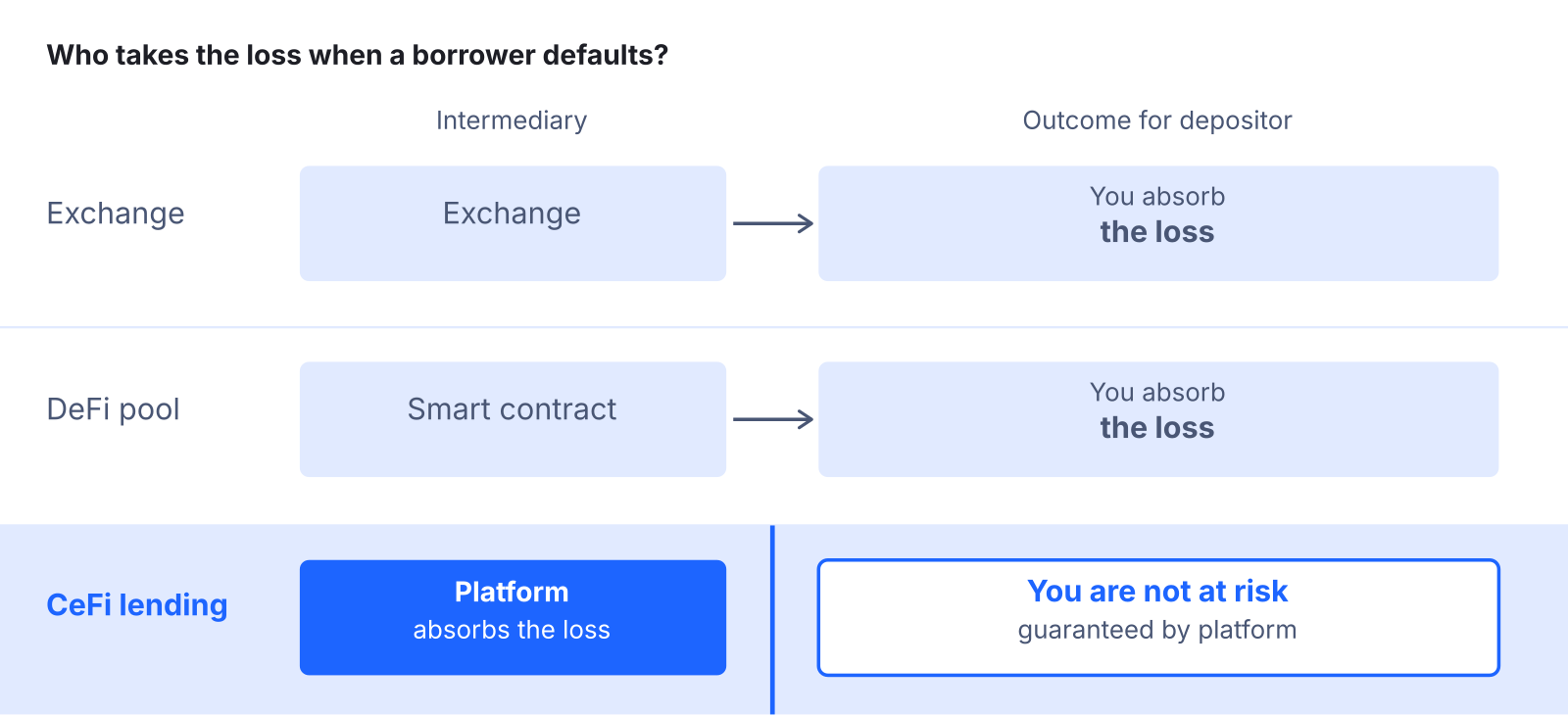
LendProtocol sits here. Built natively on the XRP Ledger, it pays 12% APR on XRP and RLUSD deposits (RLUSD is Ripple's fully-backed, regulated USD stablecoin), with daily payouts and no lock-up period. Borrowers must post 120% collateral to access a loan; if a borrower defaults, LendProtocol absorbs the loss rather than passing it to depositors. That risk model is what separates this category structurally from the other three. Exchange programs leave custody and platform risk with you. DeFi pools add smart contract and impermanent loss risk on top of that. With fixed-rate CeFi lending, the platform absorbs the default risk.
As of mid-2026, the platform has over 13,713 active lenders and 743 million XRP lent, which is enough to assess on actual results rather than stated intentions.
XRP Staking Platforms: Side-by-Side Comparison
| Option | Typical APR | Rate Type | Lock-up | Who Bears Default Risk |
|---|---|---|---|---|
| Exchange yield programs (Binance, Nexo) | 1–5% | Variable | None to 1 month | Depositor |
| Wrapped DeFi (wXRP on ETH / Flare) | 2–8% | Variable | None | Depositor |
| XRPL Native AMM | Varies with volume | Variable | None | Depositor |
| CeFi lending (LendProtocol) | 12% | Fixed | None | Platform |
One pattern holds across the XRP staking platforms in this table: higher yield options tend to transfer more risk to the user. Lower yield options are simpler but still leave the depositor exposed to counterparty risk. Fixed-rate lending with a platform guarantee breaks that pattern. It maintains the yield while removing the depositor from the default risk.
What About XLS-66, XRPL's Native Lending Protocol?
XLS-66 comes up regularly when people search where to stake XRP in 2026, so it's worth being specific.
XLS-66 is a proposed XRPL amendment developed by Ripple that would bring native, fixed-term lending directly to the XRP Ledger. The design targets institutional borrowers through credentialed, off-chain underwriting, not retail holders depositing through an app. The amendment entered validator voting in January 2026 following the XRPL v3.1.0 release. As of mid-2026, the vote has not reached the 80% sustained consensus required for mainnet activation; Ripple has both XLS-65 and XLS-66 in active developer testing.
Two things are worth being clear about. First, XLS-66 is not a consumer yield product. Retail XRP holders won't be depositing into it directly. Second, it's a separate product from consumer CeFi platforms like LendProtocol, which is built on XRPL as its settlement layer but is not an implementation of the XLS-66 standard.
For anyone asking where to stake XRP today: XLS-66 is not yet active and is aimed at a different market segment entirely.
How to Evaluate Any XRP Yield Option Before Depositing
Before committing to one of the XRP staking platforms above, these questions cut through the marketing:
- Is the rate fixed or variable? Variable rates can drop significantly during low-demand periods with no notice. Fixed rates let you model actual income before you commit.
- Who absorbs the losses? On most platforms, if a borrower defaults or the platform encounters financial trouble, depositors are exposed. Read the fine print on what actually happens in that scenario.
- What are the real conditions for the headline rate? Token lock-ups, loyalty tiers, and mandatory reinvestment in platform tokens are common. The rate available to an average user without those conditions is usually lower.
- Is there a lock-up? If you need access to your capital at short notice, a platform with mandatory lock-up periods is an operational problem, not just a minor inconvenience.
- How is custody handled? Cold storage, two-factor authentication, and encryption standards matter. Ask specifically rather than relying on vague security language. For reference, LendProtocol stores the majority of deposited assets in cold storage with AES-256 GCM encryption, the same standard used in banking, and requires 2FA on all accounts.
The Realistic Summary
XRP can't be staked in the Proof-of-Stake sense. What exists in its place are four options with meaningfully different risk profiles: exchange programs at 1–5% variable with custodial risk, wrapped DeFi at 2–8% variable with multi-layer risk, native XRPL AMM liquidity at variable fee income, and fixed-rate lending at 12% with platform-absorbed default risk.
The question of where to stake XRP doesn't have a single answer. It has four, and which one fits depends on what you're willing to manage. The yield number is only part of the picture. What matters equally is who holds the risk when something goes wrong.
FAQ
Can I stake XRP on Coinbase?
No. Coinbase does not offer XRP yield, lending, or staking programs. XRP cannot be staked natively, and Coinbase has not launched a custodial XRP earn product.
Can I stake XRP on Kraken or Binance?
Both do, at very modest rates. Kraken offers an XRP rewards product through its Auto Earn program at around 0.1% APR, useful to know it exists, less useful as a yield strategy. Binance Earn offers XRP Flexible Savings at roughly 0.5% APR under normal conditions, with occasional promotional rates that may be higher but tied to specific trading volume or balance requirements. Both rates change frequently; check the platforms directly.
Is XRP yield income taxable?
In most jurisdictions, yield received on XRP is treated as ordinary income at the time of receipt. A separate capital gains event may apply when you later sell or exchange the XRP. Tax treatment varies by country. Consult a qualified tax professional for your situation.
What's the difference between APR and APY for XRP yield?
APR is the stated rate without compounding. APY accounts for the compounding effect over the full year. Daily compounding on a 12% APR produces approximately 12.75% effective annual yield. When comparing platforms, verify which metric is being advertised, since some platforms quote APY to appear more competitive than the underlying rate justifies.
What's the highest fixed APR available on XRP right now?
Among platforms with transparent, publicly stated terms and no lock-up requirements, 12% APR is the highest available fixed rate on XRP, currently offered by LendProtocol on the XRP Ledger and paid daily.