XRP Lending: How It Works, Risks & Returns
XRP lending: 120% overcollateralization, 12% APR, daily payouts, no lock-up. Mechanics, risks, and realistic returns for XRP and RLUSD holders.
Most XRP holders face a problem nobody talks about enough: their assets sit idle. Unlike Ethereum or Solana holders, they can't stake. The XRP Ledger doesn't work that way. So the question becomes — what do you do with XRP you're not selling?
The answer, for a growing number of holders, is lending. XRP lending lets you put idle tokens to work for a fixed return, paid daily, without giving up ownership or waiting out a lock-up period. The mechanics are simple enough. The risks are real enough to understand properly. And the returns — when structured correctly — are concrete rather than speculative.
It's a question more people are asking. Search interest in "how to stake XRP" and "XRP passive income" has climbed steadily as the XRP price has recovered and more institutional players have entered the ecosystem. But a lot of the content answering those searches is either misleading (calling lending "staking") or vague on what the actual yield numbers look like in practice.
This guide covers all three: how XRP lending works at the protocol level, what risks are actually present (and which ones people misunderstand), and what kind of yield is realistic in 2026. No speculation. No hype. Just the mechanics.
What Is XRP Lending?
XRP lending is the process of depositing your XRP into a platform that loans those assets to borrowers who pay interest in return. As a lender, you earn a share of that interest — expressed as an annual percentage rate (APR) and typically paid out daily.
This is not staking. It is not a yield farm. It is, mechanically, the same thing banks have done for centuries: take deposits, lend them out at a higher rate, keep the spread. The cryptocurrency context adds some wrinkles — collateral requirements, custody arrangements, on-chain settlement — but the core model is the oldest one in finance.
What makes XRP lending distinct from crypto lending broadly is the underlying asset. XRP is the native currency of the XRP Ledger, a blockchain designed specifically for payments and settlement. It processes transactions in 3–5 seconds with near-zero fees. That infrastructure makes it well-suited for lending operations where capital moves frequently and precision matters.
At the macro level, XRP lending also solves a specific gap: XRP cannot be staked, so holders who want their assets to generate passive income have historically had no good native option. Lending platforms built on the XRPL have changed that.
Why You Can't Stake XRP — And What Lending Replaces
XRP cannot be staked — natively or otherwise — because the XRP Ledger does not use a Proof-of-Stake consensus mechanism. This is the most common misconception about XRP yield.
The XRP Ledger runs on Federated Byzantine Agreement (fBFT), a consensus model where a set of trusted validators reaches agreement on the state of the ledger without any staking, mining, or token-locking mechanism. Validators on the XRPL don't earn block rewards. Transaction fees are burned rather than distributed. All 100 billion XRP were issued at inception — there is no inflation to fund protocol-level staking rewards, and there never will be under the current design.
When exchanges or apps advertise "XRP staking," they are using the term loosely. What they're actually offering is either:
- A custodial lending program, where the platform lends out your XRP and pays you interest
- A wrapped XRP product on another chain (like wXRP on Ethereum), where your XRP is bridged out and used in DeFi protocols with entirely different risk profiles
Neither is native staking in any technical sense. If you're looking to earn yield on XRP, you are looking at lending products. Understanding that distinction changes how you evaluate returns, risks, and platform claims.
It's also worth noting: the XRPL introduced native AMMs in 2024 and a formal lending protocol amendment (XLS-66d) entered validator voting in early 2026. These are protocol-level developments — separate from consumer-facing CeFi products, but expanding the ecosystem of native yield options.
How XRP Lending Works, Step by Step
The mechanics of XRP lending differ depending on whether the platform is a CeFi (centralized finance) operation or a DeFi protocol. Here's how each works.
CeFi Lending
In a CeFi model, the platform acts as an intermediary between lenders and borrowers. The lender deposits XRP; the platform matches that capital with borrowers who post collateral; interest is collected and paid out to lenders on a defined schedule.
At LendProtocol, the process runs as follows:
- Lender deposits XRP or RLUSD — assets are held in cold storage
- Platform matches deposits with borrowers — screened and collateral-verified
- Borrower posts 120% collateral — accepted assets include BTC, ETH, SOL, XRP, RLUSD, or USDT
- Loan is issued at 12.7% APR to the borrower
- Lender earns 12% APR, paid daily
- On repayment — principal and accrued interest are returned to the lender
- On default — the platform absorbs the loss, not the lender
The 0.7% spread between borrower and lender rates is the platform's revenue — covering risk management, operations, and reserve-building against potential defaults. That 120% collateral ratio provides a buffer: a $10,000 loan requires $12,000 in posted collateral, giving the platform room to liquidate before a default becomes a net loss.
DeFi Lending
In a DeFi model, smart contracts manage the pool. Lenders deposit into a liquidity pool; the protocol algorithmically sets interest rates based on utilization; borrowers draw from the pool. There is no intermediary absorbing risk — if a borrower defaults or a smart contract is exploited, losses flow directly to depositors.
DeFi rates on XRP can be higher or lower than CeFi rates depending on market conditions. They are also variable — they change in real time as supply and demand shift. For holders who prioritize predictability over maximizing theoretical upside, the rate uncertainty alone is a meaningful drawback.
Who Is on the Other Side of the Loan?
A question lenders rarely ask but should: who is actually borrowing, and why? Understanding borrower motivations is part of understanding whether the collateral model makes sense.
| Borrower Type | Why They Borrow XRP/RLUSD | Collateral Posted |
|---|---|---|
| Crypto trader / fund | Access liquidity without selling BTC or ETH position | BTC, ETH, SOL |
| XRPL-native business | Operational XRP for payments and settlement cycles | USDT, RLUSD |
| Arbitrageur | Short-term capital for cross-market opportunities | BTC, XRP |
| Institutional treasury | Bridge funding between settlement cycles | ETH, USDT |
The common thread: these are borrowers with existing crypto holdings who want liquidity without exiting their positions. That's why overcollateralized lending works — borrowers have skin in the game. A trader who posts $12,000 in BTC to borrow $10,000 in XRP is not going to walk away from that collateral casually.
What Returns Can You Realistically Expect?
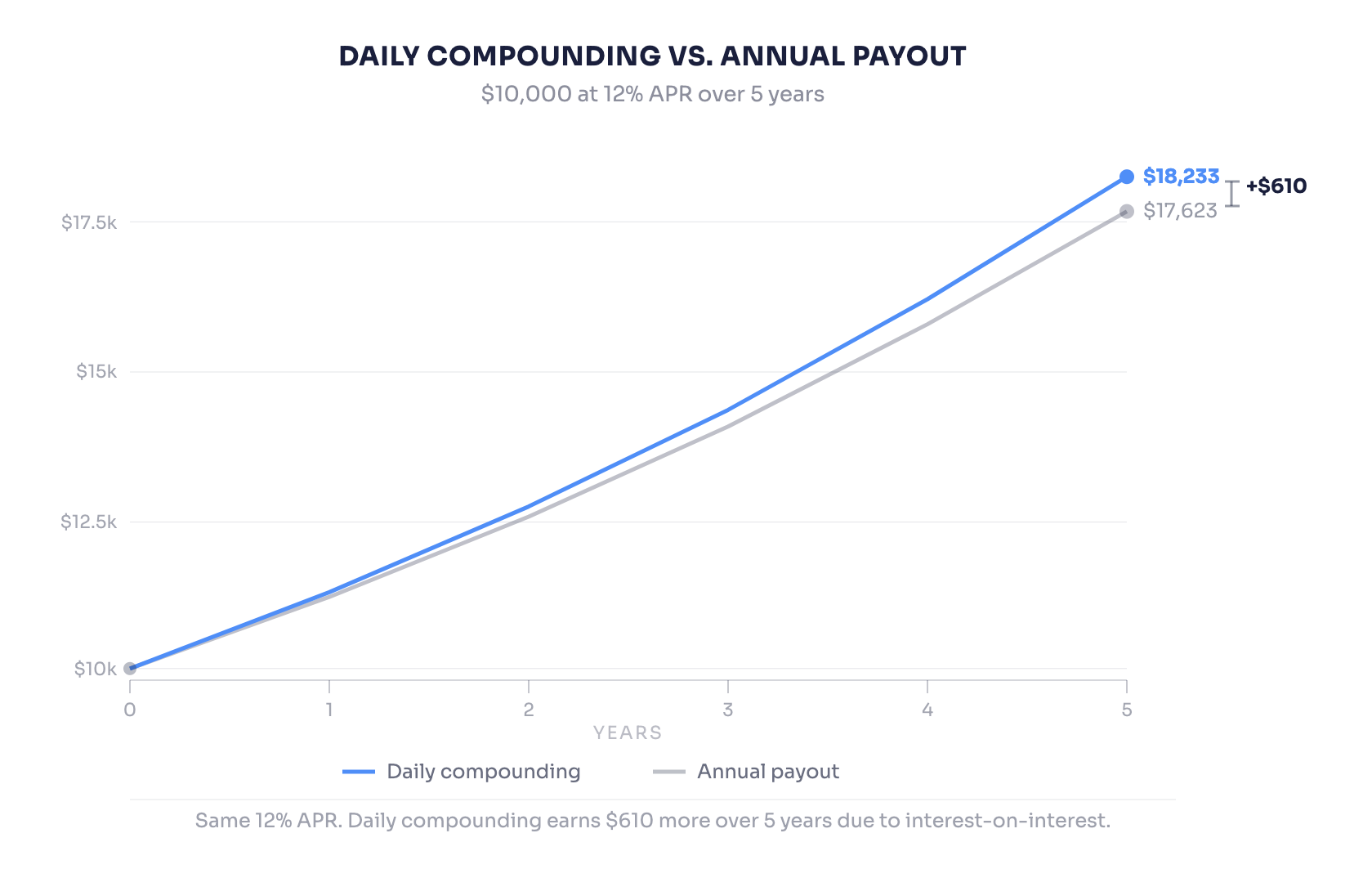
In a well-structured XRP lending arrangement, lenders can earn a fixed 12% APR with daily compounding, which works out to approximately 12.75% effective annual yield.
Daily compounding means each day's interest is added to the principal, which then earns interest the following day. The math is straightforward: (1 + 0.12/365)^365 - 1 ≈ 12.75%. Over a short period the difference is negligible; over a full year it adds meaningfully to the stated rate.
For context, here's how XRP lending compares to other yield options for XRP holders:
| Yield Method | Typical APR | Rate Type | Lock-up | Risk Bearer |
|---|---|---|---|---|
| CeFi lending (fixed-rate) | 12% | Fixed | None | Platform |
| CeFi exchange earn programs | 1–5% | Variable | Sometimes | Exchange |
| Wrapped XRP in DeFi (Aave, etc.) | 2–8% | Variable | None | Depositor |
| XRPL AMM liquidity provision | Variable | Variable | None | Depositor |
| Holding XRP (no yield strategy) | 0% | — | — | — |
The "Risk Bearer" column matters as much as the APR column. Higher variable rates in DeFi come with direct exposure to smart contract risk, oracle failures, and pool imbalances. Fixed-rate CeFi lending where the platform absorbs default risk offers a structurally different arrangement — not necessarily "safer" in all scenarios, but differently risky.
One practical note: yield on deposited XRP is taxable income in most jurisdictions when received. Selling XRP later may also trigger a separate capital gains event. This is not tax advice — consult a tax professional in your jurisdiction.
Smart Contract Risk
XRP lending carries real risks. Anyone who tells you otherwise is selling something. The question is which risks are present in a given product, how well-managed they are, and whether they match your risk tolerance.
Counterparty / Platform Risk
In any CeFi lending arrangement, you are trusting the platform. If the platform mismanages funds, suffers insolvency, or freezes withdrawals — as several crypto lenders did during the 2022 market contagion — depositors may not be fully protected regardless of what the platform's terms promise.
This is the primary risk in CeFi XRP lending. Mitigants to look for: cold storage for the majority of assets, transparent collateral policies, and audited security infrastructure. Strong signals include AES-256 encryption at rest, enforced 2FA on all accounts, and public track records of operation.
Collateral Liquidation Risk
Overcollateralization protects lenders — up to a point. A 120% collateral ratio means there's a 20% buffer against collateral price drops before a default creates a net loss. In fast-moving markets, prices can fall faster than liquidation processes can execute. A borrower who posts BTC as collateral is exposed to Bitcoin price volatility; a sharp, sudden drawdown can compress the buffer from 20% to near-zero before the platform acts.
The quality of the platform's risk management and liquidation speed matters here more than the ratio alone. Platforms that monitor collateral values in real time and have automated margin call triggers are better positioned than those that manage this process manually.
Smart Contract Risk (DeFi-Specific)
For DeFi-based XRP lending using wrapped XRP on other chains, smart contract vulnerabilities become a real exposure. Oracle attacks and pool exploits have caused significant losses across DeFi. The 2022 Mango Markets exploit — an oracle price manipulation attack on Solana — drained approximately $114 million from the protocol in a single incident. These risks are not present in CeFi structures, but bridge risk — the risk inherent in moving XRP to another chain — creates its own category of exposure.
Liquidity Risk
In DeFi lending pools, withdrawal may depend on pool utilization. If the pool is fully borrowed out, you may need to wait for repayments before accessing your principal. CeFi platforms with no lock-up terms avoid this issue — withdrawal is possible regardless of current loan activity.
XRP Price Risk
Earning yield in XRP means your dollar-denominated returns move with XRP's price. If XRP falls 30% during the year, a 12% yield in XRP terms still results in a net dollar loss. RLUSD lending addresses this directly — the same APR on a USD-pegged stablecoin removes price exposure from the yield equation, making it more suitable for holders focused on stable, predictable returns.
Who Should Consider XRP Lending?
XRP lending is not one-size-fits-all. It fits some holder profiles better than others.
XRP holders with a medium-to-long time horizon who aren't planning to sell in the near term are the most natural fit. If XRP is going to sit in a wallet for 6–18 months anyway, earning 12% APR on it changes the risk calculus without requiring any change to the underlying position.
RLUSD holders and institutional treasuries benefit from the stablecoin angle: predictable yield on a dollar-pegged asset, with no directional price exposure. For companies operating on XRPL that hold RLUSD between settlement cycles, this is a meaningful return on otherwise idle working capital.
Retail investors who have explored DeFi and found it too complex often find CeFi lending a better fit. No wallets to manage, no bridge transactions, no variable rates to monitor. The tradeoff is counterparty trust — which is a real consideration, not a minor one.
XRP lending is less suitable for holders who may need their full capital on short notice, who are uncomfortable with any counterparty risk, or who are early in their crypto journey and still learning how custody works.
How to Start Lending XRP
Getting started with XRP lending on a CeFi platform is straightforward. Here's the process:
- Choose a platform — verify it operates on XRPL, check its collateral policy and security setup, confirm it has a verifiable track record (LendProtocol reports 13,713+ active lenders and 743 million XRP lent to date as of publication)
- Create and verify your account — most CeFi platforms require KYC (identity verification)
- Enable 2FA — use an authenticator app, not SMS
- Deposit XRP or RLUSD — transfer from your wallet to the platform deposit address with the correct destination tag, if applicable; missing tags can result in lost funds on XRPL
- Monitor daily payouts — interest accrues and is credited daily
- Withdraw when you need to — on a no-lock-up platform, your principal is accessible on demand
Start with an amount you're comfortable with. Treat the first few weeks as a learning period — observe how payouts work, verify amounts, and confirm the withdrawal process works smoothly before committing larger sums.
FAQ
Can you stake XRP?
No — not in any technical sense. XRP cannot be natively staked because the XRP Ledger uses Federated Byzantine Agreement consensus, not Proof-of-Stake. There are no protocol-level staking rewards on XRPL. Products marketed as "XRP staking" are actually lending programs or liquidity provision — yield comes from borrower interest, not network validation.
How to stake XRP — what are the real options?
Since native staking doesn't exist, "staking XRP" in practice means one of three things: depositing into a CeFi lending platform, providing liquidity to an XRPL AMM, or bridging XRP to another chain and using it in DeFi. Each option carries different yield levels and different risks. CeFi lending is the most direct and predictable route for most holders who want reliable passive income without managing complex DeFi positions.
What is the best XRP lending rate available in 2026?
Fixed-rate CeFi platforms offer the most predictable returns. LendProtocol offers 12% APR on XRP and RLUSD with daily compounding — approximately 12.75% effective annual yield — with no lock-up period. Variable-rate DeFi options can occasionally exceed this but fluctuate with market utilization.
Is LendProtocol the same as the XRP Ledger's native lending protocol?
No. LendProtocol is an independent CeFi platform built on top of the XRP Ledger. The XLS-66 amendment is a separate native XRPL lending standard developed by the Ripple and XRPL community. They share the same blockchain as their settlement layer but are entirely different products with different risk models, collateral structures, and target users.
Can I withdraw my XRP at any time?
On no-lock-up platforms, yes — deposits can be withdrawn at any time without penalty. This is distinct from some DeFi lending pools where withdrawal depends on pool utilization rates.
Is RLUSD a good asset to lend?
RLUSD is Ripple's fully-backed, regulated USD stablecoin native to the XRP Ledger. Lending RLUSD removes XRP price volatility from the equation — returns are denominated in a dollar-pegged asset at the same 12% APR. This makes it attractive for risk-averse depositors, institutional treasuries, and anyone who wants yield without directional price exposure.