Earn Yield on XRP in 2026: Every Method Compared
From CeFi earn programs to native XRPL lending, compare every method to earn XRP yield in 2026: rates, risks, and what each one actually pays.
Most XRP holders face the same quiet frustration. You're sitting on a meaningful position, watching price charts, and wondering: is there a smarter way to hold this? There is. But first you have to cut through a lot of marketing noise.
"XRP staking" is everywhere in 2026. Exchange dashboards, YouTube thumbnails, Reddit threads. The problem is that it almost never means what people think it means. Before you decide how to earn yield on XRP, you need to understand what's actually happening underneath.
This guide covers every real method for earning XRP yield in 2026: how each works, what it pays, and what you're taking on when you use it.
Why XRP Doesn't Have Native Staking (And Why That Matters)
XRP cannot be staked in the traditional sense. The XRP Ledger runs on a Federated Byzantine Agreement (fBFT) consensus algorithm, not Proof of Stake, so there are no validator rewards, no delegation mechanism, and no protocol-level yield for token holders. All 100 billion XRP tokens were pre-mined at launch in 2012. No new tokens are created through any user activity.
This was a deliberate architectural decision. The XRP Ledger prioritizes transaction speed and energy efficiency over the economic incentive structures that power Proof-of-Stake blockchains like Ethereum or Solana.
So when a platform advertises "XRP staking rewards," they are offering yield through a separate financial mechanism entirely: lending, liquidity provision, custodial earn programs, or wrapped assets deployed in external DeFi ecosystems. The marketing term is familiar. It does not describe what is actually happening. That gap in meaning is where most of the risk misunderstanding starts.
The 4 Real Ways to Earn Yield on XRP in 2026
1. CeFi Earn Programs (Centralized Lending)
The most accessible path to earning interest on XRP. Platforms like Binance, Nexo, Kraken, and YouHodler accept XRP deposits and pay interest funded by their internal lending books or proprietary trading desks.
How it works:
- You deposit XRP into the platform's earn product
- The platform lends your XRP to institutional borrowers or traders, or deploys it through its own strategies
- You receive interest, paid daily, weekly, or at maturity depending on the product
- Flexible products allow withdrawal at any time; fixed-term products lock funds for higher rates
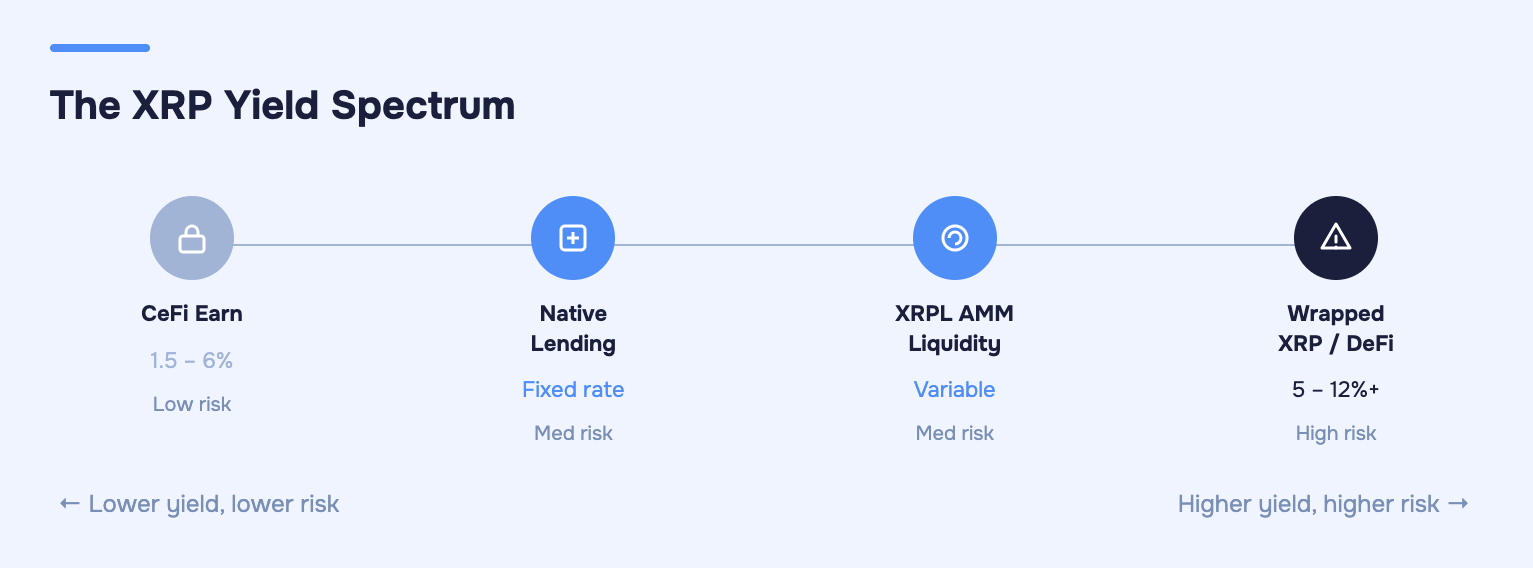
Typical APY range in 2026: 1.5% to 6%, depending on lock-up duration and platform
Nexo stands out for its daily compounding structure and tiered loyalty rates: holding the platform's native token can increase the interest rate on XRP deposits. Kraken appeals to users who prioritize regulatory compliance and transparent reserve practices, though this typically comes with lower published rates. Binance runs the largest XRP lending pool by volume, which gives it structural advantages in rate consistency.
You give up custody of your XRP. If the platform fails, faces a run on withdrawals, or is hacked, your funds are at risk. That is counterparty risk. It is the same exposure you take with a bank, without the deposit insurance.
Best for: Holders who want simplicity and are comfortable with platform-level risk in exchange for predictable returns.
2. XRPL Native AMM Liquidity Provision
The most established on-ledger yield option prior to the arrival of native lending. The XRPL added native AMM functionality as part of its ongoing protocol upgrades, letting holders earn yield without leaving the ledger or wrapping their assets.
How it works:
- You deposit two assets into a liquidity pool (e.g., XRP paired with RLUSD or another XRPL-issued token)
- Traders swap between those assets using the pool; each swap charges a fee
- Liquidity providers receive a proportional share of those fees
- Yield is variable and follows trading volume, not a fixed schedule
Well-known XRPL AMMs include Sologenic and XPMarket, both built on the ledger's native DEX infrastructure.
Typical APY range: Variable; low during quiet markets, higher during elevated trading activity
Key risks:
- Impermanent loss: If the two assets in your pool diverge significantly in price, you may end up with less value than if you had simply held both separately
- Volume dependency: Returns are driven entirely by trading volume through the pool, with no protocol floor
- Asset selection: The quality and liquidity of the paired asset matters as much as XRP's own price movement
Best for: Holders already active on the XRPL who are comfortable with variable returns and willing to monitor pool composition.
3. Wrapped XRP in External DeFi Ecosystems
Wrapping XRP lets holders access DeFi yield opportunities on other blockchains, at the cost of added technical complexity and additional risk layers. Wrapped versions of XRP (wXRP, FXRP, cbXRP) are tokens on other networks, each backed 1:1 by real XRP held in custody or locked in a smart contract.
Flare Network has become a real venue for XRP-adjacent DeFi. In February 2026, Flare enabled lending and borrowing for FXRP through an integration with the Morpho lending protocol, letting holders deposit FXRP to earn interest or use it as collateral to borrow stablecoins. Morpho's isolated market design keeps each lending pair separate, which limits contagion between positions.
On Ethereum-compatible chains, platforms like Aave and Compound have historically accepted wrapped XRP as collateral or a lending asset, though liquidity remains significantly lower than for major stablecoins or ETH.
Typical APY range: 5% to 12%+ during periods of high borrowing demand
Risks worth naming clearly:
- Bridge risk: Moving XRP to another chain requires trusting a bridge. If the bridge is exploited or pauses redemptions, your wrapped XRP can lose its peg
- Smart contract risk: External DeFi protocols carry code vulnerabilities that native XRPL transactions don't
- Custodial wrapper risk: Some wrapped XRP relies on a company holding real XRP. Legal trouble or a hack at the custodian can affect the token's value
Best for: Advanced users who understand bridging mechanics and are explicitly seeking higher yield in exchange for greater complexity and risk.
4. Native XRPL Lending Protocol (XLS-66d)
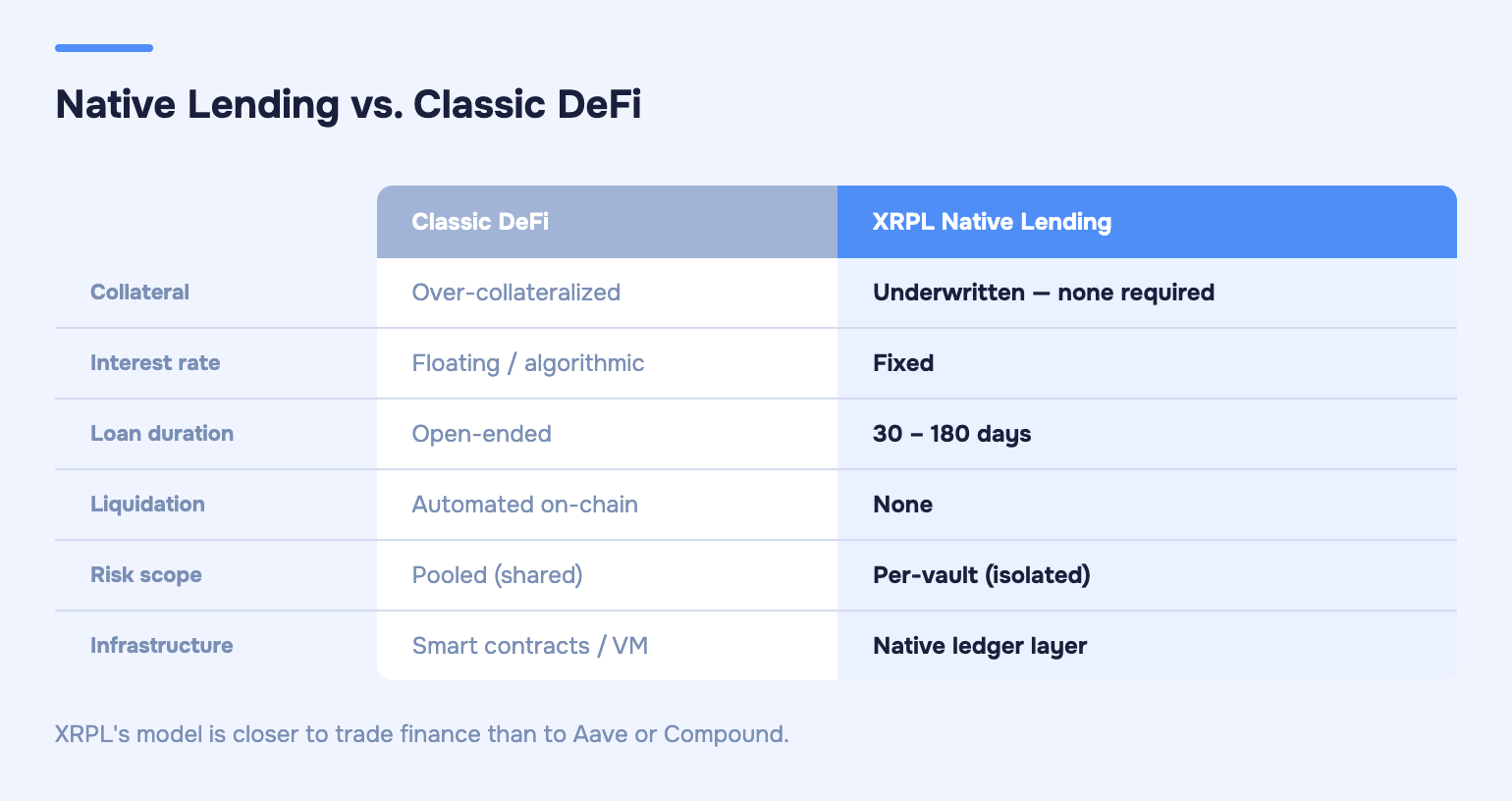
The biggest development for XRP yield in 2026 is the XRPL's own native lending protocol, a credit system built directly into the ledger itself. This is different from third-party DeFi lending: the lending logic sits inside the XRP Ledger through the XLS-66d amendment, with no dependency on external smart contracts.
In January 2026, the XLS-66d amendment entered validator voting following the release of XRPL v3.1.0. It introduces Single Asset Vaults (SAVs): isolated pools that hold one asset (XRP, RLUSD, etc.) and structure fixed-term, fixed-rate loans for institutional borrowers. Loan terms typically run 30 to 180 days. A default in one vault does not cascade to others.
Ripple engineer Edward Hennis described the protocol's design as "fixed-term, fixed-rate, underwritten credit," structured the way traditional credit markets work rather than the over-collateralized, liquidation-heavy model common in most DeFi.
What this means for XRP holders:
- Depositing into a public vault gives exposure to institutional borrowing demand: market makers, payment firms, treasury desks
- Yield comes from real credit demand, not token incentive programs or fee volume
- First-loss capital from loan brokers absorbs defaults before lender deposits are affected
- The ledger enforces loan terms, repayment schedules, and authorization directly, without a separate application layer
XRPL validator Vet described the protocol as a "liquidity pump" for the network, pointing to use cases like cross-border corridor funding and inventory financing for payment service providers.
LendProtocol is one of the first native XRPL lending protocols built on this infrastructure, an early mover on the XLS-66d framework. It gives XRP and RLUSD holders access to institutional credit demand through XRPL's SAV-based lending model, with yield accruing and compounding daily. LendProtocol's borrowers (market makers, payment service providers, fintech firms) don't post excessive collateral. Loans are fixed-term, fixed-rate, and underwritten off-chain, closer to trade finance than typical DeFi. For lenders: yield driven by real business borrowing demand, no lock-up periods, and the ability to withdraw at any time.
XRP Yield Methods Compared: 2026 Overview
| Method | Typical APY | Custody | Complexity | Key Risk |
|---|---|---|---|---|
| CeFi Earn (Binance, Nexo, etc.) | 1.5% to 6% | Platform holds XRP | Low | Counterparty / platform failure |
| XRPL AMM Liquidity | Variable | Self-custody | Medium | Impermanent loss, low volume |
| Wrapped XRP in DeFi (FXRP, wXRP) | 5% to 12%+ | Bridge / custodian | High | Bridge exploit, smart contract bug |
| XRPL Native Lending (XLS-66d) | Market-rate (fixed-term) | Protocol / vault | Medium | Credit default, liquidity mismatch |
APY ranges are approximate and based on publicly reported rates as of mid-2026. Actual returns fluctuate with market demand. This table is for informational comparison only.
What Actually Drives XRP Yield?
Unlike Ethereum staking, where yield comes from block rewards baked into the protocol, every form of XRP yield traces back to one of three sources:
- Borrowing demand. Someone needs XRP or stablecoins and is willing to pay interest for it. This is the most durable yield source, and it is what the XRPL native lending protocol is built to capture at institutional scale.
- Trading fees. AMM liquidity providers earn when traders use their pools. Real yield, but entirely dependent on volume, which can fall sharply in slow markets.
- Platform economics. CeFi earn programs pay from the platform's own lending and trading operations. You are trusting the platform's risk management in exchange for a fixed rate.
Token incentive rewards are a fourth source, but a temporary one. Platforms use them to bootstrap liquidity; the yields fade when the incentive budget runs out or emission schedules change. APYs driven primarily by incentive tokens often look attractive and disappear quickly. Before committing to any yield product, it's worth asking which of these four sources is actually paying you.
A Note on Risk That Most Guides Skip
A few things worth holding in mind before choosing a method:
- "XRP staking" is not a technically precise term. Platforms use it interchangeably for fundamentally different products. Always check what the yield is actually generated from.
- Higher APY is not better by default. A 10% yield from a poorly audited bridge is not superior to 3% from a well-capitalized CeFi platform or a native ledger vault. The comparison only holds when risk is constant.
- Lock-up terms differ significantly across methods. CeFi fixed-term products can lock XRP for 30 to 90 days. Native XRPL lending through LendProtocol has no lock-up: lenders can withdraw at any time, subject to available vault liquidity.
- The XLS-66d amendment is still early. Institutional adoption takes time. Vault TVL, loan origination volume, and borrower diversity are the numbers that will determine whether native XRPL lending becomes a significant yield source at scale.
How to Think About Earning XRP Yield in 2026
There is no single best method. The right choice depends on how much complexity you're willing to manage, how much counterparty risk you're comfortable with, and what return profile you're after.
What has changed in 2026 is the range of options available natively on the XRP Ledger itself. Holders no longer have to choose between bridging to Ethereum for yield or accepting whatever a centralized exchange offers. Native AMMs, the XLS-66d lending protocol, and platforms like LendProtocol have made it possible to keep XRP on its home ledger and still put it to work. Whether that is worth it compared to a simpler CeFi product depends on your priorities, not on any universal ranking.
The tools are there. Use the one that fits what you actually need.
This article is for informational purposes only and does not constitute financial advice. Cryptocurrency investments carry substantial risk, including the potential loss of principal. Always conduct independent research before making any financial decision.
FAQ
Can you stake XRP to earn rewards?
No. The XRP Ledger uses a Federated Byzantine Agreement (fBFT) consensus algorithm, not Proof of Stake, so there is no native staking mechanism. When platforms advertise "XRP staking," they mean lending, liquidity provision, or custodial earn programs — not protocol-level staking. The yield comes from a separate financial product, not from the ledger itself.
What is the best way to earn yield on XRP in 2026?
There is no single best method — it depends on your priorities. CeFi earn programs (Binance, Nexo, Kraken) offer 1.5–6% APY with the least complexity but require giving up custody. Native XRPL lending through platforms like LendProtocol offers fixed-rate yield from institutional borrowers with no lock-up period. XRPL AMM pools offer variable fee-based yield. Wrapped XRP in external DeFi offers the highest potential APY (5–12%+) but the most risk. Match the method to your risk tolerance, not just the advertised rate.
Is it safe to earn interest on XRP through centralized platforms?
It carries counterparty risk. When you deposit XRP on a CeFi platform, you give up custody. If the platform becomes insolvent, gets hacked, or freezes withdrawals, your funds are at risk. There is no deposit insurance equivalent in crypto. Platforms like Kraken and Binance have large reserve bases and regulatory oversight, which reduces — but does not eliminate — that risk. Always check whether the platform holds reserves transparently and whether its earn product is lending-based or exchange-funded.
What is the XRP Ledger native lending protocol and how does it work?
The XRPL native lending protocol (XLS-66d amendment) is a credit system built directly into the XRP Ledger, not a separate smart contract. It uses Single Asset Vaults (SAVs) — isolated pools holding one asset each — to fund fixed-term, fixed-rate loans for institutional borrowers. Loan terms run 30 to 180 days. Lenders deposit XRP or RLUSD into a vault and earn interest from borrowing demand. A loan broker manages underwriting and deposits first-loss capital as a default buffer. A default in one vault does not affect others.
What is impermanent loss and does it affect XRP AMM liquidity providers?
Impermanent loss happens when the two assets in a liquidity pool change in price relative to each other. If you deposit XRP paired with RLUSD and XRP's price rises significantly, the AMM rebalances the pool, leaving you with less XRP than you started with. The trading fees you earned may or may not offset that difference depending on volume. It affects any AMM liquidity provider on any chain, including XRPL. Pairing XRP with a stablecoin reduces but does not eliminate the effect.
What is wrapped XRP and what are the risks?
Wrapped XRP (wXRP, FXRP, cbXRP) is a token on another blockchain — Ethereum, Flare, or others — backed 1:1 by real XRP held in custody or a smart contract. Wrapping lets XRP holders access DeFi protocols on networks with broader smart contract ecosystems. The risks: bridge exploits can cause the wrapped token to lose its peg; custodians holding the underlying XRP can face legal or technical failures; smart contract vulnerabilities on the destination chain can result in loss of funds. Each additional layer between you and the native XRP adds a new failure point.