XRP Staking Rates 2026: What Platforms Are Actually Offering
XRP staking rates range from 0.5% to 12% APR depending on the platform — but the headline number is rarely the whole story. What's actually behind each rate, and what you're exposed to if a borrower defaults.
Here are the current XRP staking rates across the main platforms — with the conditions behind each headline and the three variables that actually determine what you earn.
The 2026 Platform Rate Comparison
XRP staking rates in 2026 range from 0.5% APR on large-exchange flexible products to 12% APR on dedicated lending platforms — a 24× gap that comes down to rate structure, lock-up terms, and who absorbs the loss when a borrower doesn't repay.
| Platform | Rate | Type | Lock-up | Conditions |
|---|---|---|---|---|
| LendProtocol | 12% APR (~12.75% effective annual) | Fixed | None | XRP or RLUSD; platform absorbs all borrower default risk |
| Nexo | Up to 8.25% APY | Variable | Flexible or 6-month term | Max rate requires 6-month lock + 2M NEXO token holding + NEXO-denominated payouts |
| Bitrue Power Piggy | ~1.5% APY | Variable | None | Must hold XRP during daily snapshot window to earn that day's yield |
| Binance Earn (Flexible) | ~0.5% APR | Variable | None | Resets frequently; sub-1% in practice |
| Binance Earn (Locked) | ~2% APR | Variable | 30 days | Higher rate, but no access during the term |
Rates as of September 2026, via XRP interest rate tracker. Variable rates subject to platform adjustments.
On 100,000 XRP, the difference between 0.5% and 12% is roughly 500 XRP versus 12,000 XRP earned per year. That spread is real — but so are the conditions behind it. The platforms in this table are not offering the same product at different prices. They are offering structurally different products that happen to be compared on the same metric. A broader market map is in the XRP lending rates guide.
Three Differences That Explain the Gap
1. Fixed vs. variable rate. Variable XRP staking rates track the demand for XRP borrowing. When borrowing demand falls — during quieter markets, for instance — yield compresses, sometimes to near zero. Fixed rates hold regardless of conditions, but require a platform willing to absorb that commitment over the life of the loan. One platform in this comparison offers a fixed rate; the rest adjust dynamically.
2. Lock-up and actual liquidity. Nexo's 8.25% APY headline is a max-tier rate, not a default one. Reaching it requires three simultaneously stacked conditions: a six-month term lock, a holding of 2 million NEXO tokens in your account, and receiving your interest payments in NEXO rather than XRP. Each condition introduces its own exposure — term illiquidity, NEXO price risk, and single-asset concentration. The base Nexo flexible rate without these requirements is considerably lower. Exchange products from Binance and Bitrue offer better withdrawal access, but compress yield to reflect that liquidity.
3. Who absorbs default risk. This is the variable that rarely appears in rate comparisons and matters most. Some platforms pool depositor funds and distribute default losses across that pool — if a borrower fails to repay, the shortfall is shared among depositors. Others act as the principal in every loan, covering defaults from their own reserves before depositors are affected. The difference doesn't show up in the APR column. It shows up when something goes wrong.
Platform Profiles: What You're Actually Signing Up For
LendProtocol is a fixed-rate XRP lending platform built on the XRP Ledger. Depositors lend XRP or RLUSD; borrowers post 120% collateral — in BTC, ETH, SOL, XRP, RLUSD, or USDT — to access loans. If a borrower defaults, LendProtocol covers the loss, not the depositor. The stated rate is 12% APR, fixed, paid daily, with no lock-up. At daily compounding, that works out to an effective annual yield of approximately 12.75%. Assets sit in cold storage; all accounts require 2FA; data at rest is encrypted with AES-256 GCM. The platform has facilitated over 743 million XRP in loans across 13,713+ active lenders.
For RLUSD holders, the same rate and terms apply — 12% APR on Ripple's fully-backed USD stablecoin, removing XRP price exposure while keeping the yield.
Nexo is a broader CeFi platform — lending, borrowing, an exchange, and a credit card product built around a loyalty-tier model. XRP earn rates are competitive in the upper tiers but require meeting those stacked conditions. For holders who don't want NEXO exposure or a six-month lock, the effective rate is lower than the headline.
Binance and Bitrue offer XRP yield as one feature among many on large trading exchanges. The rates are thin but the access is seamless for holders already on those platforms. Neither is built for yield optimization; both are convenient if the priority is simplicity over return.
One Thing Every Platform Has in Common
None of them are actually offering staking. XRP cannot be staked — the XRP Ledger runs on Federated Byzantine Agreement (fBFT) consensus, not Proof-of-Stake, so there are no protocol-level validator rewards distributed to token holders. What every platform in this comparison is doing is lending: your XRP goes to borrowers who pay interest, and the platform passes some or all of that interest back to you. If you are choosing a destination rather than comparing rates, see best place to stake XRP.
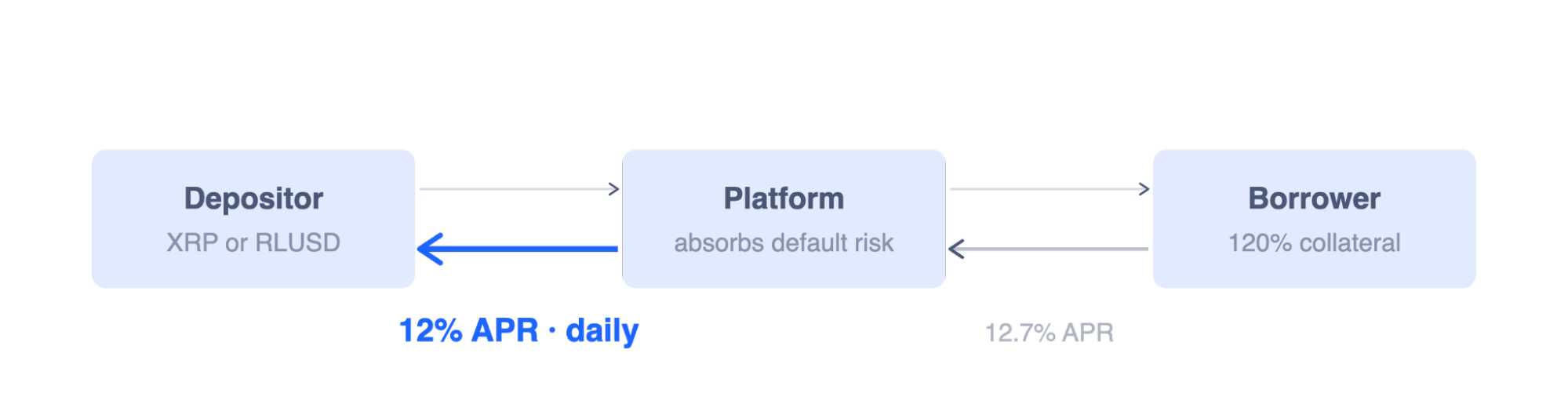
The word "staking" in this context is a convention — widely used, broadly understood to mean "earning yield on idle crypto," and technically incorrect. It matters because it reframes what you're evaluating. The relevant questions are not about validator uptime or network security. They are: who is borrowing, what collateral backs the loan, and what happens to your deposit if repayment fails.
FAQ
Can you stake XRP?
No. XRPL uses Federated Byzantine Agreement consensus, not Proof-of-Stake. There are no native staking rewards. "XRP staking" on platforms refers to lending or yield products — not a blockchain-level function.
What are the best XRP staking rates in 2026?
The highest fixed XRP staking rate in 2026 is 12% APR — no lock-up, paid daily, with platform-assumed default risk. Variable rates from Nexo reach up to 8.25% APY with conditions; exchange flexible products typically sit under 2%. For a detailed breakdown of XRP staking alternatives and how each platform handles depositor risk, the differences go deeper than the APR.
How are XRP staking rewards paid?
It depends on the platform. LendProtocol pays XRP staking rewards daily, in XRP. Binance Earn pays daily or at term end depending on the product. Nexo's highest-tier payouts are denominated in NEXO tokens rather than XRP.
Why do rates vary so much across platforms?
Rate variation reflects structural differences: fixed versus variable rates, who bears default risk, and whether the platform is purpose-built for lending or offers yield as a secondary product. Exchanges optimize for trading volume; dedicated lending platforms optimize for yield.