XRP Passive Income: Real Methods vs Hype
Learn how to make money with XRP through lending, AMM pools, and RLUSD yield — plus which high-APY products are too good to be true.
XRP holders face a problem that most crypto investors don't: the asset they hold can't be staked. Not because staking products aren't available — they are — but because the XRP Ledger runs on a consensus algorithm, not proof-of-stake, so there's no on-chain staking mechanism to begin with. Any product marketed as "XRP staking" is actually something else wearing a friendlier label.
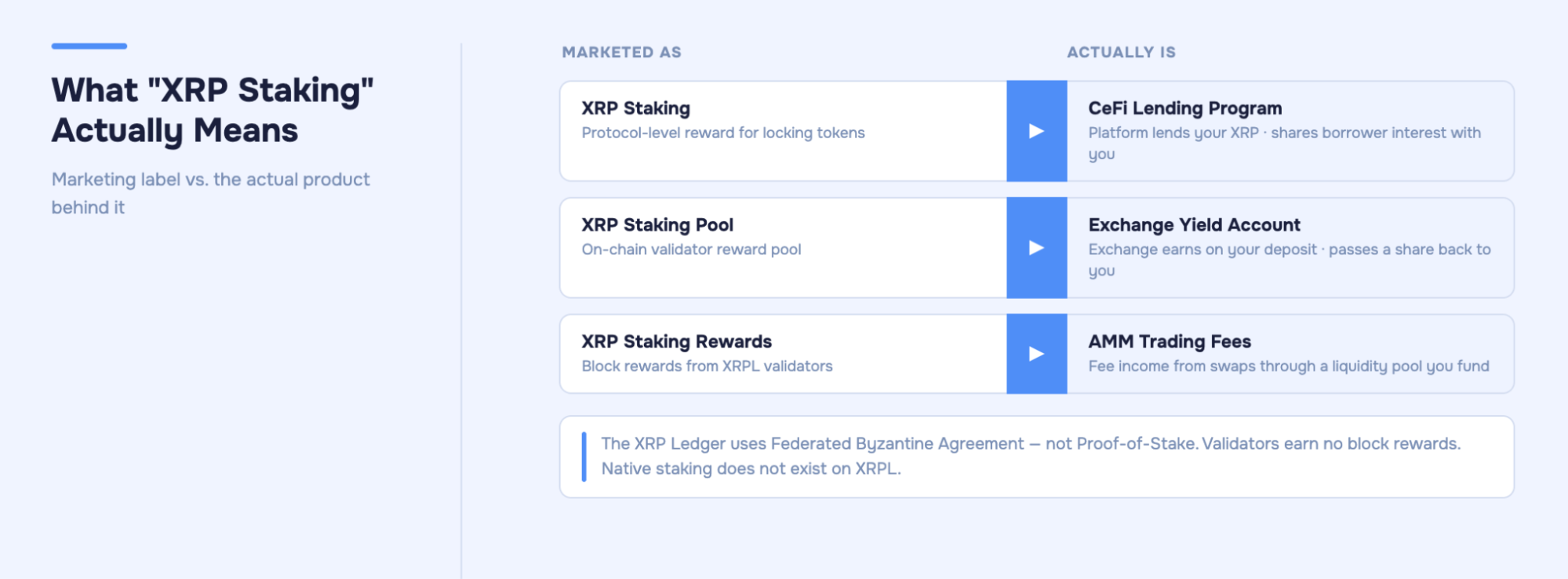
That gap between what's advertised and how these products actually work is where most of the confusion — and some of the real risk — lives. This article breaks down every major method for generating XRP passive income, what's genuine, what's overstated, and what has no legitimate basis at all.
Why XRP Doesn't Actually Stake
XRP can't be staked because the XRP Ledger doesn't use proof-of-stake. The network runs on Federated Byzantine Agreement (fBFT), where a set of trusted validators reach consensus on transaction order without any financial stake backing their participation. Validators don't earn block rewards. There's nothing to lock up, no reward pool to draw from, no protocol-level yield.
This means every product labeled "XRP staking" is off-chain. The yield doesn't come from the network — it comes from someone else: a lending platform, an exchange running a yield program, or a DeFi protocol via a wrapped token.
That's not inherently a problem. Off-chain yield is real. But understanding where it comes from — and who holds the risk — is exactly what separates genuine methods from hype.
The Real Methods for XRP Passive Income
1. Lending Platforms (CeFi)
The most direct route to XRP passive income is depositing into a centralized lending platform. The platform lends your XRP to borrowers — typically institutional counterparties or margin traders — and shares the interest with you.
This is genuine yield from a real economic activity: borrowing demand. The rate you earn reflects what borrowers are willing to pay to access liquidity, minus the platform's operating margin.
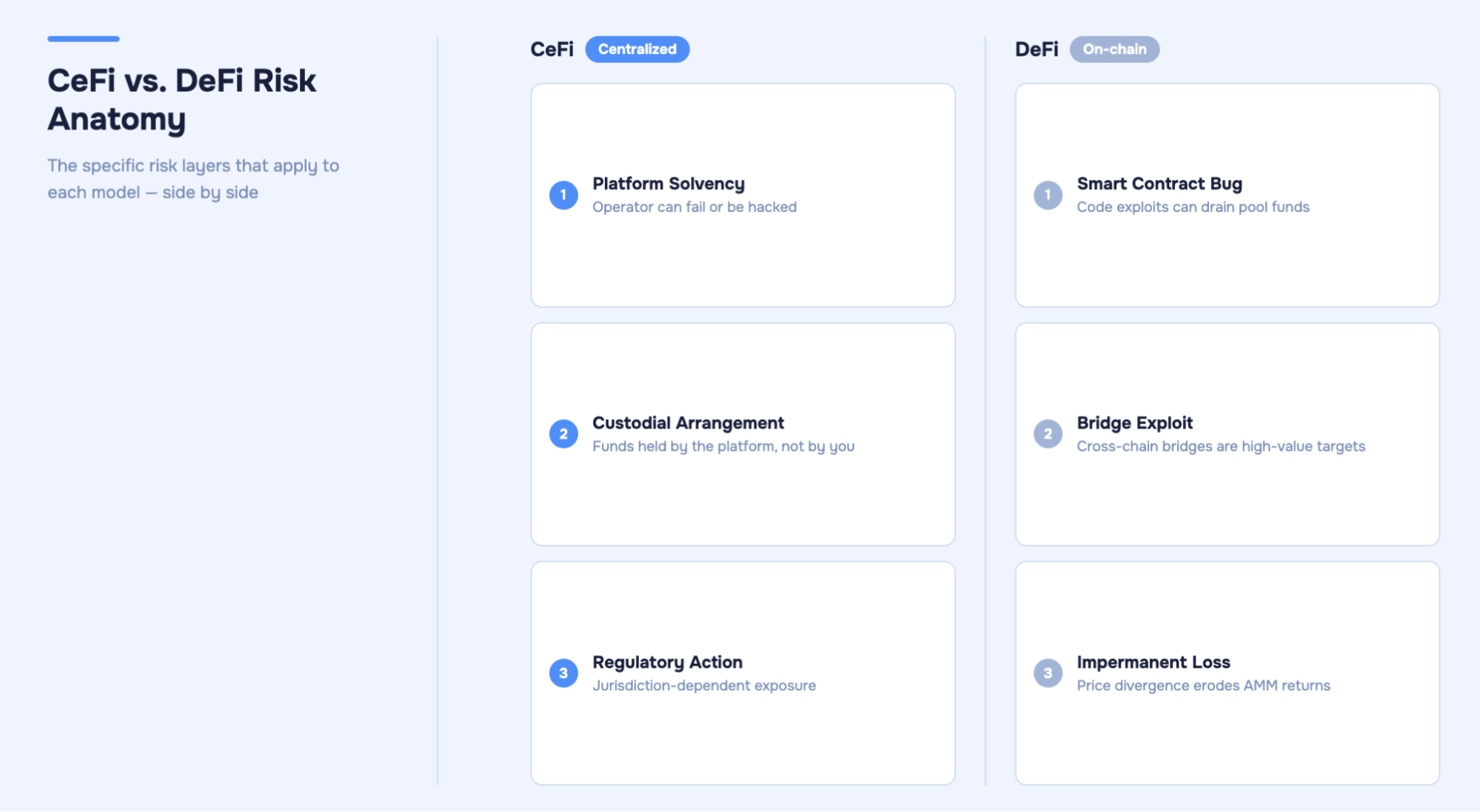
The risk is platform risk. If the platform becomes insolvent or gets hacked, your funds are exposed. This is why the platform's collateral requirements and risk model matter more than the advertised rate. An overcollateralized lending model — where borrowers must post more in collateral than they borrow — provides a meaningful buffer that undercollateralized or unsecured models don't.
LendProtocol, a CeFi lending platform built natively on the XRP Ledger, runs on exactly this structure. Borrowers post 120% of the loan value in collateral (BTC, ETH, SOL, XRP, RLUSD, or USDT), and the platform itself absorbs default risk — depositors don't. The result is a fixed 12% APR with daily payouts and no lock-up. With more than 13,700 active lenders and 743 million XRP lent to date, it's the most established native yield product on the XRP Ledger.
Key risks: Platform solvency, regulatory exposure, custodial arrangement.
2. XRPL Native AMM Pools (DeFi)
The XRP Ledger's built-in automated market makers are a legitimate, fully on-chain way to earn yield. You deposit a pair of assets into a liquidity pool and earn a proportional share of every trading fee generated by swaps through that pool.
XRPL AMM pools are a native feature of the ledger itself, not smart contracts layered on top. This eliminates the class of vulnerabilities — contract bugs, admin key exploits, upgrade risks — that affect smart-contract-based AMMs on other networks. The pools run under the same consensus mechanism that has secured the XRP Ledger since 2012.
The catch is impermanent loss. When the price ratio between the two assets in your pool shifts after you deposit, your position can be worth less than if you'd simply held both assets separately. The loss only materializes when you withdraw, and fee income can offset it — but on volatile pairs, impermanent loss can outpace earnings. XRP-stablecoin pairs are the most practical starting point for this reason: at least one side of the pair holds a stable value.
Liquidity providers set and vote on pool fees proportional to their LP token holdings, with fees typically ranging from 0.1% to 1% per trade. Actual APY varies entirely with trading volume through the pool — there's no fixed rate.
Key risks: Impermanent loss, token risk on the non-XRP side of a pair, variable returns.
3. Earning on RLUSD
RLUSD is Ripple's fully-backed, regulated USD stablecoin on the XRP Ledger. For holders who want yield without exposure to XRP's price movements, RLUSD is the more straightforward option.
Lending platforms operating on XRPL support RLUSD deposits alongside XRP. LendProtocol accepts both at the same 12% APR — meaning a holder earns meaningful yield on a dollar-pegged stablecoin without touching any price-volatile asset. That's relevant not just for retail holders but for institutional treasury teams that need yield on idle stablecoin balances between operational settlements. Keeping RLUSD productive on-chain, rather than moving it off the ledger between uses, also contributes to RLUSD's liquidity depth on XRPL.
Key risks: Platform risk, RLUSD peg (though it is fully backed and regulated).
4. Wrapped XRP on Other Chains (DeFi — Higher Risk)
Some protocols allow XRP holders to bridge their assets to other blockchains via wrapped tokens, then participate in DeFi yield farming on those chains. This is real, but the risk profile is substantially different from the previous methods.
Bridging XRP to another network introduces bridge risk: the smart contract or protocol connecting the two chains is an additional point of failure. Bridge exploits are historically among the most costly incidents in crypto — when a bridge is compromised, the wrapped tokens it backs can lose their value entirely.
Yields in this category can be higher, but the risk is correspondingly elevated. This approach is only appropriate for holders who understand bridge mechanics and are explicitly willing to accept smart contract exposure in exchange for potentially higher returns.
Key risks: Bridge exploits, smart contract vulnerabilities, liquidity risk, impermanent loss on DeFi pools.
What's Hype: The Methods That Don't Hold Up
"XRP Staking" Labels
When a platform offers "XRP staking," they're offering a lending or yield product with a more familiar label. The underlying product may be fine — the problem is the expectation the word sets. Holders who assume they're participating in a protocol-secured staking mechanism may underestimate the custodial and platform risk that actually applies. Always look past the label to understand the actual mechanism: where does the yield come from, who holds the collateral, and who absorbs losses if a borrower defaults?
Platforms Advertising 50%+ APY
During research for this article, content appeared in search results advertising 88% APY on XRP through claimed XRPL AMM integration. This is not credible. XRPL AMM pools earn trading fees — returns depend on pool trading volume and cannot produce anything close to 88% APY at any meaningful scale. Platforms advertising returns that high without a transparent, auditable mechanism for generating them are either structurally unsound or fraudulent. Do not deposit funds into any platform that cannot explain specifically and verifiably where the yield originates.
A useful heuristic: if an APY would double your money in under a year and the platform cannot explain its borrower base, collateral structure, or fee mechanism in plain terms — the risk of total loss is real.
Airdrops as a Passive Income Strategy
Airdrops can add value for long-term XRP holders, but treating them as reliable income is a mistake. They're intermittent, unpredictable, and in many cases amount to tokens with no established value. They're a bonus — not a strategy.
Comparison: XRP Passive Income Methods at a Glance
| Method | Yield Source | Typical APY | Lock-up | Key Risk | Custody |
|---|---|---|---|---|---|
| CeFi Lending (overcollateralized) | Borrower interest | 12% | None | Platform solvency | Platform cold storage |
| CeFi Lending (general) | Borrower interest | 3–8% | Optional | Platform solvency | Custodial |
| XRPL AMM Pools | Trading fees | Variable | None | Impermanent loss, token risk | Non-custodial (on-chain) |
| RLUSD Lending | Borrower interest (stablecoin) | ~12% | None | Platform risk, peg risk | Platform-held |
| Wrapped XRP DeFi | Farming rewards, fees | Variable, higher | Varies | Bridge exploits, smart contracts | Bridged (non-custodial) |
| High-APY unverified products | Unknown | Advertised only | — | High probability of loss | Unknown |
How to Make Money With XRP: A Practical Decision Framework
The right method depends on three variables: how much counterparty risk you're willing to accept, whether you want on-chain control or are comfortable with a custodial arrangement, and whether price-stable yield matters more than maximizing nominal APY on XRP itself.
- Lowest friction, fixed yield: CeFi lending with no lock-up and daily payouts. Read the terms closely — specifically whether the platform or the depositor absorbs default losses. That single detail changes the risk profile entirely.
- On-chain, no custody: XRPL AMM pools. Understand impermanent loss before committing, favor pairs where you're comfortable holding both assets, and size the position to match your risk tolerance.
- Price-stable yield: RLUSD lending. The nominal rate is the same as XRP lending on platforms like LendProtocol, but dollar-denominated yield removes XRP price movement from the equation — your real return doesn't depend on what XRP does.
- Higher yield, higher risk: Wrapped XRP on other chains. Appropriate only for holders who understand bridge mechanics and are accepting smart contract exposure deliberately.
None of these is inherently better or worse — they represent genuinely different tradeoffs between yield, risk, and control.
The Bottom Line
XRP passive income is real — but it requires being precise about what you're actually doing. Lending generates interest from borrower demand. AMM pools generate fees from trading volume. Wrapped-token DeFi generates yield from liquidity provision across chains. None of it is "staking," and the risk profiles are genuinely different from each other.
The biggest mistake XRP holders make when thinking about how to make money with XRP isn't choosing the wrong yield method — it's treating rate as the only variable and ignoring who holds the risk, where the yield comes from, and what happens when something goes wrong.
Pick the mechanism that fits your risk tolerance, verify how the platform you're using actually generates yield, and don't deposit into anything that can't answer that question clearly.
FAQ
Can XRP be staked?
No, not in the technical sense. The XRP Ledger uses Federated Byzantine Agreement, which doesn't distribute staking rewards. Products marketed as "XRP staking" are lending or yield programs run by third-party platforms — not protocol-level staking.
What is the highest realistic APY for XRP passive income?
CeFi lending platforms currently offer 8–12% APR on XRP, with the higher end coming from overcollateralized models like LendProtocol's 12% fixed rate. AMM pools are fully variable. Anything advertising materially above 15% APY without a transparent, auditable mechanism is a red flag.
How do I make money with XRP without selling it?
Deposit into a CeFi lending platform that accepts XRP and pays regular interest on your balance, or provide liquidity to an XRPL AMM pool. Both let you maintain your XRP position while earning yield on it.
Is RLUSD a better option than XRP for earning yield?
For holders who don't want price exposure, yes. RLUSD earns the same rate as XRP on most platforms but removes the variable of XRP price movements from the result. A 12% APR on a dollar-pegged asset is a predictable dollar return; 12% APR on XRP includes both interest income and underlying price change.
What risk is most often underestimated?
Platform solvency for CeFi, and impermanent loss for AMM pools. Platform risk gets underweighted because a platform looks stable until the moment it doesn't. Impermanent loss gets skipped because the mechanism is counterintuitive — it's mathematically guaranteed to occur whenever paired assets diverge in price, and the question is only whether fee income compensates for it.
Does LendProtocol use the XRP Ledger's native XLS-66 lending protocol?
No. LendProtocol is a CeFi product that uses the XRP Ledger as its settlement and custody layer. It operates its own lending model — overcollateralized at 120%, with the platform absorbing default risk. The XLS-66 standard is a separate open protocol developed by the XRPL community for uncollateralized institutional lending. These are distinct products.