Staking XRP: What Actually Works in 2026
XRP doesn't have a native staking mechanism, but that doesn't mean your XRP has to sit idle. This guide breaks down why staking XRP isn't possible, compares every real yield option on the market, and shows you how to start earning a fixed 12% APR today.
You can't stake XRP the way you stake Ethereum or Solana. The XRP Ledger has no staking layer, so any "XRP staking" product is actually lending, custody, or liquidity provision by another name. The real way to earn on idle XRP is to lend it, and platforms like LendProtocol pay a fixed 12% APR for exactly that.
That mismatch matters before you put money anywhere. Knowing why staking doesn't exist stops you from paying for a label instead of a rate. Once you can see what each "XRP staking" product actually is, comparing them against each other gets a lot easier.
What Does "Staking XRP" Actually Mean?
Staking XRP is not possible: the XRP Ledger doesn't use the Proof-of-Stake consensus model that staking depends on. When people search "staking XRP," they're almost always looking for a way to earn passive yield on holdings, and that's a real, solvable problem, just not one solved through staking.
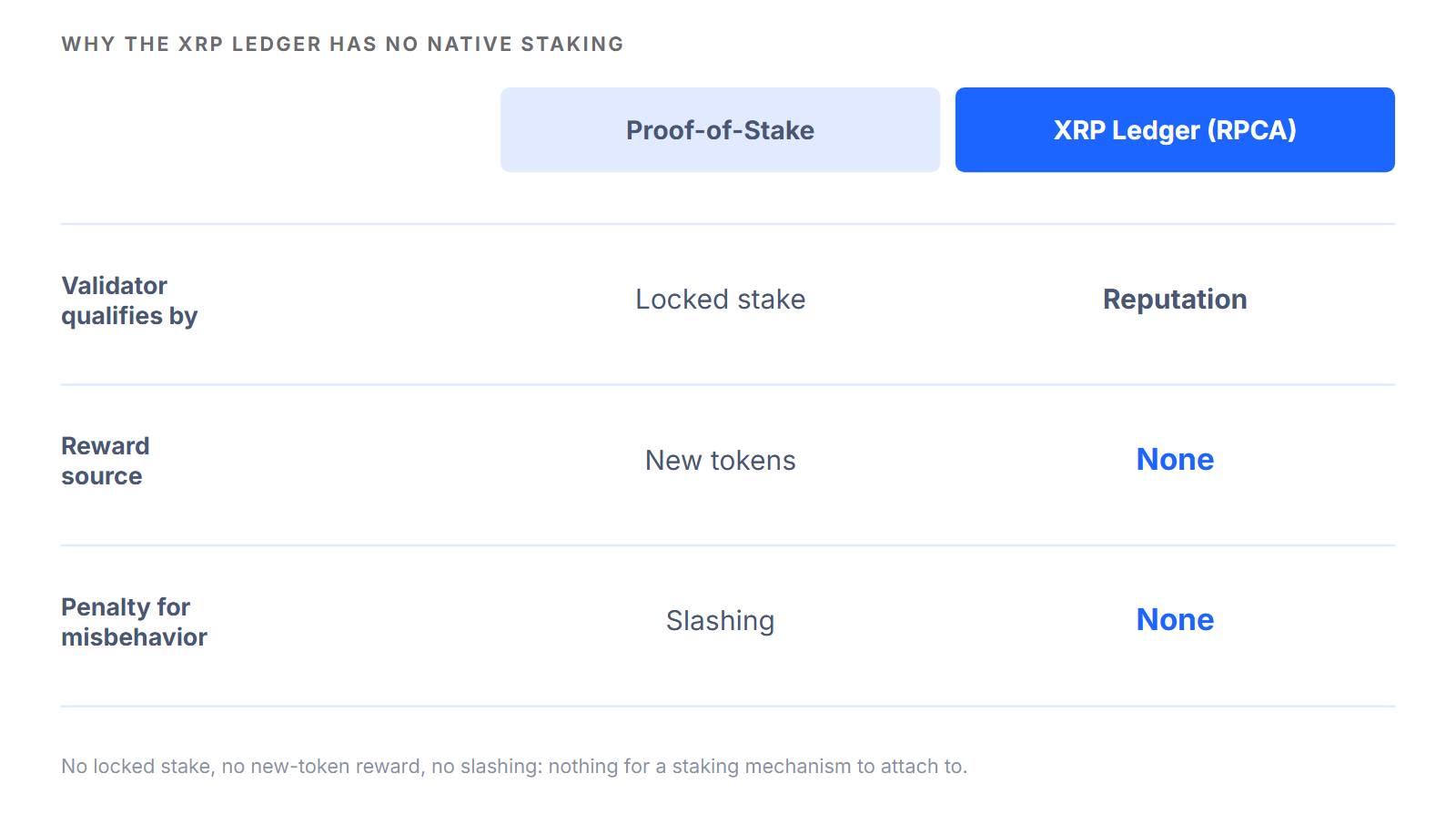
Proof-of-Stake networks like Ethereum let validators lock up (stake) tokens as collateral to earn the right to validate transactions, and they're paid newly issued tokens as a reward. The XRP Ledger (XRPL) was built differently from day one. It uses the Ripple Protocol Consensus Algorithm (RPCA), a form of federated Byzantine Agreement, where a trusted set of validators confirms transactions by voting, not by locking capital. No stake, no slashing, no protocol-level reward. That's a deliberate design choice: RPCA settles transactions in three to five seconds at near-zero cost, without the energy or capital lockup that Proof-of-Stake requires.
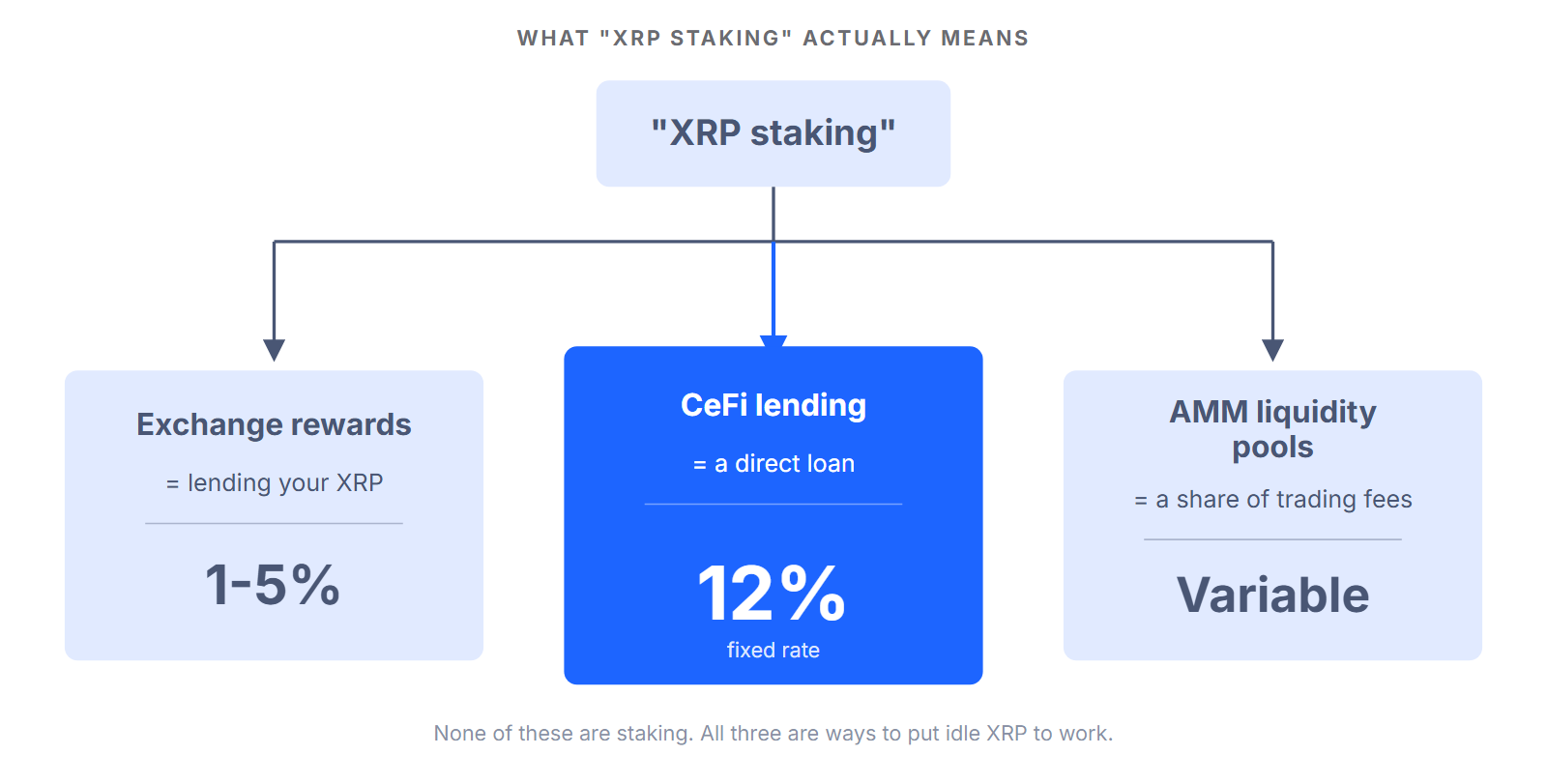
So when a search result or exchange banner talks about an "XRP staking" program, it's using the word loosely. Underneath, your XRP stake is being lent out, pooled into liquidity, or held in a custodial interest account. The yield comes from that activity, not from network consensus.
Why the XRP Ledger Has No Native Staking Mechanism
The short answer: RPCA consensus doesn't need staked capital to secure the network, so there was never a technical reason to build one in. Validators on the XRPL earn trust through reputation and uptime, not locked tokens, and no new XRP is minted to pay out staking rewards: the total supply was fixed at genesis.
This isn't a gap Ripple has ignored, either. J. Ayo Akinyele, RippleX's head of engineering, has outlined conceptual frameworks for native staking on the XRPL, and Ripple CTO David Schwartz has floated a dual-layer consensus model as one possible design. But the RippleX team has been explicit that this is a trade-off discussion, not a proposal: no concrete staking mechanism is scheduled for implementation as of August 2026.
Closer to activating is something different: XLS-65 and XLS-66, a pair of proposed amendments that would add native, uncollateralized institutional lending directly to the ledger. As of early August 2026, those amendments are still in validator voting (around 40% and 37% support respectively, against the 80% threshold required for activation) and haven't gone live on mainnet. That's also a separate product from the consumer-facing CeFi lending platforms already operating on top of the XRPL, which aren't implementations of the XLS-66 standard. More on that distinction in the FAQ below.
Until (or unless) something like that activates, "staking XRP" in the network-native sense stays theoretical. Every yield product available today sits outside the protocol layer.
How to "Stake" XRP Today: Your Real Options
Since native staking doesn't exist, your real choices for earning yield on XRP fall into three categories: centralized exchange "earn" programs, decentralized liquidity provision, and CeFi lending platforms, each with a different risk and return profile. None of them are staking in the technical sense, but all of them put idle XRP to work.
Centralized exchange rewards programs are the most visible option. Exchanges like Nexo, YouHodler, and Kraken run auto-earn or rewards products that call themselves "staking" for marketing familiarity, typically paying in the 1-5% range. Kraken's own support pages, for example, list XRP rewards with no lock-up requirement and rates that vary by region, often under 1% APY, paid out weekly. Under the hood, the exchange is lending or deploying your XRP, not staking it on-chain. Unlike a platform that states its lending mechanics upfront, you usually can't see where that yield is actually coming from.
Decentralized liquidity provision works differently. XRPL's native Automated Market Maker (AMM) went live in 2024, letting XRP holders deposit into liquidity pools and earn a share of trading fees. Returns here are variable (dependent on pool volume, asset pair, and fee tier) and carry impermanent loss risk if the price of XRP moves relative to the paired asset.
CeFi lending platforms are where LendProtocol operates. Instead of pooling your XRP into a liquidity market, it lends deposits directly to overcollateralized borrowers and pays you a fixed rate for supplying that capital. It's the closest thing to a "set it and forget it" yield product for XRP holders who want a predictable number rather than a variable one.
| Option | Typical yield | Rate type | Lock-up | Who bears default risk |
|---|---|---|---|---|
| Fixed-rate CeFi lending | 12% APR (~12.75% effective) | Fixed | None | The platform |
| Centralized exchange rewards (e.g., Nexo, YouHodler, Kraken) | 1-5% | Variable | Varies by platform | Exchange / pooled |
| AMM liquidity provision | Variable | Variable | None, but exit risk | Liquidity provider |
| Traditional bank savings | 0.5-4.5% | Variable | None | N/A (insured, low yield) |
Lined up, the case for fixed-rate lending over a variable exchange "staking" plan comes down to two things: you know the number before you commit, and you're not exposed to a pool that dilutes as more depositors chase the same yield.
How to Stake XRP on LendProtocol: A Step-by-Step Guide
Getting started takes four steps: deposit XRP or RLUSD, the platform matches your funds with an overcollateralized borrower, you earn 12% APR paid daily, and you can withdraw at any time with no lock-up. There's no validator setup, no minimum staking period, and no smart contract to interact with directly. More than 13,700 lenders have already deposited a combined 743 million XRP this way.
- Deposit XRP or RLUSD. You choose the asset: XRP if you want exposure to price upside, RLUSD if you'd rather earn yield without volatility.
- The platform matches your deposit with a borrower. Borrowers post BTC, ETH, SOL, XRP, RLUSD, or USDT as collateral at a 120% ratio before receiving a loan: a $10,000 loan requires $12,000 in posted collateral.
- Your XRP stake starts earning immediately. You're paid 12% APR, compounded and paid out daily, which works out to roughly 12.75% effective annual yield.
- Withdraw whenever you want. There's no lock-up period. On repayment, your principal and accrued interest return to you. If a borrower defaults, the platform, not you, absorbs the loss.
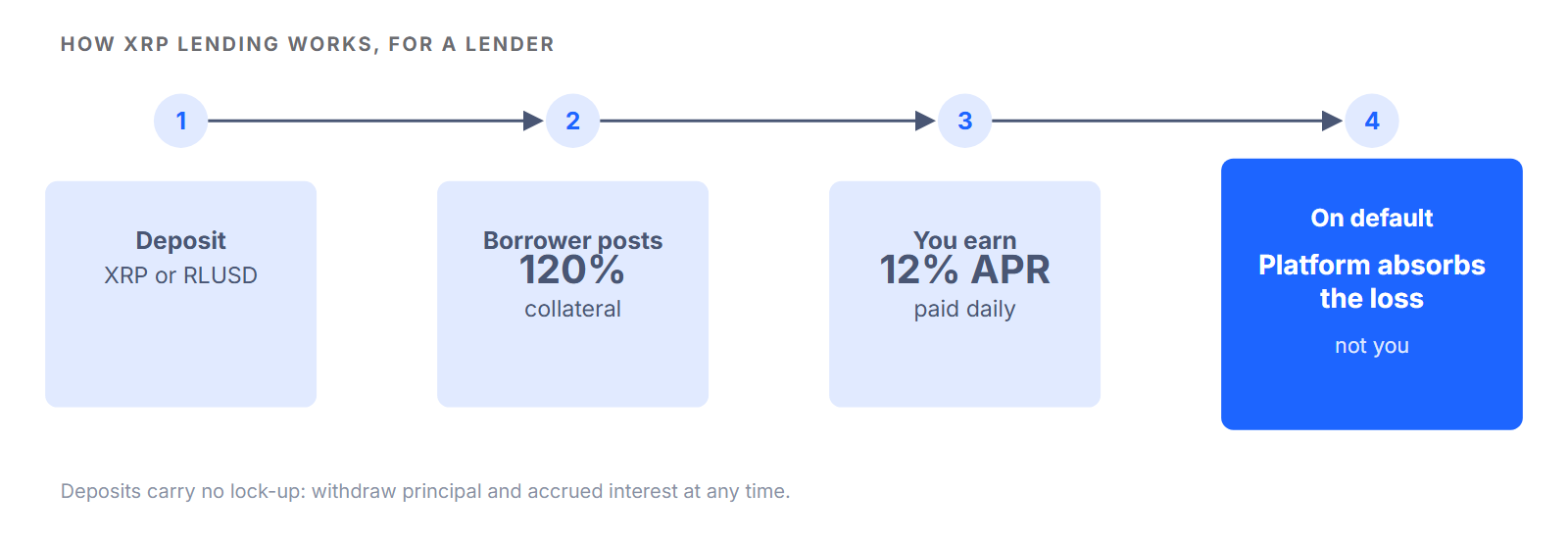
That last point is the structural difference between this model and most DeFi lending markets. In protocols like Aave or Compound, default risk is shared across the depositor pool. Here, the platform is the counterparty: it takes on the credit risk itself and pays lenders a fixed rate regardless of what happens with any individual loan, funded by the 0.7% spread between what borrowers pay (12.7%) and lenders receive (12%).
XRP Staking Rewards Compared: What Yield Can You Realistically Expect
Yield on XRP ranges from under 1% on a traditional savings account to a stated 12% APR through fixed-rate CeFi lending, with most alternatives (exchange rewards programs and AMM pools) landing in the low single digits or fluctuating unpredictably. The gap is large enough that it's worth understanding what drives it before choosing where to park capital. Running your own numbers through an XRP yield calculator turns these percentages into an actual dollar figure for your deposit size.
| Product category | APR / yield range | Rate type |
|---|---|---|
| Fixed-rate lending (lender side) | 12% (fixed, ~12.75% effective annual) | Fixed |
| Fixed-rate lending (borrower side) | 12.7% | Fixed |
| Wrapped DeFi lending | 2-8% | Variable |
| AMM liquidity provision | Variable | Variable |
| Centralized exchange rewards | 1-5% | Variable |
| Traditional bank savings | 0.5-4.5% | Variable |
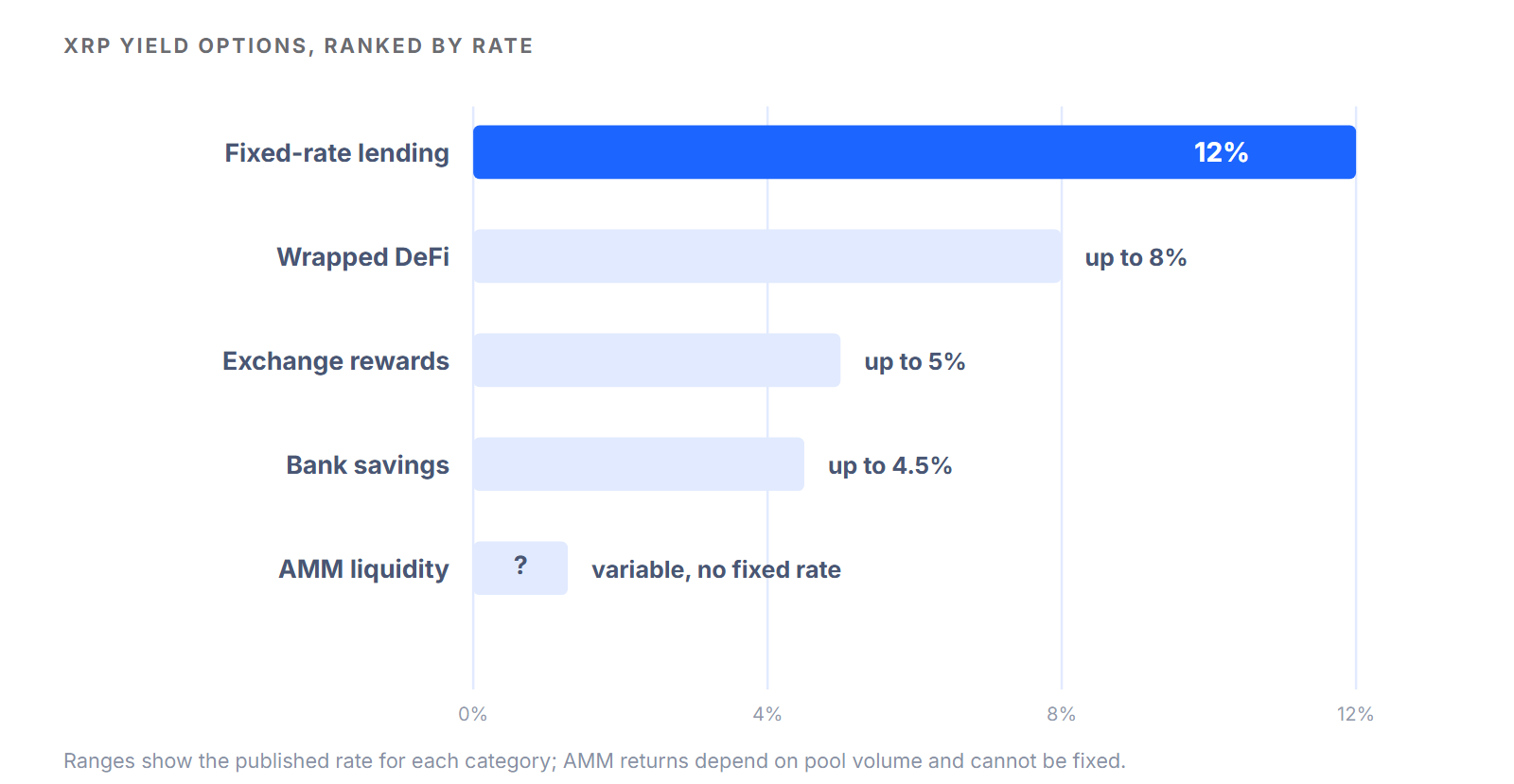
Note that the 12% rate above is a stated offer, not a guaranteed return in perpetuity. Rates on any yield product can be revised going forward, and this table isn't a promise of future performance. But relative to the alternatives above, it's the highest fixed rate currently available specifically for XRP and RLUSD holders.
Risks to Understand Before You Stake XRP
The main risks in any XRP staking-style product are counterparty risk (can the platform pay out what it owes you), custody risk (who actually holds the keys), and market risk (XRP's price can move independently of your yield). None of these risks disappear just because a product calls itself "staking." Understanding who holds your assets and who absorbs losses matters more than the label, and a due diligence guide for XRP lending platforms walks through the specific questions worth asking before you deposit.
- Counterparty and custodial risk. Any centralized product, whether an exchange or a lending platform, requires trusting that entity's solvency and security practices. Ask how assets are stored, what encryption standards protect account data, and whether two-factor authentication is enforced. The platform covered in this guide, for example, keeps the majority of deposits in cold storage, encrypts account data with AES-256 GCM, and requires 2FA on every account.
- Collateral and default risk. In a lending model, ask what collateral ratio borrowers must post and who absorbs losses if a borrower defaults. A 120% overcollateralization ratio, for instance, provides a cushion against price volatility before a default becomes a net loss for the platform.
- Price volatility. Staking or lending XRP doesn't hedge against XRP's price moving against you. If price stability matters more than upside, a USD-pegged asset like RLUSD removes that variable while still earning yield.
- Regulatory and terminology risk. Because "staking" is used loosely across the industry, always check whether a product is actually staking (network-level, non-custodial) or a custodial interest/lending program before assuming how your funds are being used.
RLUSD: The Stablecoin Alternative to XRP Staking
If price exposure is the part of XRP staking you're not comfortable with, RLUSD offers the same 12% APR without it. RLUSD is Ripple's fully-backed, regulated USD stablecoin, native to the XRP Ledger, and it's accepted as both a deposit asset and loan collateral on the platform.
For a lender, that means capturing the same fixed yield as XRP without exposure to XRP's price swings. That's a meaningful distinction for risk-averse depositors and institutional treasury teams managing idle balances. For borrowers, RLUSD collateral means access to liquidity without needing to sell stablecoin holdings outright. It's a bigger deal than it sounds: giving institutions a reason to keep RLUSD balances on the XRPL between settlements supports the stablecoin's broader adoption, not just individual yield-seeking.
The Bottom Line
There's no such thing as staking XRP in the technical sense. Any platform telling you otherwise is repackaging a lending or custodial product under a more familiar name. That's fine to know going in: it just changes the question from "where do I stake XRP" to "which yield product offers the best rate for the risk I'm willing to take."
By that measure, a fixed 12% APR, daily payouts, no lock-up, and a platform that absorbs default risk instead of passing it to depositors is hard to match against exchange rewards programs paying low single digits or variable DeFi pools with no rate certainty at all. LendProtocol was built specifically to answer the fact that XRP can't be staked: it turns idle XRP and RLUSD into a working, yield-generating asset without requiring you to bridge to another chain or hand over custody to a black box.
If you're holding XRP or RLUSD and it's sitting idle, depositing it here is the most direct way to put it to work today.
FAQ
Can you stake XRP directly on the XRP Ledger?
No. The XRP Ledger uses RPCA consensus, not Proof-of-Stake, so there's no native staking mechanism and no protocol-level reward for holding or locking XRP.
Is XRP staking safe?
"XRP staking" products are custodial lending or rewards programs, so safety depends on the platform, not a blockchain staking mechanism. Check custody practices (cold storage, encryption), collateralization requirements, and who bears default risk before depositing.
What's the best way to earn yield on XRP in 2026?
Among current options, fixed-rate CeFi lending offers the highest and most predictable returns for XRP holders. A 12% APR is well above the 1-5% typical of exchange rewards programs and the 2-8% range of variable DeFi lending markets.
Will the XRP Ledger ever get native staking?
Possibly, but not yet. RippleX engineers have floated conceptual frameworks for native staking without a concrete implementation timeline, and the separate XLS-65/XLS-66 lending amendments remain in validator voting as of August 2026. Neither is live on mainnet.
Is XRP staking the same as XRPL's new lending protocol (XLS-66)?
No. XLS-66 is a proposed, not-yet-activated blockchain standard for uncollateralized institutional lending built directly into the XRP Ledger. LendProtocol is a separate, already-operating CeFi platform that lends XRP and RLUSD against overcollateralized borrower deposits. The two share the same underlying blockchain but are otherwise unrelated products.