Is XRP Lending Safe? A Due Diligence Guide
XRP can't be staked — but it can be lent. Use this 7-point checklist to evaluate any XRP lending platform before you deposit.
XRP can't be staked. That single fact pushes a lot of XRP holders toward lending platforms, but "is XRP lending safe?" is not a question most of those platforms answer clearly. This guide covers what to actually check before you deposit, what the risks look like in practice, and how to read the fine print.
Is XRP Lending Legitimate?
XRP lending is legitimate as a product category. Whether any specific platform is safe is a different question, and it depends on the risk model, collateral requirements, and custody arrangements. Not just the fact that it offers yield.
XRP runs on the XRP Ledger, which uses Federated Byzantine Agreement consensus rather than Proof-of-Stake. That design choice means there is no native staking mechanism. Holders who want yield have two realistic paths: centralized lending platforms (CeFi) or decentralized protocol pools. Both are real products. Neither is inherently safer by label alone.
Why People Ask "Is XRP Legit?" (And What They're Really Asking)
When people ask whether XRP is legit, they usually mean one of two things. First: whether the XRP asset itself is legitimate. Second: whether the lending products built around XRP are trustworthy.
On the first question: XRP has been trading since 2012, settled billions in cross-border payments, and survived one of the most closely watched regulatory battles in crypto history (Ripple vs. the SEC, which concluded in 2024). The asset is legitimate.
On the second question: "legitimate" and "safe" are not the same thing. A platform can be a real company with real operations and still carry risks individual lenders should understand. That's what the checklist below is for.
The 7-Point Safety Checklist for XRP Lending
1. Who Bears the Default Risk?
This is the most important question. If a borrower defaults, who loses money: the platform or you?
In most DeFi protocols (Aave, Compound), depositors bear risk collectively through pooled liquidity. If the protocol has a shortfall, lenders absorb losses in proportion to their share. Some CeFi platforms work the same way, even if the language around it is softer.
The alternative is platforms that act as principal between lenders and borrowers, absorbing default losses themselves. LendProtocol works this way: if a borrower defaults, the platform covers the loss rather than passing it to depositors. Before depositing anywhere, find the exact language in the terms that describes this arrangement. If it's vague, assume the risk sits with you.
2. What's the Collateral Ratio?
Overcollateralized lending is safer than undercollateralized lending, but the ratio matters.
A 100% collateral ratio offers no buffer if collateral prices drop. A 150% ratio gives more room. In a crypto lending environment where assets can move 20% in a day, you want at least 120% with active monitoring and a clear liquidation process.
What to check: Does the platform publish its collateral ratio? What assets count as collateral? Is liquidation automated or manual?
3. Where Are the Assets Held?
"Custodial" means the platform holds your assets. "Non-custodial" means you retain control. Most CeFi lending platforms are custodial by definition: you hand over your XRP or RLUSD and receive a yield obligation in return.
Within custodial arrangements, there's a real gap between storage approaches:
| Storage Type | Risk Profile |
|---|---|
| Cold storage (offline) | Lower — inaccessible to remote attacks |
| Hot wallet (online) | Higher — connected to the internet |
| Third-party custodian | Depends on the custodian's security practices |
| Unspecified | Treat as highest risk |
A platform that holds most assets in cold storage and uses hot wallets only for operational liquidity is substantially more secure than one that keeps everything online. If you can't find clear documentation on this, ask.
4. What's the Rate, and Is It Fixed?
A 12% APR on XRP sounds attractive. But is it fixed or variable?
Variable rates in DeFi shift with supply and demand. When lots of people deposit and few borrow, rates drop. You might go in expecting 8% and earn 2% a month later.
Fixed-rate products offer certainty. LendProtocol publishes a fixed 12% lender APR, with daily compounding producing roughly 12.75% effective annual yield. Whether a fixed rate is better depends on your time horizon, but predictability has real value in volatile markets.
The question to ask: Is the stated APR guaranteed, and under what conditions can the platform change it?
5. Is There a Lock-Up Period?
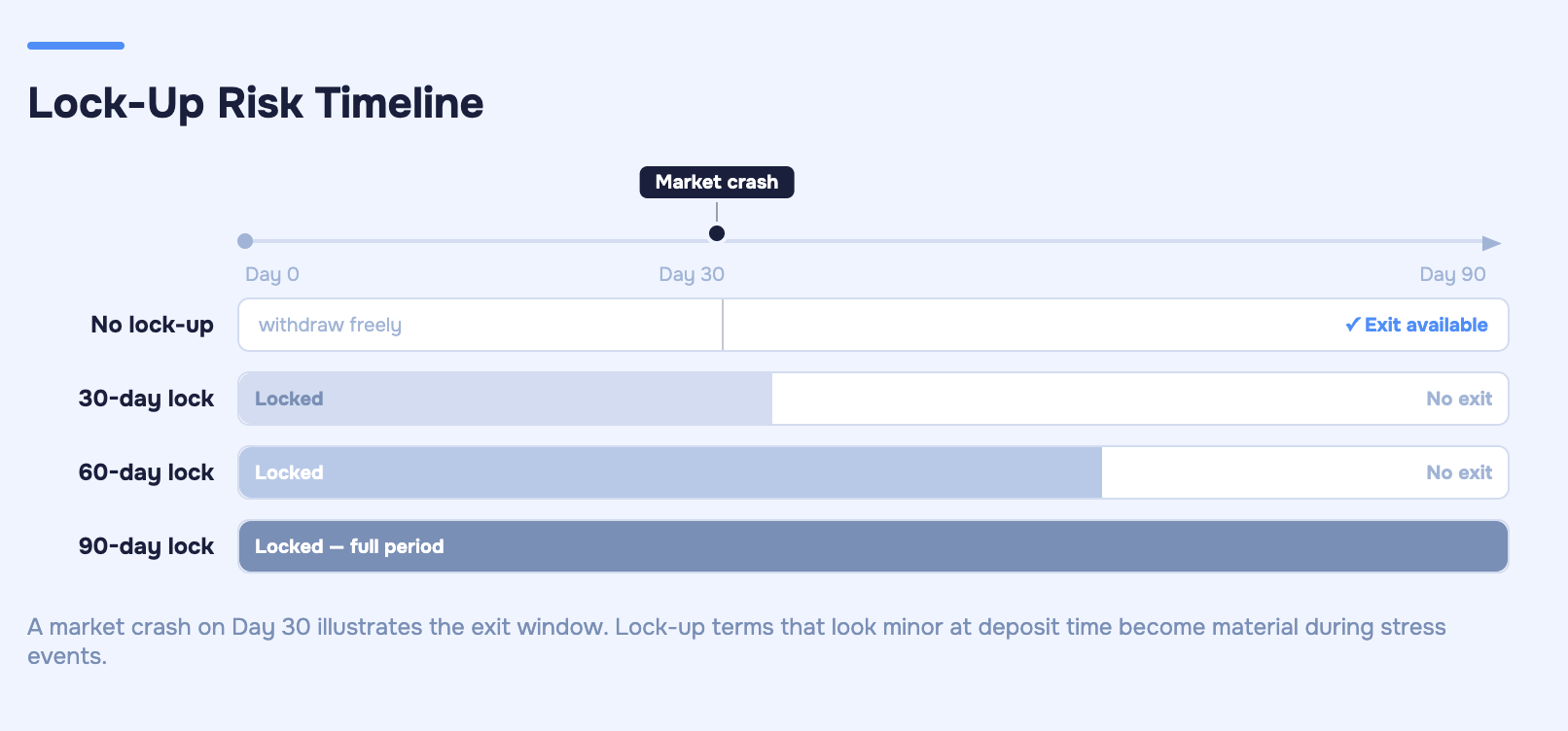
Lock-ups are common in lending products. Some platforms require 30, 60, or 90-day commitments before you can withdraw. During that window, you have no exit if something goes wrong.
No-lock-up products let you pull out anytime, which matters most during market stress, exactly when you're most likely to want your capital back.
Check the withdrawal terms before depositing. "Withdraw anytime" in marketing copy sometimes means "within 5 to 7 business days after submitting a request." That's a different thing.
6. What Security Infrastructure Is in Place?
Beyond cold storage, look for:
- Two-factor authentication (2FA): mandatory for all accounts, not just available as an option
- Encryption standards: AES-256 or equivalent for data at rest
- Audit history: has the platform been audited by a third party? When? What was found?
- Proof of reserves: can the platform demonstrate it holds the assets it claims to hold?
None of these are guarantees, but their presence shows the operator takes security seriously. Their absence should prompt the obvious follow-up question.
7. How Does the Platform Make Money?
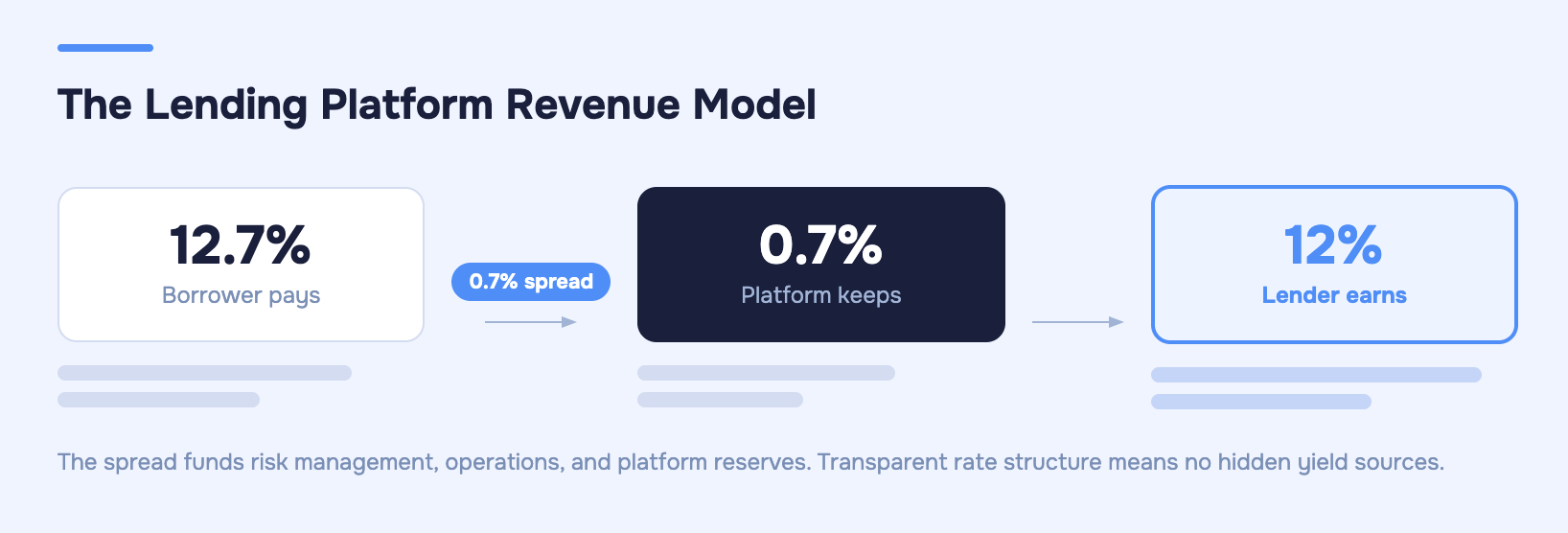
A platform offering 12% to lenders has to be earning more than 12% somewhere. Understanding the spread tells you whether the business model holds up.
The clean version: charge borrowers a higher rate than you pay lenders, keep the difference as revenue. LendProtocol charges borrowers 12.7% APR and pays lenders 12%. The 0.7% spread covers operations, risk management, and reserves. That math is transparent.
The warning signs: platforms offering very high lender rates (20% or more) with no clear explanation of where borrower yield comes from, or platforms that reinvest depositor funds in other protocols. The second structure is sometimes called "yield farming" and adds layers of smart contract and protocol risk that many depositors don't realize they're taking on.
Is XRP Lending Safe? The Risk Landscape, Plainly
No lending product is risk-free. That includes XRP lending, stablecoin lending, and anything else that pays yield on deposited assets. What varies is the type and size of the risk.
The main risks in XRP lending:
- Counterparty risk: the platform fails, exits, or gets hacked
- Collateral risk: a rapid price crash outpaces liquidation mechanisms
- Smart contract risk (DeFi only): code exploits drain protocol funds
- Regulatory risk: rules change in ways that affect platform operations
The checklist above addresses these directly: platform-absorbed default risk, overcollateralization, cold storage, fixed rates, and a transparent business model each reduce a specific exposure.
The question isn't whether XRP lending is safe in some general sense. It's whether the platform you're looking at has good answers to all seven points.
CeFi vs. DeFi XRP Lending: A Comparison
| Factor | CeFi (e.g., LendProtocol) | DeFi (e.g., Aave-style) |
|---|---|---|
| Default risk | Platform absorbs | Pooled — depositors bear |
| Rate type | Fixed | Variable, algorithmic |
| Lock-up | None (varies by platform) | Utilization-dependent |
| Collateral management | Platform-managed | On-chain, automated |
| Custody | Centralized | Smart contract |
| Payout frequency | Daily | Continuous accrual |
| Deposit assets | Platform-specific | Wide token range |
| XRP support | Yes (native) | Limited — requires bridging |
Neither model is objectively safer. CeFi concentrates risk in the operator; DeFi distributes it across code and protocol design. The better fit depends on which failure modes you're more comfortable with.
Before You Deposit
The yield on XRP lending is real. So are the risks. Most depositors skip a few paragraphs of terms and conditions and find out the hard way which risks they were carrying.
The seven questions in this checklist cover who bears default risk, collateral ratio, asset custody, rate structure, lock-up terms, security setup, and business model. Those answers determine how risk is distributed. Get them before you commit anything.
FAQ
Is XRP lending safe for beginners?
XRP lending can work for beginners if the platform has a clear risk model and plain-language terms. Fixed-rate, no-lock-up products where the platform absorbs default risk are easier to evaluate than variable-rate DeFi pools. The checklist above applies at any experience level.
Is XRP legit as a yield-generating asset?
XRP has no native staking yield. That's a design decision of the XRP Ledger, not a flaw. Yield on XRP comes from lending it to borrowers or providing liquidity to protocols. Both are legitimate mechanisms, and both carry the counterparty or smart contract risks described in this article.
What is overcollateralized lending?
A loan is overcollateralized when the borrower posts more in collateral than the value they're borrowing. A 120% collateral ratio means a $10,000 loan requires $12,000 in posted collateral. The 20% buffer absorbs price volatility before a default becomes a net loss to the lender or the platform.
What's the difference between APR and APY in lending?
APR (Annual Percentage Rate) is the stated yearly rate before compounding. APY or effective annual yield accounts for compounding frequency. A 12% APR with daily compounding produces roughly 12.75% effective annual yield, because each day's interest earns interest the next day.
Can I lose my principal when lending XRP?
It depends on the platform's risk model. On platforms where the operator absorbs default risk (like LendProtocol), lender principal is protected from borrower defaults, though platform-level failure through hacking or insolvency is a separate and real risk. On DeFi platforms with pooled risk, a protocol shortfall can reduce what depositors get back.
How do I verify a lending platform's collateral claims?
Look for proof-of-reserves documentation, third-party audits, and on-chain transparency. For platforms built on the XRP Ledger, public ledger data on XRPSCAN.com can be used to check wallet balances. If a platform makes collateral claims it can't back with verifiable data, treat that as a red flag.