XRP Yield Calculator — Estimate Your Returns
XRP can't be staked — but it can earn 12% APR. Use our XRP staking calculator to estimate returns from overcollateralized lending on XRPL.
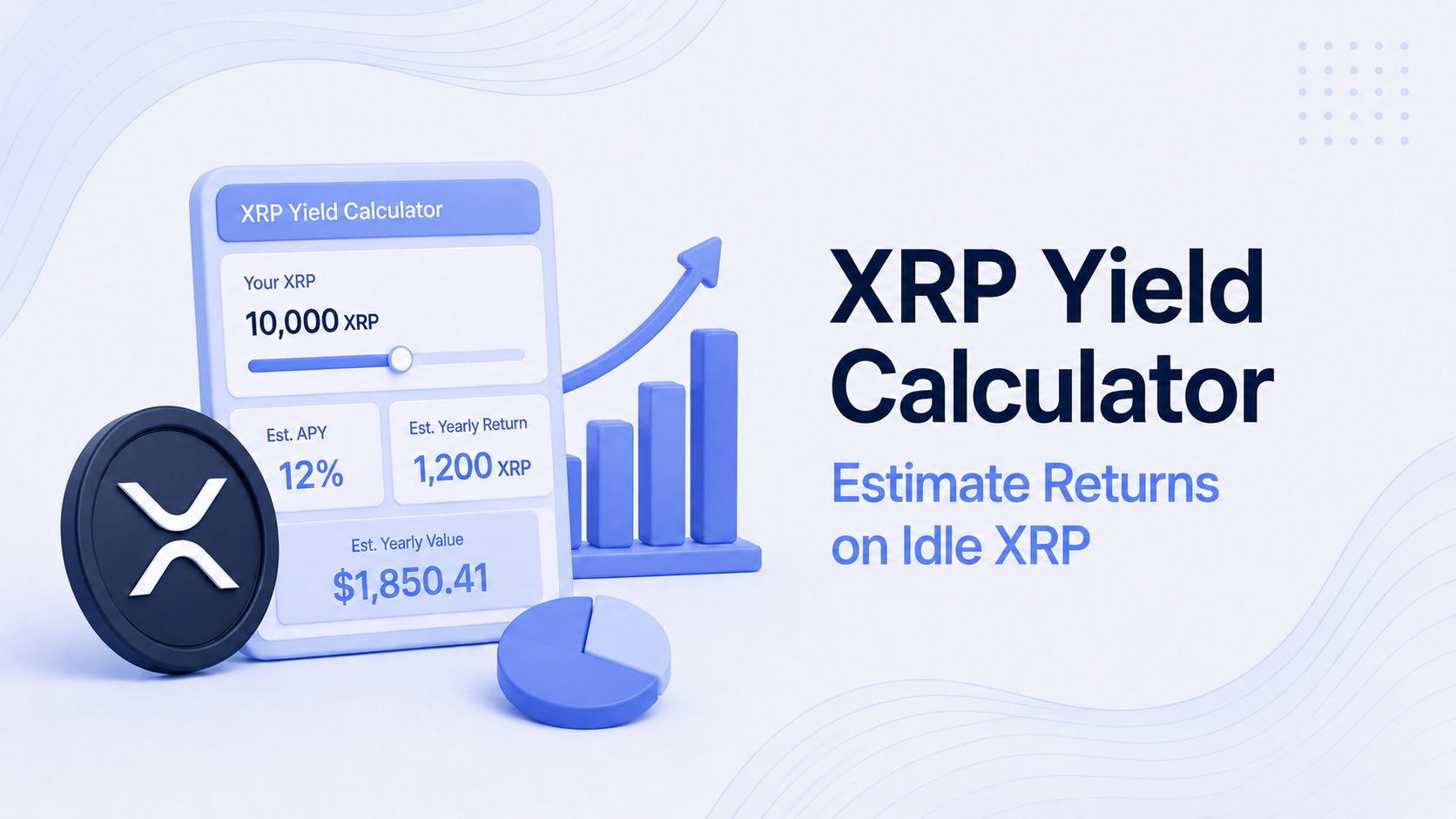
XRP cannot be staked. The XRP Ledger runs on Federated Byzantine Agreement consensus rather than Proof-of-Stake, so holding XRP earns nothing at the protocol level. The calculator below models what lending it instead would return.
XRP Yield Calculator: See What Your Holdings Could Earn
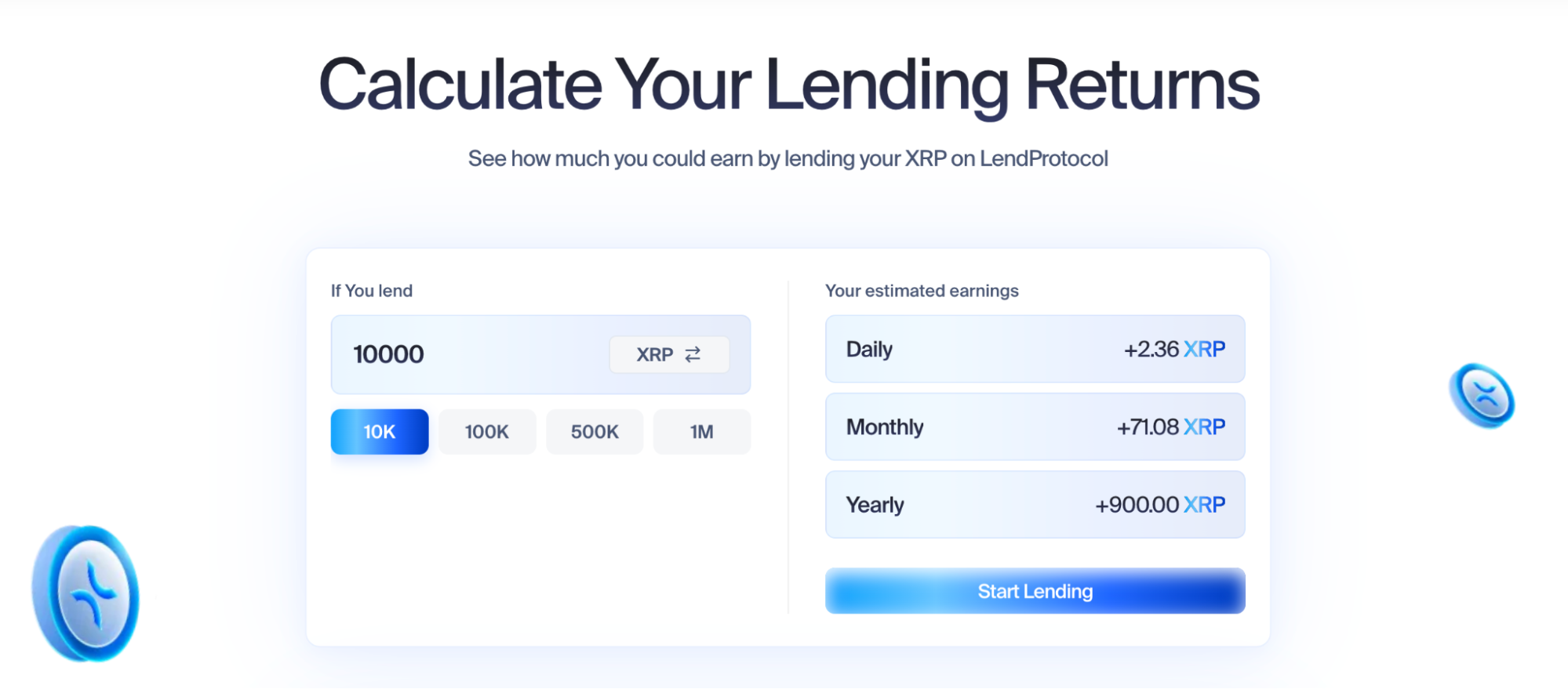
The calculator uses daily compounding at a fixed 12% APR — the rate available on XRP lending platforms — and outputs total interest earned plus effective annual yield (~12.75%).
What the three outputs mean:
- Daily payout — interest earned and credited each day
- Monthly estimate — approximate earnings after 30 days of compounding
- Annual projection — full-year figure at ~12.75% effective APY
The 0.75% gap between the stated APR and the effective annual yield comes from daily compounding: each day's interest adds to the principal, which earns interest the next day. Over twelve months that small daily effect builds into a noticeably higher real return.
Why XRP Holders Need a Yield Strategy
XRP has no native staking mechanism, which leaves holders with an obvious problem: the asset appreciates or it doesn't, but sitting on it generates nothing.
Before XRP lending platforms existed, the options were thin. Leave XRP on a centralized exchange and hope it offered a yield product. Bridge to Ethereum or another network to access DeFi, taking on smart contract risk, bridging fees, and a new wallet setup. Or hold and earn zero. None of those were built with XRP holders specifically in mind.
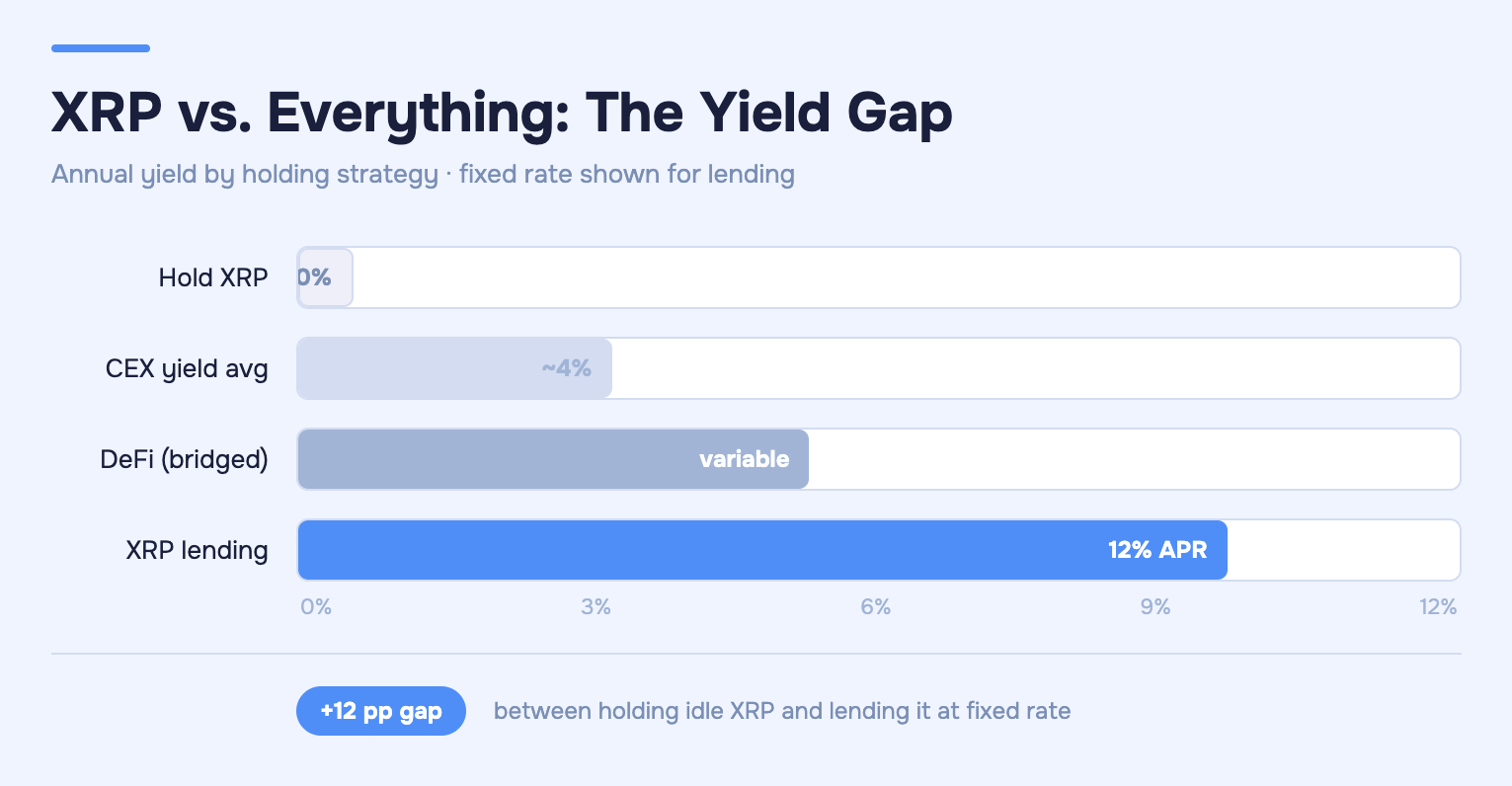
Native XRPL lending changes the math. Platforms on the XRP Ledger match depositors with overcollateralized borrowers at a fixed rate, paid daily, with no lock-up. For someone who holds XRP and has no intention of selling, that's the most direct way to earn yield on XRP without leaving the ecosystem.
How XRP Lending Works: The Mechanics Behind the APY
XRP APY from lending works differently from DeFi yield farming. There's no liquidity pool, no variable utilization rate, and no token reward. The mechanics are closer to a fixed-rate loan book.
Here's how a deposit moves through the system:
- Depositor lends XRP to the platform
- Platform matches deposits with borrowers seeking XRP or RLUSD liquidity
- Borrowers post overcollateralized collateral — typically 120% of the loan value — in BTC, ETH, SOL, XRP, RLUSD, or USDT
- Loan is issued at the borrower rate (12.7% APR on LendProtocol)
- Depositor earns 12% APR, paid daily
- On repayment, principal plus accrued interest returns to the lender
- On default, the platform absorbs the loss, not the depositor
Step 7 is the structural difference between CeFi lending and a DeFi pool. In Aave or Compound, default risk spreads across depositors. On a platform like LendProtocol, the company acts as principal — it takes the loss. The 0.7% spread between borrower and lender rates, combined with the 20% collateral buffer, is what funds that guarantee.
Fixed rate, daily payouts, platform-absorbed default risk. That's the trade-off for giving up decentralization.
XRP APY Options: A Comparison
Here's how the main approaches to earning yield on XRP compare:
| Method | Typical APY | Risk to Principal | Lock-up | Complexity |
|---|---|---|---|---|
| XRP lending (CeFi, e.g. LendProtocol) | ~12% fixed | Platform bears default risk | None | Low |
| Centralized exchange yield products | 2–8% variable | Platform bears default risk | Varies | Low |
| DeFi protocols (via bridge) | Variable | Smart contract + bridge risk | Utilization-dependent | High |
| AMM liquidity provision (XRPL DEX) | Variable | Impermanent loss + smart contract | None | Medium |
| Holding XRP (no yield) | 0% | None (price risk only) | None | None |
Fixed-rate XRP lending at 12% APR sits well above the typical CEX range and doesn't require bridging to another chain.
One note on RLUSD: Ripple's regulated USD stablecoin earns the same 12% APR through the same lending mechanism. For holders who want yield without exposure to XRP price movements, depositing RLUSD gets there. The calculator above works for RLUSD deposits as well — just treat your RLUSD balance as the principal.
What the XRP Staking Calculator Is Actually Modeling
People searching for an xrp staking calculator are almost always looking for something that doesn't technically exist. XRP can't be staked. The XRP Ledger has no validator rewards, no delegated staking, no protocol-level yield of any kind. The search term is a shorthand for "how much can I earn on XRP," and the honest answer involves lending.
The calculator models XRP lending returns under these parameters:
- APR: 12% (fixed)
- Compounding: Daily
- Effective annual yield: ~12.75%
- Payout frequency: Daily
These are real rates from XRP Ledger-native lending. If you find another calculator showing higher APR, check whether it's modeling a variable rate — those can swing below 1% in slow markets — or whether the compounding assumption is different.
Factors That Affect Your Actual Returns
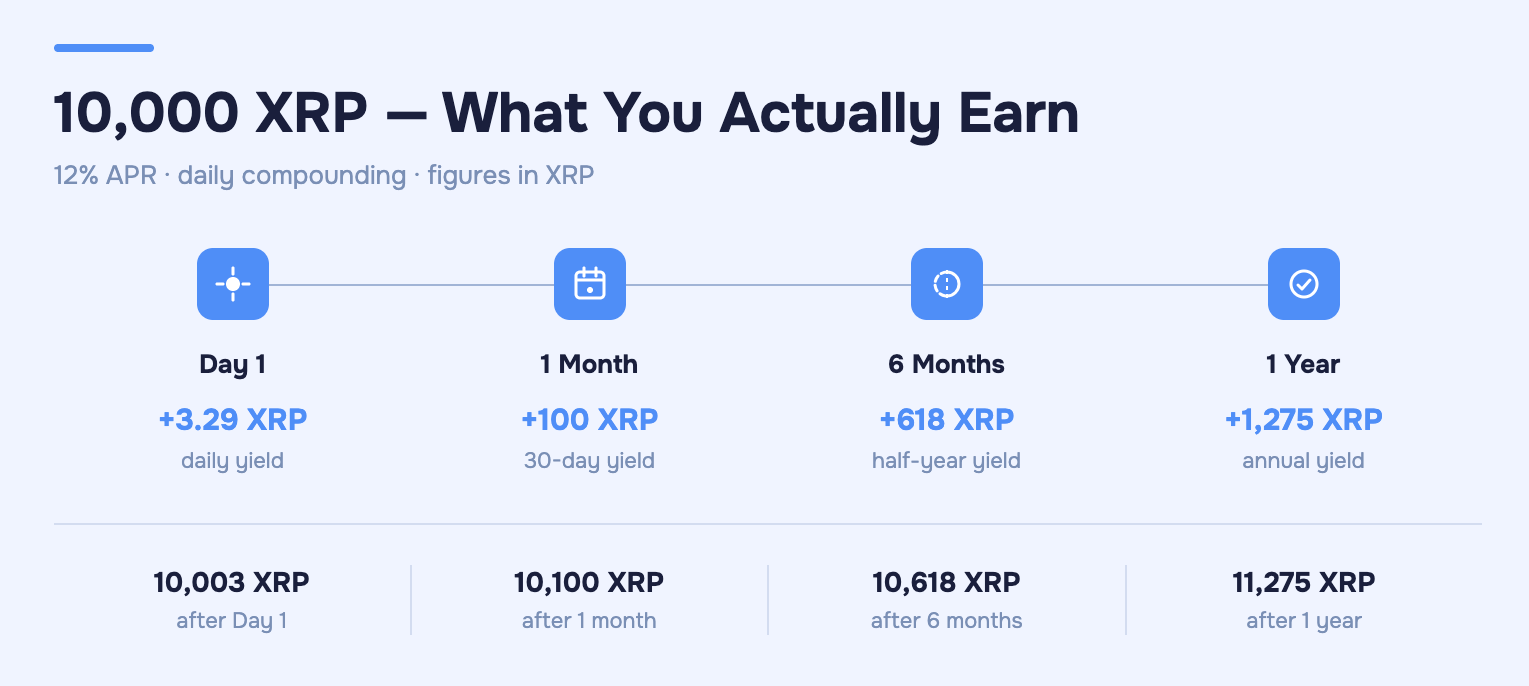
Compounding frequency. Daily compounding outperforms monthly or quarterly compounding at the same stated APR. At 12%, daily compounding produces ~12.75% effective annually. Annual compounding produces exactly 12%.
Deposit duration. The compounding benefit builds over time. At 12% APR daily, $10,000 earns roughly $1,275 in year one. Leave that interest in rather than withdrawing it, and year two starts from a higher base.
Fixed vs. variable rates. A fixed-rate platform locks the return regardless of market conditions. Variable DeFi rates track utilization — XRP APY on those platforms can swing from under 1% to above 20% in the same calendar year. Projections from variable-rate calculators are less reliable.
Platform risk. A platform guarantee on principal protection is only as good as the platform. Cold storage, AES-256 encryption, and 2FA reduce operational exposure, but CeFi lending still involves counterparty risk. Regulatory changes in the XRP space are a real variable too.
Tax treatment. Most jurisdictions treat lending yield as ordinary income, similar to bank interest. The specifics vary by country and personal situation — worth confirming with a tax advisor before treating yield projections as net returns.
Conclusion
XRP was built for payments, and the ledger reflects that — no staking, no protocol yield, no reward for holding. For a long-time holder, that used to mean accepting zero return on an idle position.
Fixed-rate lending at 12% APR with daily compounding is the most direct alternative currently available on XRPL. Run $50,000 through the calculator and it comes back at roughly $6,375 for the year — not a variable projection, a fixed-rate figure from a locked collateral model.
The numbers are in the calculator. What to do with them is your call.