Is XRP Proof of Stake? Here's the Real Answer
XRP isn't Proof of Stake, and it never has been. This guide breaks down why the XRP Ledger uses a different consensus model, how it compares to Ethereum and Solana, and how to start earning a fixed 12% APR on XRP instead.
Is XRP proof of stake? No. The XRP Ledger runs on the Ripple Protocol Consensus Algorithm (RPCA), a form of Federated Byzantine Agreement where trusted validators vote on transaction order instead of staking tokens. That's why XRP has no staking rewards, no slashing, and no lock-up. It's also why earning yield on XRP means lending it, not staking it.
That design choice is the source of most of the confusion about XRP and staking. Once you see what XRPL does instead of Proof of Stake, "stake XRP" stops looking like a real option, and what to do with idle XRP instead gets a lot clearer.
What Is Proof of Stake, and Why Do People Ask If XRP Uses It?
Proof of Stake is a consensus model where validators lock up (stake) their own tokens as collateral. The network rewards them with newly issued tokens for validating honestly, and slashes (confiscates) part of their stake if they act maliciously or go offline. Ethereum and Solana are the two networks most people mean when they say "staking."
People search "is XRP proof of stake" because XRP ranks in the top 10 by market cap, and staking is the default yield mechanism on every other major chain. If ETH and SOL pay you for staking, assuming XRP does too is a reasonable guess. It doesn't. That's a protocol-level design choice, not a missing feature Ripple forgot to ship.
Is XRP Proof of Stake? The Short Answer
No. XRP has never been a Proof of Stake asset. The XRP Ledger settles transactions through RPCA instead, a consensus protocol that predates most Proof of Stake networks and rests on a different security assumption: trusted validators reaching agreement by voting, not capital locked up as collateral.
That's not a subtle distinction. It means XRP holders can't stake XRP the way they'd stake ETH or SOL. No validator client to run, no delegation option, no unbonding queue to wait out. If a product markets itself as "XRP staking," it's describing something else, usually lending, under a more familiar label. XRPL's own documentation is explicit that the ledger doesn't rely on proof of work or proof of stake for consensus.
How the XRP Ledger Reaches Consensus Instead
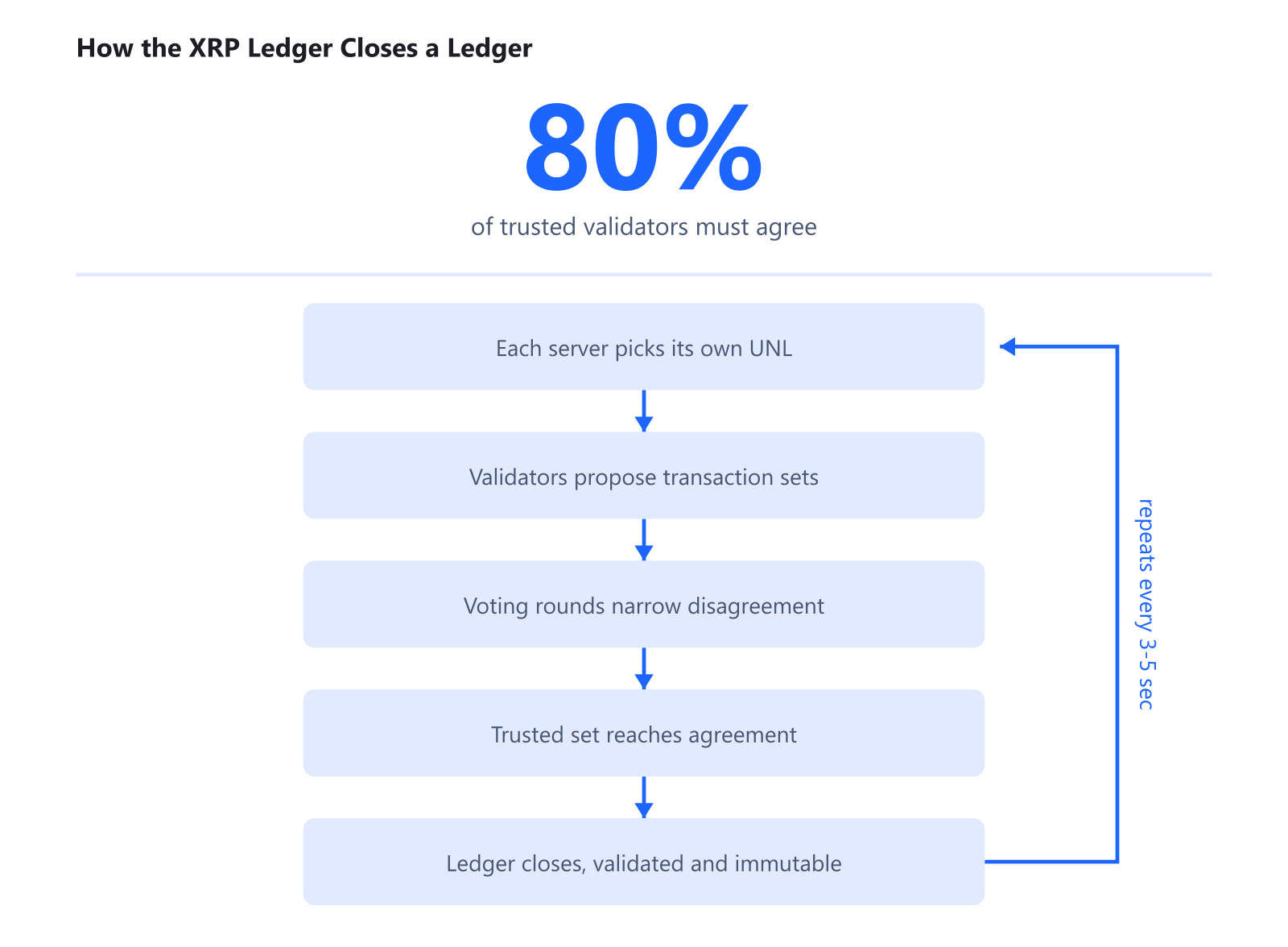
The XRP Ledger reaches consensus through RPCA, where each validator maintains a Unique Node List (UNL): a set of other validators it trusts not to collude. It closes each ledger only once roughly 80% of that trusted set agrees on it. No mining, no staked capital, no block reward.
The mechanics differ sharply from both older models. In Proof of Work, validators (miners) compete by burning electricity to find a valid hash. In Proof of Stake, validators are selected to propose or attest blocks in proportion to how much they've staked, and are financially punished for misbehaving. On XRPL, validators propose transaction sets and exchange them over several rounds, narrowing disagreement each round, until enough of the trusted set converges on an identical result. Once about 80% of a validator's UNL agrees, the ledger closes, validated and immutable, typically every three to five seconds. A formal analysis published on arXiv has independently confirmed the safety properties the protocol relies on.
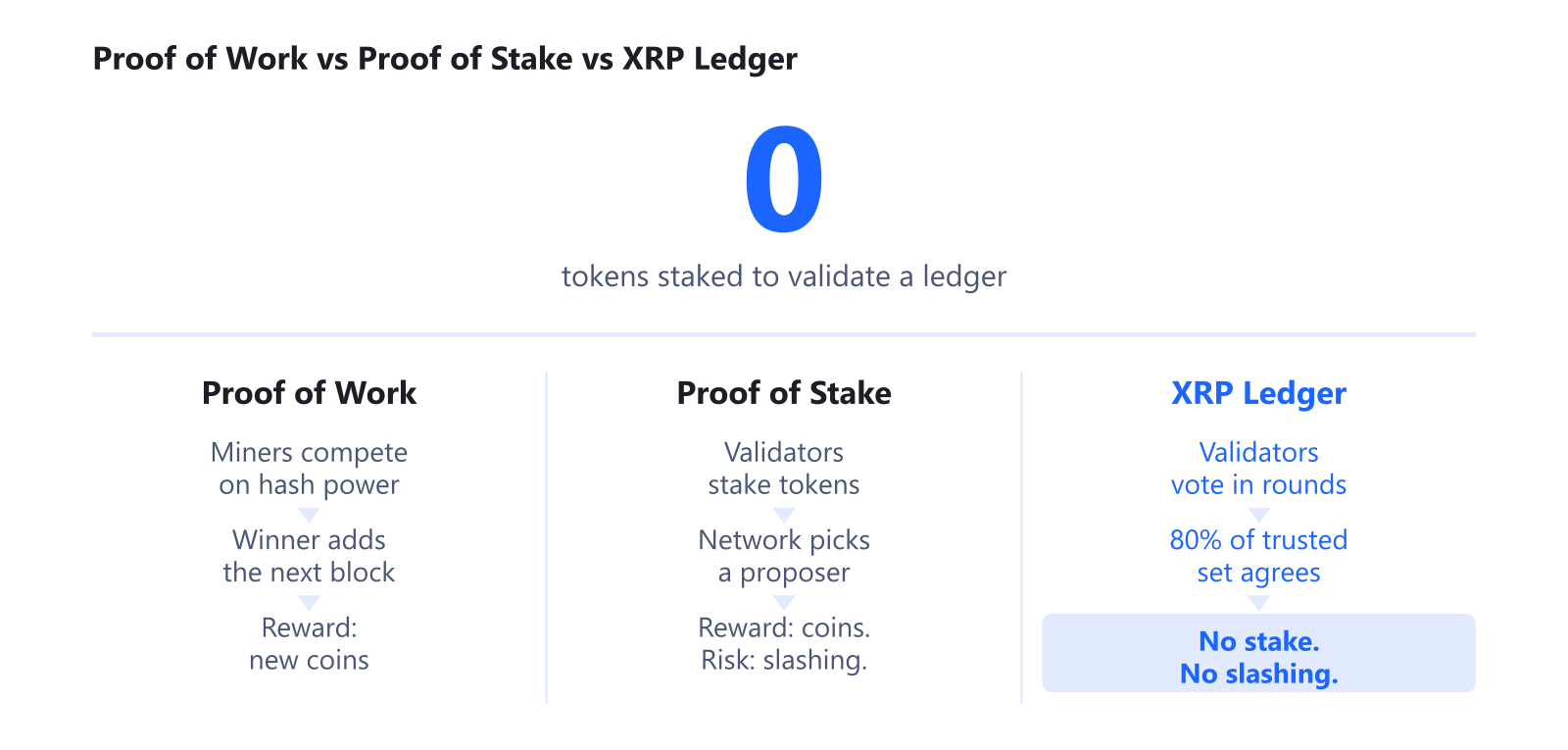
Validators earn their place on a UNL through reputation and consistent uptime, not locked tokens. And because XRP's total supply was fixed at the ledger's genesis, there's no new-issuance reward to distribute even if the network wanted to pay one out. That combination (reputation-based trust plus a fixed supply) is why the question "is XRP proof of stake" always resolves to no: there's neither the staking mechanism nor the token-issuance model that Proof of Stake requires.
Proof of Stake vs. XRP Ledger Consensus: Where They Diverge
The two models diverge on almost every structural point that matters to a holder: how validators qualify, how they get paid, and what happens if they misbehave.
| Feature | Proof of Stake (e.g., Ethereum, Solana) | XRP Ledger (RPCA / FBA) |
|---|---|---|
| Validator selection | Based on amount of staked capital | Based on trust and reputation (UNL) |
| Capital lock-up | Required: tokens staked as collateral | None: no tokens are locked to validate |
| Reward mechanism | New tokens issued to validators | No block reward; no new issuance |
| Slashing / penalties | Yes: stake can be confiscated for misbehavior | No slashing mechanism exists |
| Consensus threshold | Varies by protocol (often ~66%) | ~80% of a validator's trusted UNL |
| Finality time | Seconds to minutes, protocol-dependent | 3-5 seconds |
| Energy profile | Low relative to Proof of Work, but capital-intensive | Low; no mining or staking overhead |
| Native yield for holders | Yes: staking rewards | None |
That last row is the one that matters most for anyone landing on this page. Because XRPL pays no native reward for holding or locking XRP, any yield on idle XRP has to come from outside the protocol. That's where lending platforms fill the gap.
Does XRP Have Staking? What "XRP Staking" Products Actually Are
Does XRP have staking? No, not at the protocol level. What gets marketed as "XRP staking" on exchanges and apps is a lending, custodial-interest, or liquidity product wearing staking's terminology because it's more familiar to users coming from Ethereum or Solana.
Depositing XRP into one of these programs usually means the platform lends your XRP to borrowers or deploys it for internal liquidity, then pays you a share of what that earns, a structure covered in more detail in this breakdown of how XRP lending actually works. It's a real yield mechanism, just not the one the word "staking" technically describes. That distinction matters because the two carry different risk profiles: staking risk sits at the protocol level (slashing, validator downtime), while lending risk sits with the counterparty (can the platform pay out what it owes, and who absorbs a default).
LendProtocol is a clear example of this category done transparently. It doesn't call itself a staking product. It states upfront that it's a lending platform, paying a stated 12% APR on deposited XRP or RLUSD by matching lenders with overcollateralized borrowers.
Why Did Ripple Build XRPL Without Proof of Stake?
Ripple built the XRP Ledger around RPCA rather than Proof of Stake because the ledger's design goals (fast, cheap, deterministic settlement) didn't require staked capital to secure the network. Validators earn trust through consistent, correct behavior over time, which is enough to secure the network without the economic overhead Proof of Stake introduces.
That trade-off buys XRPL some real advantages: transactions settle in three to five seconds, fees run near-zero, and the network doesn't need a token-issuance schedule to pay validators, since the total XRP supply was fixed at launch. It's a deliberate engineering choice, not an oversight Ripple has ignored. RippleX's head of engineering, J. Ayo Akinyele, has described conceptual frameworks for adding native staking to XRPL, and David Schwartz (Ripple's CTO at the time he floated the idea, now CTO Emeritus after stepping back from the role in late 2025) proposed a dual-layer consensus model as one possible direction. Neither is a scheduled protocol change as of August 2026.
What is closer to activating is something entirely different: XLS-65 and XLS-66, a pair of proposed amendments for native, uncollateralized institutional lending, currently sitting around 40% and 37% validator support respectively against the 80% threshold needed to activate. That's a lending proposal, not a staking one, and a separate product from the consumer CeFi lending platforms that already operate on top of XRPL today.
What This Means If You're Holding XRP for Yield
Since the XRP Ledger's consensus model rules out native staking, the practical question shifts from "how do I stake XRP" to "how do I earn yield on XRP instead." Lending is the direct answer: deposit XRP or RLUSD with a platform that lends it to borrowers and pays you a share of the interest.
That's the model LendProtocol runs. Lenders deposit XRP or RLUSD, the platform matches deposits with borrowers who post 120% collateral in BTC, ETH, SOL, XRP, RLUSD, or USDT, and interest accrues daily at a stated 12% APR, which compounds to roughly 12.75% effective annual yield. There's no lock-up: withdraw principal and accrued interest whenever you want. If a borrower defaults, the platform absorbs the loss rather than passing it to the lender, a structural difference from pooled-risk DeFi lending markets like Aave, where depositors share default exposure.
- XRP deposits suit holders who want exposure to XRP's price alongside the yield.
- RLUSD deposits suit holders who want the same fixed rate without XRP's price volatility. RLUSD is Ripple's fully-backed, regulated USD stablecoin, native to XRPL.
- Worth checking on any platform, and covered in more depth in this XRP lending safety checklist: cold storage for the bulk of deposited assets, strong encryption (AES-256 GCM), and mandatory two-factor authentication.
More than 13,700 lenders have deposited a combined 743 million XRP through LendProtocol to date, evidence that plenty of XRP holders have already made this call: stop waiting on staking and start lending instead.
The Bottom Line
XRP isn't Proof of Stake, and it never has been. The XRP Ledger secures itself through RPCA, a form of Federated Byzantine Agreement where trusted validators vote their way to consensus every three to five seconds, with no staked capital, no slashing, and no block reward involved. That's a deliberate trade-off for speed and low fees, not a gap waiting to be patched.
For XRP and RLUSD holders, that means the real decision isn't whether to stake: it's which yield product to use instead. LendProtocol was built specifically to answer that gap: a fixed 12% APR, daily payouts, no lock-up, and a platform that assumes default risk itself rather than passing it on to depositors.
FAQ
Is XRP proof of stake?
No. The XRP Ledger uses RPCA, a form of Federated Byzantine Agreement, not Proof of Stake. Validators reach consensus by voting within a trusted set, not by locking up staked capital.
Does XRP have staking?
No, not natively. There's no protocol-level staking mechanism on the XRP Ledger. Products advertised as "XRP staking" are typically lending or custodial-interest programs using the term loosely.
Is XRP proof of work instead, like Bitcoin?
No. XRP doesn't use Proof of Work either. RPCA is a distinct third model: validators reach agreement through rounds of voting, without mining or staking.
If XRP isn't proof of stake, how do you earn yield on it?
Through lending, not staking. Platforms like LendProtocol let you deposit XRP or RLUSD, match it with overcollateralized borrowers, and earn a stated 12% APR paid daily, with no lock-up period.
Will the XRP Ledger ever switch to Proof of Stake?
Unlikely in the near term. RippleX engineers have discussed conceptual staking frameworks without a scheduled implementation. The nearer-term development, XLS-65/XLS-66, addresses native institutional lending, not staking, and remains in validator voting as of August 2026.
Why doesn't the XRP Ledger need Proof of Stake to be secure?
Because RPCA only needs roughly 80% agreement among a trusted UNL to close a ledger, enough to stop a minority of bad actors without anyone locking up capital. It's a different security assumption than Proof of Stake, not a weaker one.