Does XRP Have Staking? Liquid Staking Explained
XRP has no native staking mechanism, and there's no such thing as an XRP liquid staking token either. Here's the technical reason why, based on how the XRP Ledger reaches consensus, and what to use instead.
Does XRP have native staking? No. The XRP Ledger runs on RPCA, a form of Federated Byzantine Agreement where trusted validators vote on transaction order. That's not Proof-of-Stake, where tokens are locked up for rewards. There's no staking contract, no validator bonding, and no XRP liquid staking token, because there's no underlying stake to represent.
Does XRP have staking? Not in the way Ethereum or Solana do, and not by accident: it's baked into how the XRP Ledger reaches consensus. That mechanism explains why "stake XRP" isn't a real option, why "XRP liquid staking" is a search term with no product behind it, and what earns yield on idle XRP instead.
What "Native Staking" Actually Means
Native staking means locking a blockchain's own asset directly into its consensus process to earn a protocol-level reward, the way ETH and SOL holders help validate their own networks. It's a base-layer function written into the protocol, not a product a company builds on top of it.
Three things define native staking: validators lock tokens as collateral, the protocol pays a reward (usually newly issued tokens) for honest validation, and it can slash (confiscate part of that stake) if a validator misbehaves or goes offline. Take away any one of those three and you're not looking at staking anymore. That's why so many exchanges and apps calling their deposit programs "staking" are stretching the word: underneath, it's usually lending, custodial interest, or liquidity provision under a more familiar label.
Does XRP Have Staking? The Technical Breakdown
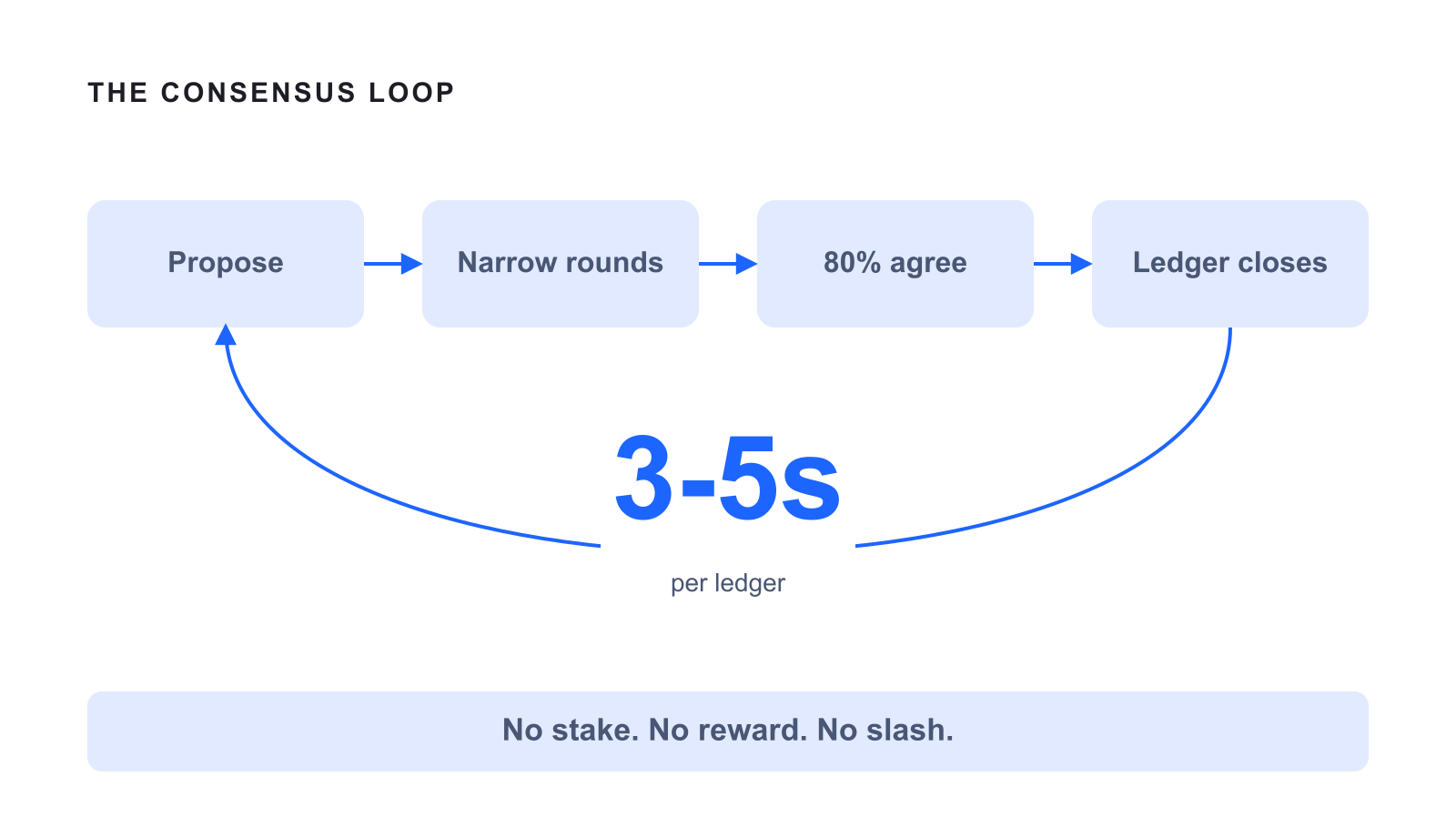
No. XRP has no staking mechanism at any layer of the protocol, and it never has. The XRP Ledger settles transactions through RPCA (Ripple Protocol Consensus Algorithm), where each validator maintains a Unique Node List (UNL) of other validators it trusts, and a ledger only closes once roughly 80% of that trusted set agrees. There's no mining and no staked capital, and no block reward changes hands at any point.
That's why the three defining features of staking don't apply to XRP: nothing gets locked, nothing gets minted as a reward, and nothing gets slashed. XRPL's own documentation is explicit that the ledger doesn't rely on proof of work or proof of stake for consensus, and independent research, including the formal analysis published on arXiv, has examined RPCA's safety properties directly.
| Feature | Proof of Stake (Ethereum, Solana) | XRP Ledger (RPCA) |
|---|---|---|
| Validator selection | Amount of staked capital | Trust and reputation (UNL) |
| Capital lock-up | Required | None |
| Reward mechanism | New token issuance | No block reward |
| Slashing | Yes | No mechanism exists |
| Consensus threshold | Varies, often ~66% | ~80% of trusted UNL |
| Finality | Seconds to minutes | 3-5 seconds |
| Native yield for holders | Yes | None |
So, does XRP have staking in the strict technical sense? No. The gap between "staking" and "no staking" isn't a missing feature. It's a different security model.
Why the Ledger Was Never Built for Staking
XRPL's validators don't need staked capital to secure the network, because RPCA's security comes from reputation and voting, not from financial collateral at risk. Validators earn a place on trusted UNLs through consistent, correct uptime over time. There's nothing to lock, so there's nothing to reward.
The other half of the answer is supply. XRP's total supply was fixed at the ledger's genesis in 2012: all 100 billion units, with no mechanism to mint more. Proof-of-Stake networks fund staking rewards by minting new tokens; XRPL has no issuance schedule to draw from even if it wanted to pay one out. Trust-based validator selection plus a fixed supply is a deliberate trade-off for fast, cheap, deterministic settlement, not a gap Ripple has overlooked.
What About XRP Liquid Staking?
XRP liquid staking doesn't exist, and structurally it can't. Liquid staking is a Proof-of-Stake concept: you stake a token through a protocol like Lido, and in exchange you receive a liquid derivative (stETH is the best-known example) that represents your staked position and can still be traded or used in DeFi while the original stake keeps earning rewards. The whole mechanism depends on a real staked position existing underneath the derivative token.
XRP has no staking position to derive a token from, so there's nothing for an "XRP liquid staking" token to represent. What people find when they search that term is wrapped XRP (tokens like FXRP on Flare or wXRP through custodial bridges) moved onto a smart-contract chain and used as DeFi collateral or in lending vaults. FXRP recently gained approval as collateral in a $280 million RLUSD lending vault on Ethereum, for instance. That yield comes from lending and liquidity activity on the destination chain, not from staking XRP anywhere, and it carries bridge risk and smart-contract risk that don't apply when XRP lending happens natively on its own ledger instead. Calling it "liquid staking" borrows a familiar label for a mechanism that works differently.
Is Native Staking Coming to the XRP Ledger?
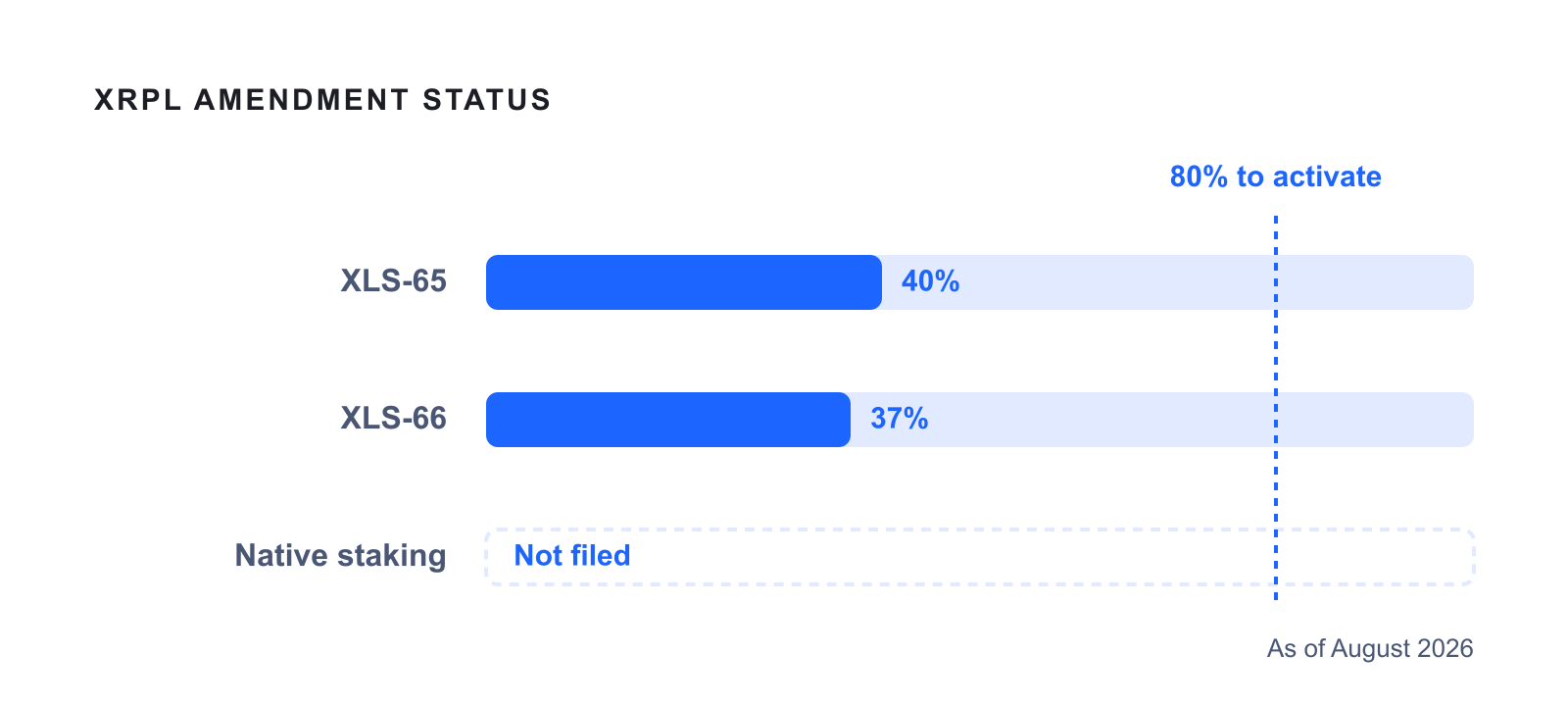
Not yet. RippleX's head of engineering, J. Ayo Akinyele, has published an analysis of what native staking would require: a genuine source of rewards (XRPL burns transaction fees rather than distributing them) and a fair way to allocate them. He's been explicit that even if built, staking still couldn't secure consensus, since XRPL validators don't compete for block production like Proof-of-Stake validators do. Any reward layer would sit alongside RPCA, not inside it. Ripple CTO David Schwartz has floated a more concrete design: a two-layer system where an inner layer of roughly 16 stake-weighted validators would handle ledger advancement with slashing, while the current validator set shifts to an outer layer overseeing amendments and fees. Both are exploratory, not roadmap items. As of August 2026, neither has an activation date.
What's further along is a different proposal: XLS-65 and XLS-66, a pair of amendments for native, uncollateralized institutional lending, sitting around 40% and 37% validator support against the 80% threshold needed to activate. That's a lending standard aimed at credentialed institutional borrowers, not a staking mechanism, and it's a separate product from consumer CeFi lending platforms already operating on XRPL today.
How XRP Holders Earn Yield Instead
Since there's no staking layer to use, yield on XRP has to come from outside the protocol. Lending is the direct substitute. You deposit XRP or RLUSD with a platform. It matches your deposit with a borrower who posts collateral. You earn a share of the interest, paid on the platform's schedule instead of a protocol reward.
LendProtocol runs that model on top of the XRP Ledger. Deposit XRP or RLUSD, and the platform matches you with a borrower posting 120% collateral in BTC, ETH, SOL, XRP, RLUSD, or USDT. You earn a stated 12% APR paid daily, compounding to roughly 12.75% effective annual yield, with no lock-up. If a borrower defaults, the platform absorbs the loss instead of passing it to lenders, a different arrangement than pooled-risk DeFi markets like Aave, where depositors share default exposure. More than 13,700 lenders have deposited a combined 743 million XRP through the platform to date.
- The 12% rate is a stated offer, not a guaranteed return: it can move with market conditions and platform utilization.
- RLUSD deposits earn the same rate without exposure to XRP's price swings, useful for treasury teams and risk-averse depositors.
- On the security side, the majority of deposits sit in cold storage, data is encrypted with AES-256 GCM, and two-factor authentication is required on every account.
For a full comparison of every real yield option (exchange rewards, wrapped DeFi, AMM pools, and fixed-rate lending), see the complete guide to where XRP holders earn yield.
The Bottom Line
So, does XRP have staking? No. Not now, and not without a fundamental change to XRPL's consensus model. The XRP Ledger secures itself through RPCA, a form of Federated Byzantine Agreement where trusted validators vote their way to consensus every three to five seconds, with no stake required at any point. XRP liquid staking follows the same answer: without an underlying stake, there's no position for a liquid staking token to represent.
For XRP and RLUSD holders, that reframes the question from "how do I stake" to "which yield product replaces it." LendProtocol was built for exactly that gap: a fixed 12% APR, daily payouts, no lock-up, and a platform that assumes default risk itself instead of passing it on to depositors.
FAQ
Does XRP have staking?
No. The XRP Ledger uses RPCA, a form of Federated Byzantine Agreement, not Proof-of-Stake. There's no validator bonding, no staking reward, and no slashing mechanism anywhere in the protocol.
Is there XRP liquid staking?
No. Liquid staking tokens represent an underlying staked position, and XRP has no staking position to represent. Tokens marketed near this term are usually wrapped XRP (like FXRP) used as DeFi collateral on another chain, a lending or liquidity mechanism, not staking.
How do I stake XRP, then?
You can't, technically, but you can lend it. Platforms like LendProtocol let you deposit XRP or RLUSD, match it with an overcollateralized borrower, and earn a stated 12% APR paid daily, with no lock-up period required.
Will the XRP Ledger ever get native staking?
Possibly, but not on any confirmed timeline. RippleX engineers have discussed conceptual staking frameworks without a scheduled implementation date. The nearer-term development, XLS-65/XLS-66, addresses institutional lending, not staking, and remains in validator voting as of August 2026.
What's the difference between XRP staking and XRP lending?
Staking pays a protocol-level reward for locking tokens to help secure a Proof-of-Stake network. XRPL has no such mechanism. Lending pays interest because a borrower is using your deposited XRP or RLUSD and paying for that capital. That's a counterparty relationship, not a consensus one.