Can I Stake My XRP? Earn 12% APR Instead
XRP can't be staked, but it can be lent. See why native XRP staking doesn't exist, where to earn yield instead, and how lending compares to DeFi, CEX, and savings alternatives.
Can I stake my XRP? No, not natively. The XRP Ledger runs on Federated Byzantine Agreement consensus, not Proof-of-Stake, so there's no protocol-level reward for holding XRP the way there is for ETH or SOL. If you're searching for where you can stake your XRP, the answer is nowhere: that option doesn't exist on XRPL. What does exist is lending: platforms such as LendProtocol pay a stated 12% APR on deposited XRP instead.
Why Can't You Stake XRP?
XRP can't be staked because the XRP Ledger doesn't run on Proof-of-Stake. It uses Federated Byzantine Agreement (fBFT): a consensus model where a trusted set of validators confirm transactions by voting, not by locking up capital.
Proof-of-Stake chains like Ethereum pay rewards because validators risk their own staked tokens to secure the network; penalizing bad actors is what keeps the system honest. XRPL validators don't stake anything, so there's nothing to reward them for. That's a design choice from XRPL's earliest days, not a missing feature. The ledger was built for fast, cheap settlement, not staking-based security.
This is also why the question "can I stake my XRP" keeps surfacing. Newcomers coming from Ethereum or Solana assume every major chain has a staking option, and the confusion is understandable. XRP is a top-10 asset by market cap, and staking is the default yield mechanism most people know.
Where Can I Stake My XRP? The Short Answer
Where can I stake my XRP? Nowhere. No wallet, validator, or exchange offers genuine XRP staking, because the underlying protocol has no staking mechanism to plug into.
Some exchanges advertise "XRP staking" or "XRP rewards" programs. Read the fine print and these are almost always relabeled lending or flexible-savings products: you deposit XRP, the exchange lends it out or uses it for internal liquidity, and pays you interest. Nothing is being staked on-chain. The terminology is marketing shorthand, not a technical description. Know that before depositing anything expecting validator-style rewards.
What About XRPL's Native Lending Protocol (XLS-66)?
XLS-66 isn't staking either. It's a proposed base-layer lending standard for XRPL. It's still working through validator voting: backing sits above 37% as of August 2026, well short of the 80% support that XRPL's default validator list must hold for an amendment to activate. Once live, it would let institutions issue uncollateralized, off-chain-underwritten loans through isolated vaults: a mechanism built for credentialed institutional borrowers, not a retail yield product.
That's a different model from consumer lending platforms. A CeFi lending platform, by contrast, sits on top of the XRP Ledger as a settlement layer and requires borrowers to post collateral above the loan value on every loan. It works today, independent of whatever XRPL's validators eventually decide about XLS-66.
The Real Alternative: Lending Instead of Staking
Since staking isn't an option, lending is the closest thing XRP holders have to a yield mechanism. Once you see how XRP lending actually works, the structure resembles a savings account more than a staking pool:
- You deposit XRP or RLUSD with a lending platform
- The platform matches your deposit with a borrower
- The borrower posts collateral above the loan value
- You earn a fixed rate, typically paid daily
- You withdraw principal plus interest on your own schedule
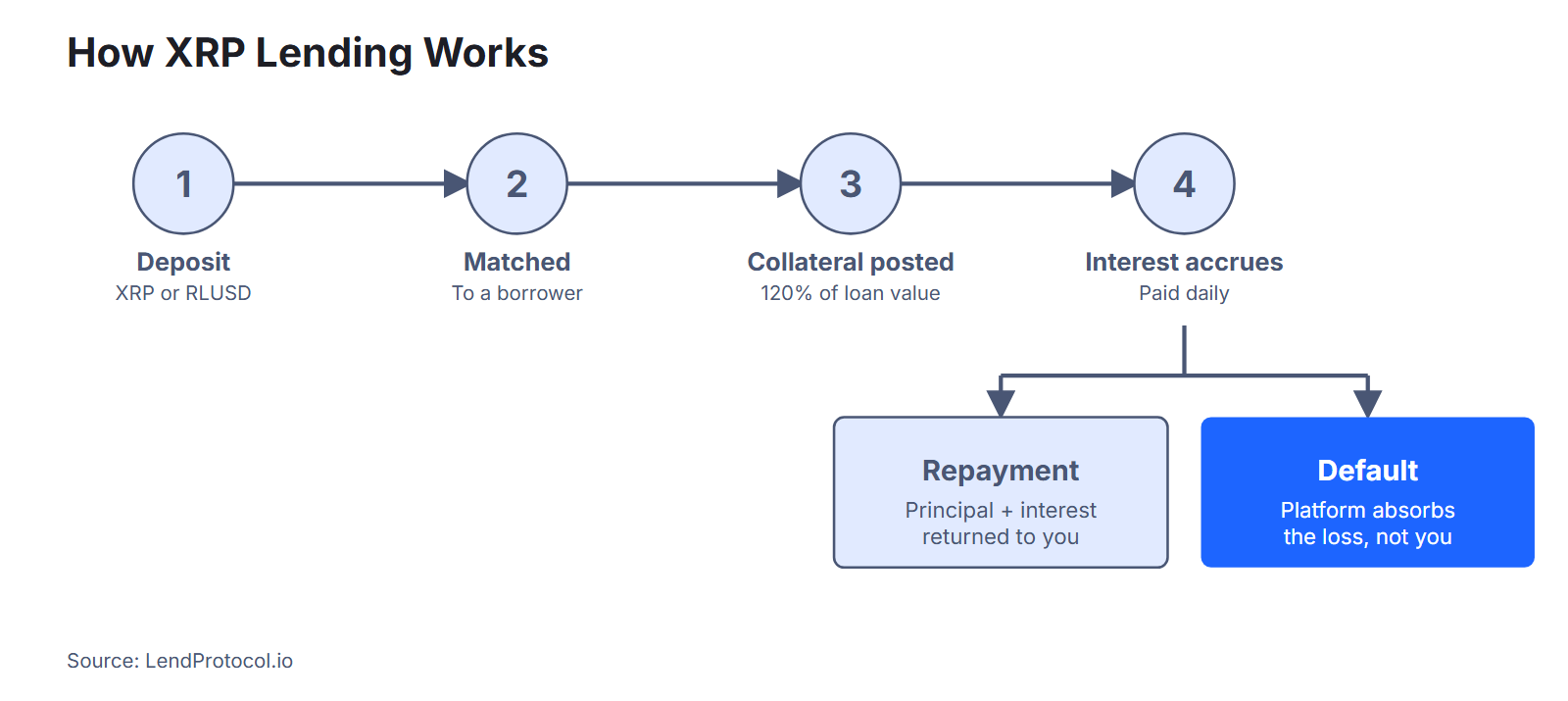
The details vary by provider: collateral ratios, payout frequency, and who absorbs the risk if a borrower defaults are the questions worth asking before depositing anywhere.
Comparing Yield Options for XRP Holders
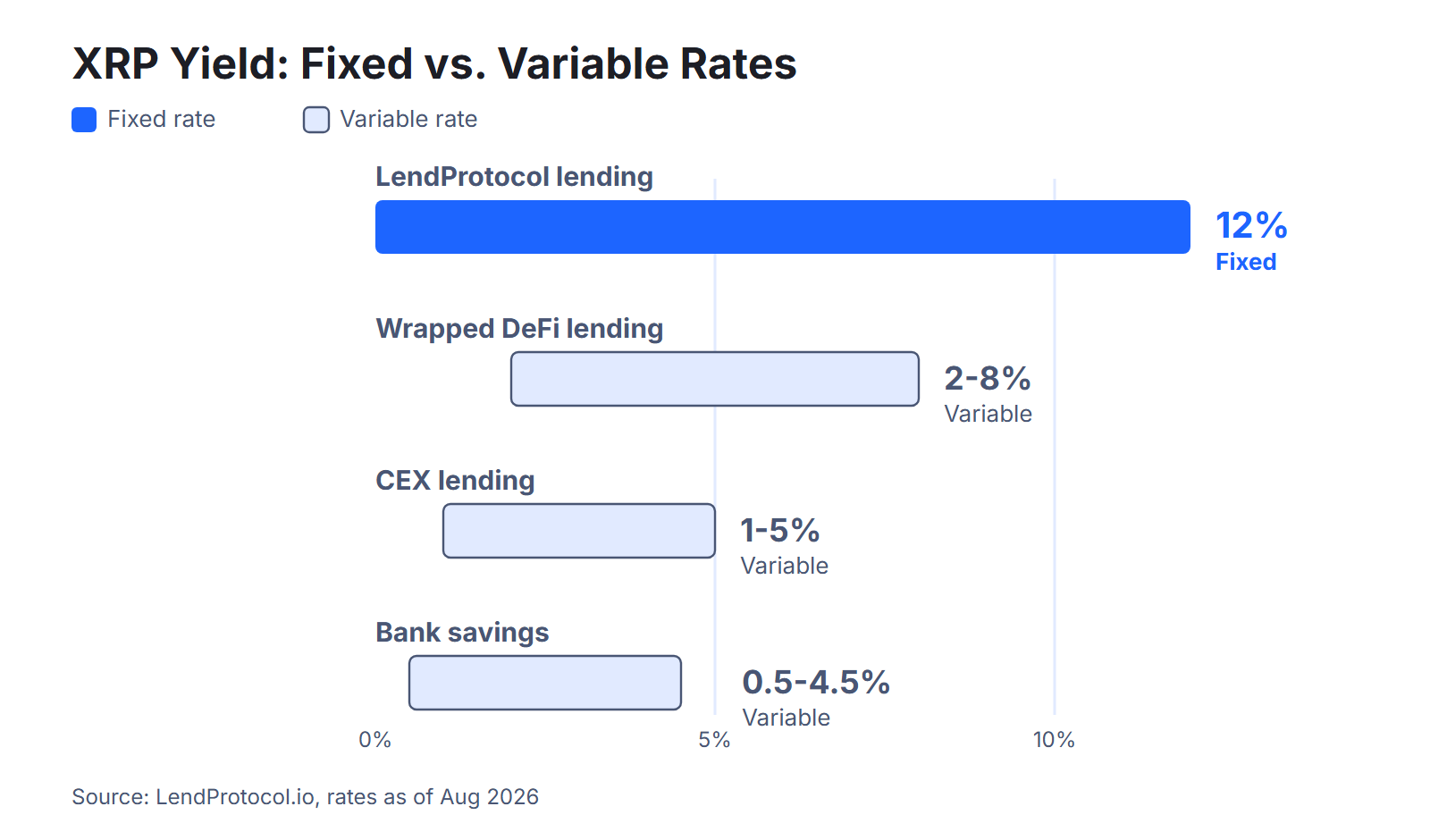
Every other way to earn yield on XRP pays a rate that floats with the market. Fixed-rate lending is the outlier. Here's where each option lands.
| Option | Yield | Rate type | Risk carried by |
|---|---|---|---|
| LendProtocol (lending) | 12% APR (lender), stated offer | Fixed | Platform absorbs default risk |
| Wrapped DeFi lending | 2-8% | Variable | Depositor (pooled risk) |
| AMM liquidity provision | Variable | Variable | Depositor (impermanent loss) |
| Centralized exchange lending | 1-5% | Variable | Depositor / exchange counterparty risk |
| Traditional bank savings | 0.5-4.5% | Variable | Depositor (deposit insurance limits apply) |
That 12% figure is a stated offer, not a guaranteed return, but it's fixed rather than floating, and daily compounding pushes the effective annual yield to roughly 12.75%.
How to Start Earning Yield on XRP (Without Staking)
Getting started takes five steps: pick an overcollateralized platform, confirm who bears default risk, deposit XRP or RLUSD, collect daily payouts, and withdraw whenever you want.
- Pick a platform that overcollateralizes loans. A 120% collateral ratio on every loan gives lenders a buffer before a borrower default turns into an actual loss.
- Check who absorbs default risk. In classic DeFi lending, depositors share losses through pooled liquidity. On platforms like LendProtocol, the platform itself absorbs defaults instead of passing them on to lenders. Run any provider through a quick XRP lending safety checklist before committing funds.
- Deposit XRP or RLUSD. You don't need to wrap the asset, bridge it to another chain, or open a new wallet. Deposits stay within the XRP Ledger ecosystem.
- Collect daily payouts. Interest accrues and pays out daily rather than sitting locked until maturity.
- Withdraw on your own schedule. No lock-up period means your XRP isn't stuck waiting for an unbonding period, unlike many Proof-of-Stake unstaking queues.
Security matters as much as yield: look for cold storage of the majority of deposited assets, AES-256 GCM encryption, and mandatory two-factor authentication before depositing anywhere.
FAQ
Can I stake my XRP on Coinbase or Kraken?
Not on Coinbase. It doesn't offer any XRP staking or rewards product, since XRP isn't a Proof-of-Stake asset. Kraken runs an "XRP Rewards" program instead, but it's an off-chain, opt-in product that pays interest on deposited XRP, not validator-level staking.
Will XRP ever support staking?
Only if the XRP Ledger's consensus mechanism changes from Federated Byzantine Agreement to Proof-of-Stake, which isn't part of any current XRPL roadmap. XLS-66, the ledger's native lending proposal, addresses institutional lending, not staking.
Is lending XRP as safe as staking would be?
It depends entirely on the platform. Overcollateralization (posting more collateral value than the loan itself) and clear default-risk ownership are the two factors that matter most. Look for a platform that states outright who absorbs losses if a borrower defaults, and check the exact collateral ratio before depositing anything.
What's the difference between lending and staking anyway?
Staking pays you for helping secure a Proof-of-Stake blockchain. Lending pays you because someone else is borrowing your assets and paying interest on them. The yield mechanism, the risk profile, and the underlying blockchain requirement are all different. XRP supports one, not the other.