XRP Staking vs Lending: Which Pays More in 2026
XRP can't be staked. Compare LendProtocol's fixed 12% APR against exchange earn programs, XRPL AMM pools, and wrapped DeFi routes with the rates, risks, and lock-up terms of each.
XRP is one of the most-held cryptocurrencies in the world, and most of the people holding it are earning nothing on it. Not because the options don't exist — but because the terminology is a mess. Search "how to stake XRP" and you'll get hundreds of articles, most pointing toward products that have nothing to do with staking in the technical sense of the word.
This article clears that up. It explains what "XRP staking" actually means in 2026, how XRP lending works as the real alternative, and which pays more — with a rate comparison built on current market data. It also covers how to get started, what risk model each option carries, and how RLUSD fits into the picture for holders who want dollar-denominated yield.
Can You Actually Stake XRP?
No. XRP cannot be staked natively, and there is no roadmap to change that. The XRP Ledger runs on Federated Byzantine Agreement (fBFT) consensus — a protocol where validators confirm transactions through a trust-based agreement model, not by locking tokens. Because validators aren't compensated in XRP for participation, there are no protocol-level rewards to distribute to holders. The XRP spent on transaction fees isn't redistributed — it's permanently destroyed.
This is a deliberate architectural choice. The XRP Ledger was designed for fast, high-throughput settlement: transactions finalize in three to five seconds with near-zero fees. That performance comes from a lightweight consensus mechanism that doesn't need economic incentives baked in. Proof-of-stake was never part of the design.
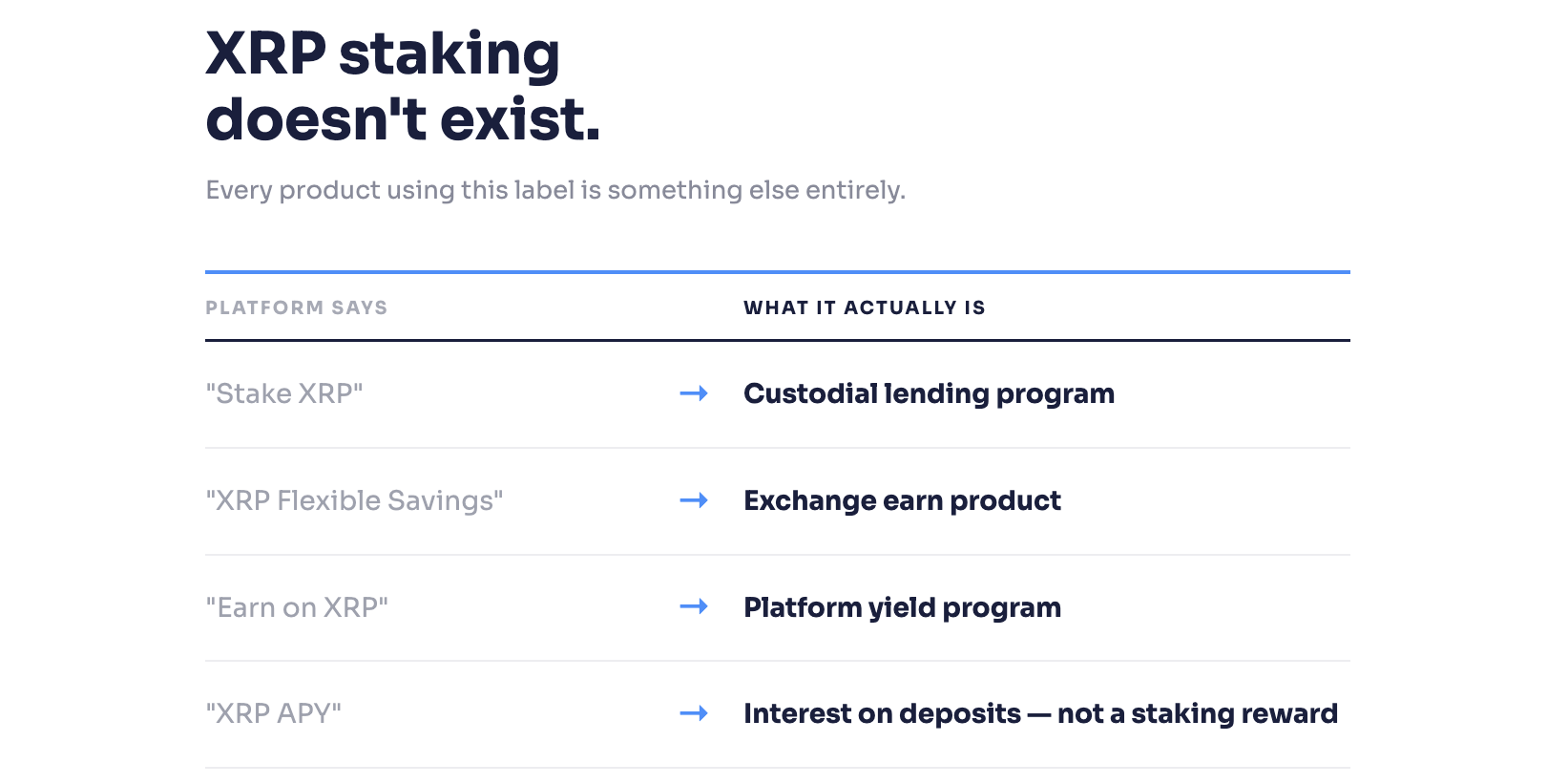
So when exchanges and apps advertise "XRP staking," they are using the word loosely — applying a label that resonates with crypto users to a product that works quite differently. Understanding that gap is the first step to evaluating your actual options.
What Gets Called "XRP Staking" — and What It Really Is
Every product marketed as XRP staking in 2026 falls into one of three categories, each with a different risk profile and yield source.
Exchange earn programs. Platforms like Binance and MEXC offer "Flexible Savings" or "Earn" products that accept XRP deposits. The exchange lends your XRP to other users or deploys it in yield strategies, then pays you a share. You're lending, not staking. Rates typically land between 1% and 3% APY and shift with platform demand.
Custodial yield platforms. CeFi lenders like Nexo and YouHodler accept XRP deposits and pay variable interest. Rates are higher than exchange earn programs — currently between 4% and 11% APY depending on the platform and tier — but they fluctuate with market conditions. Nexo's higher rates, for instance, require holding significant quantities of NEXO tokens or locking XRP for a fixed term.
Wrapped DeFi. Products on Ethereum, Flare, and other networks let you bridge XRP into a wrapped token form and deploy it in DeFi protocols. The XRPL's native AMM — live since 2024 — also offers liquidity provision directly on-ledger. These routes can offer 2%–8% in trading fees, but they introduce bridging risk, smart contract exposure, and impermanent loss that don't appear in the headline rate.
None of these are staking in the technical sense. In proof-of-stake systems like Ethereum, yield comes from the base protocol — validators receive newly minted tokens for securing the network. In the XRP ecosystem, every yield product sources returns from a third-party arrangement: lending, liquidity provision, or a platform's own program. The origin of the yield determines the nature of the risk.
XRP Lending Explained: How the Yield Actually Works
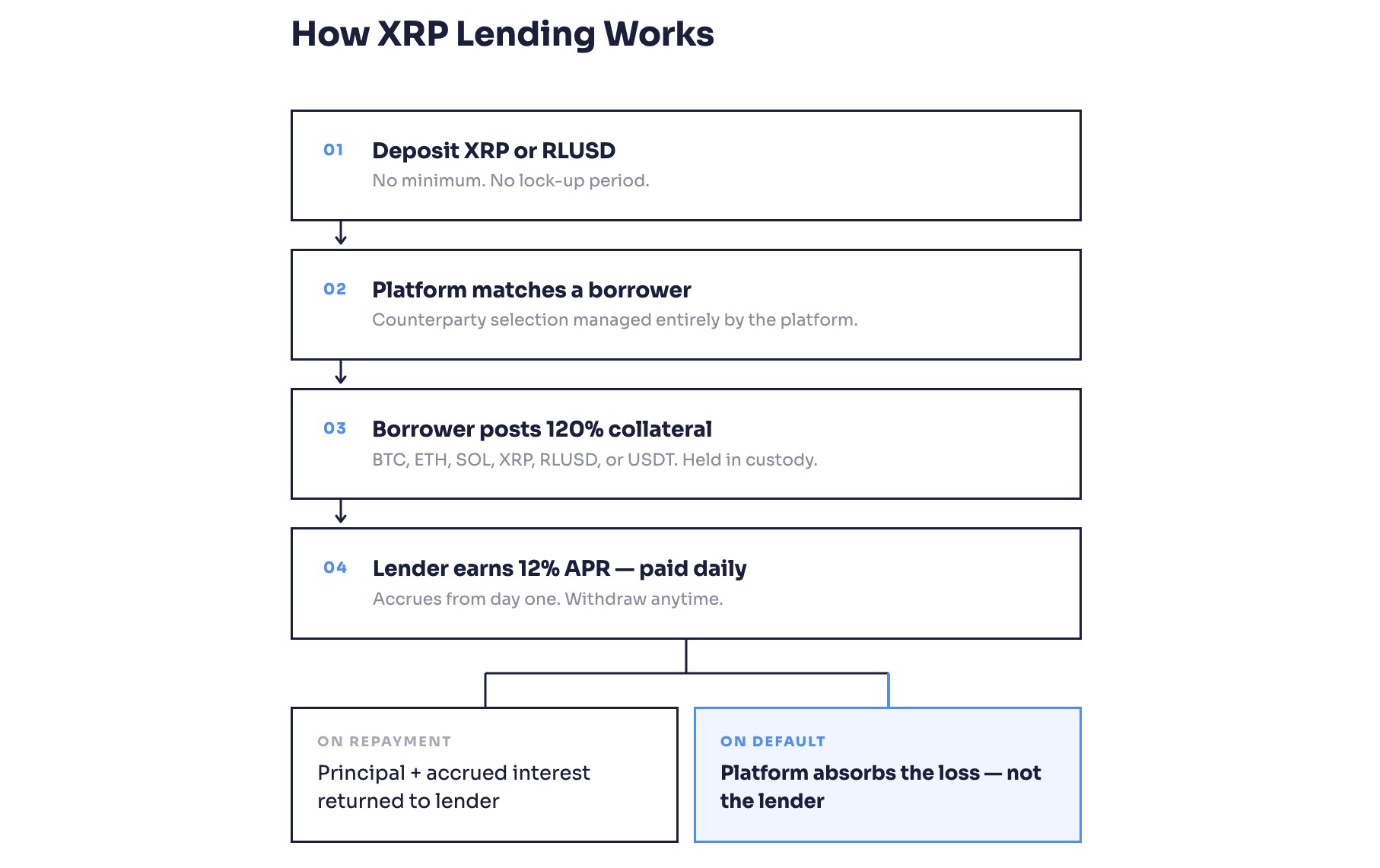
XRP lending is the most direct and liquid way to earn yield on XRP in 2026. The structure is simple: you deposit XRP into a lending platform, the platform matches your deposit with a borrower who needs XRP liquidity, the borrower pays interest on the loan, and you receive a share of that interest.
The critical variables across platforms:
- Rate type — fixed (predictable across time) or variable (fluctuates with demand)
- Who manages risk — the platform or the depositor
- Lock-up — none, flexible, or fixed term
- Payout frequency — daily, weekly, or at redemption
LendProtocol is a CeFi lending platform built on the XRP Ledger that focuses specifically on this use case. It accepts XRP and RLUSD deposits, pays 12% APR — fixed — with daily payouts and no lock-up period. Borrowers must post 120% collateral in BTC, ETH, SOL, XRP, RLUSD, or USDT. If a borrower defaults, LendProtocol absorbs the loss; depositors' capital is not at risk from individual loan failures.
The economics are transparent. LendProtocol charges borrowers 12.7% APR and pays lenders 12%. The 0.7% spread funds operations and builds the reserve buffer that backs the platform's commitment to absorb default losses.
The daily compounding effect matters here: 12% APR paid daily compounds to approximately 12.75% effective annual yield, because each day's interest is added to the principal and earns interest the following day.
Rate Comparison: XRP "Staking" vs. Lending in 2026
| Platform / Method | Stated APR / APY | Rate Type | Lock-Up | Who Bears Default Risk |
|---|---|---|---|---|
| LendProtocol | 12% APR (~12.75% effective annual) | Fixed | None | Platform |
| Nexo (XRP) | Up to 8.25% APY | Variable | Optional (higher rates require NEXO tokens) | Mixed |
| YouHodler | Up to 11% APY | Variable | Varies by product | Depositor / Platform |
| Binance Flexible Savings | 1–3% APY | Variable | None | Exchange |
| Wrapped DeFi (Ethereum / Flare) | 2–8% | Variable | None (bridge exit cost applies) | Depositor |
| XRPL AMM Liquidity Provision | Variable | Variable | None | Depositor |
| Traditional bank savings (USD) | 0.5–4.5% | Variable | Varies | Deposit insurance (limited) |
Several things stand out in this comparison.
First, the fixed nature of LendProtocol's 12% APR means the rate you see is the rate you earn — it doesn't drop when market conditions soften. Variable-rate platforms publish their peak figures; real-world yields often land lower.
Second, Nexo's maximum rates come with significant conditions: holding millions of NEXO tokens, electing to receive interest in NEXO rather than XRP, and in some cases locking funds for a fixed term. Without meeting those conditions, the base rate is considerably lower.
Third, DeFi routes introduce risks that don't appear in the headline APY — bridge exploits, smart contract bugs, oracle failures, and impermanent loss can all erode real returns below what the protocol's advertised rate implies.
Fourth, the effective annual yield from daily compounding on LendProtocol's 12% APR (~12.75%) exceeds the top-end stated rate of most variable-rate alternatives. The question "which pays more" has a clear answer in the current rate environment.
Finally, context matters for the exchange rates listed. A platform showing 11% APY for XRP may be publishing a peak figure achieved under specific conditions — high borrower demand, a particular product tier, or a promotional period. Market rate trackers currently show the average XRP lending rate across major platforms sitting around 7.5% APY, with the majority of flexible-savings products paying toward the lower half of their advertised ranges. A fixed 12% APR, regardless of market conditions, is a structurally different value proposition.
Who Bears the Risk? The Detail Most Comparisons Skip
Yield and risk are always paired. Before depositing XRP anywhere, the relevant question isn't just "what's the rate?" — it's "who absorbs the loss if something goes wrong?"
DeFi protocols. Depositors share risk through pooled liquidity. If a borrower position isn't liquidated in time — because of sudden price movement or an oracle delay — the shortfall is distributed across the pool. Smart contract exploits and governance failures have caused significant depositor losses on major DeFi protocols. Rates are algorithmic and can fall sharply when borrower demand drops.
Exchange earn programs. You're trusting a centralized institution to manage funds, custody assets, and remain solvent. Several large exchanges have failed or halted withdrawals in recent years. Rates are set by the platform and can be cut without extended notice.
Overcollateralized CeFi lending with platform-assumed risk. LendProtocol operates as principal between lenders and borrowers — not merely as infrastructure. When a borrower defaults, LendProtocol absorbs the loss, not the depositor. The 120% collateral requirement creates a meaningful buffer: collateral values would need to fall more than 16.7% before a defaulted loan results in a net loss for the platform, and the 0.7% spread accumulated across all active loans continuously builds reserves.
This model is structurally similar to how retail banks handle credit risk — the institution takes on loan exposure so individual depositors don't need to manage or even know about specific borrower performance. For most XRP holders, that separation is the most practically significant feature of the platform.
The security infrastructure reinforces this: assets are held primarily in cold storage, data is encrypted with AES-256 GCM, and all accounts require two-factor authentication. As of mid-2026, the platform has over 13,700 active lenders and has processed over 743 million XRP in total lending volume — figures that reflect meaningful adoption within the XRPL ecosystem.
How to Start Earning Yield on XRP: A Practical Guide
Since native staking doesn't exist on the XRP Ledger, lending is the functional answer to "how to stake XRP." Here's how the main routes work in practice.
Via LendProtocol (fixed rate, platform-assumed risk):
- Create an account at lendprotocol.io
- Complete identity verification (standard KYC process)
- Enable two-factor authentication — required on all accounts
- Deposit XRP or RLUSD to your lending balance
- Interest accrues from the first day at 12% APR, paid daily to your account
- Withdraw at any time — no lock-up, no notice period required
No minimum deposit is specified. The platform accepts both XRP and RLUSD, so holders of either asset can start earning without converting between assets.
Via centralized exchange earn programs:
- Log into your exchange account (Binance, Nexo, YouHodler)
- Navigate to the "Earn," "Savings," or equivalent section
- Select XRP and choose between flexible or fixed-term products
- Deposit the desired amount and confirm
- Monitor your balance — rates may change, and some platforms allow the platform to adjust terms
Via DeFi (wrapped XRP on Ethereum or Flare):
- Set up an Ethereum-compatible wallet
- Use a bridge service to move XRP to the target network as a wrapped token
- Connect to a DeFi lending protocol or AMM
- Supply liquidity to an XRP-paired pool
- Monitor the position actively — impermanent loss, utilization rates, and protocol risk all require ongoing attention
The exchange route is the easiest to start but typically pays the least, and rate control belongs entirely to the platform. DeFi routes offer variable yield potential but require technical fluency and active management. The fixed-rate lending route through a platform like LendProtocol is designed to match the simplicity of an exchange product while offering a higher, stable rate and cleaner risk terms.
RLUSD: Yield Without XRP Price Exposure
Not every XRP Ledger participant wants exposure to XRP's price. RLUSD — Ripple's regulated, fully-backed USD stablecoin native to the XRPL — offers a separate path.
LendProtocol accepts RLUSD deposits at the same fixed 12% APR paid on XRP, with the same daily payout structure and no lock-up. For holders who want to participate in the XRPL ecosystem but prefer to hold a dollar-denominated position, this is the relevant option. Returns accrue in RLUSD, so yield calculations aren't complicated by XRP price movements.
The comparison to traditional savings is direct: standard USD savings accounts currently pay 0.5%–4.5% depending on jurisdiction and rate environment. A 12% APR on a regulated, dollar-pegged stablecoin is a material step up — without leaving the XRP Ledger.
RLUSD is also accepted as borrower collateral on the platform, alongside BTC, ETH, SOL, XRP, and USDT. This makes it dual-purpose: deposit it to earn yield, or use it to borrow XRP working capital without liquidating a stablecoin position.
FAQ
Can you stake XRP?
No. XRP cannot be staked natively on the XRP Ledger. The network uses Federated Byzantine Agreement consensus, which has no protocol-level reward mechanism for token holders. Any product described as "XRP staking" is actually a lending product, exchange earn program, or custodial yield arrangement — not staking in the technical sense.
What is the best way to earn yield on XRP in 2026?
Fixed-rate lending platforms offer the highest certain yield on XRP in 2026. LendProtocol's stated offer is 12% APR with daily payouts and no lock-up. Variable-rate alternatives through centralized exchanges typically pay 1%–8% APY, with rates that fluctuate based on platform conditions and account tier. Wrapped DeFi options offer 2%–8% with added technical complexity. This is informational — always review a platform's current terms and risk model before depositing.
How is XRP lending different from XRP staking?
XRP staking doesn't exist as a native protocol function. XRP lending is a financial arrangement: you deposit XRP, a borrower takes a loan against posted collateral, pays interest, and you receive a share of that interest. The yield originates from borrower demand rather than from a protocol reward schedule. Lending is the functional alternative to staking on the XRP Ledger.
Is XRP lending safe?
The safety profile depends entirely on the platform and its risk model. In overcollateralized lending where the platform assumes default risk — as LendProtocol does — individual depositors are not exposed to specific borrower failures. In pooled DeFi protocols, depositors share default risk with all other participants. In exchange earn programs, depositors carry the solvency and custody risk of the exchange itself.
Does LendProtocol pay yield on RLUSD?
Yes. LendProtocol accepts both XRP and RLUSD deposits and pays 12% APR on both, with daily compounding. RLUSD depositors earn yield without exposure to XRP price volatility, making it relevant for risk-averse holders and institutional treasury teams.
What collateral do borrowers post on LendProtocol?
Borrowers must post 120% of the loan value in accepted collateral — BTC, ETH, SOL, XRP, RLUSD, or USDT. The 20% overcollateralization provides a buffer against collateral price movements before a default creates a net loss for the platform's reserve.
How does daily compounding affect my actual yield?
A 12% APR compounded daily produces approximately 12.75% effective annual yield. Each day's interest is added to the principal, which earns interest the following day. Over a full year, the compounding effect adds roughly 0.75 percentage points above the stated APR — without requiring any action from the depositor.
What is RLUSD?
RLUSD is Ripple's regulated, fully-backed USD stablecoin native to the XRP Ledger. It maintains a 1:1 peg to the US dollar and is used in payments, settlements, and yield-bearing deposits across XRPL-native platforms. More information is available at ripple.com/rlusd.
Is there a lock-up period to earn yield on XRP?
It depends on the platform. Exchange earn programs often offer a choice between flexible (no lock-up) and fixed-term (locked, higher rate) products. LendProtocol has no lock-up period — depositors can withdraw at any time without a notice period or penalty.