XRP Staking Rewards: Realistic Rates 2026
XRP can't be staked natively — but you can earn up to 12.75% APY through lending. See real XRP staking rates by platform and what the risks actually are.
There's a persistent myth floating around crypto forums: that you can stake XRP the same way you stake Ethereum or Solana. You can't. But that doesn't mean XRP holders are stuck with zero yield — it means the path to earning on XRP runs through lending, not staking. And the rates available right now are worth knowing.
This guide breaks down what XRP staking rewards actually are, what rates are realistic in 2026, and how different methods compare.
Why "XRP Staking" Isn't Really Staking
XRP cannot be natively staked, and this isn't a technicality — it's a fundamental design choice. The XRP Ledger uses Federated Byzantine Agreement (fBFT) consensus, not Proof-of-Stake. Transactions are validated by a network of trusted nodes rather than by stakers competing for block rewards. There are no delegation mechanisms and no protocol-level yield for holding XRP.
When platforms advertise "XRP staking," they're typically describing custodial arrangements where users deposit XRP in exchange for interest payments. The platform deploys those assets through lending markets, liquidity provision, or institutional borrowing, then passes a share of the returns back to depositors.
That's not inherently a problem — but it's a distinction that matters for understanding both risk and return.
XRP APY Rates: What the Market Looks Like in 2026
So what can you actually earn? The honest answer: it varies widely by platform and method.
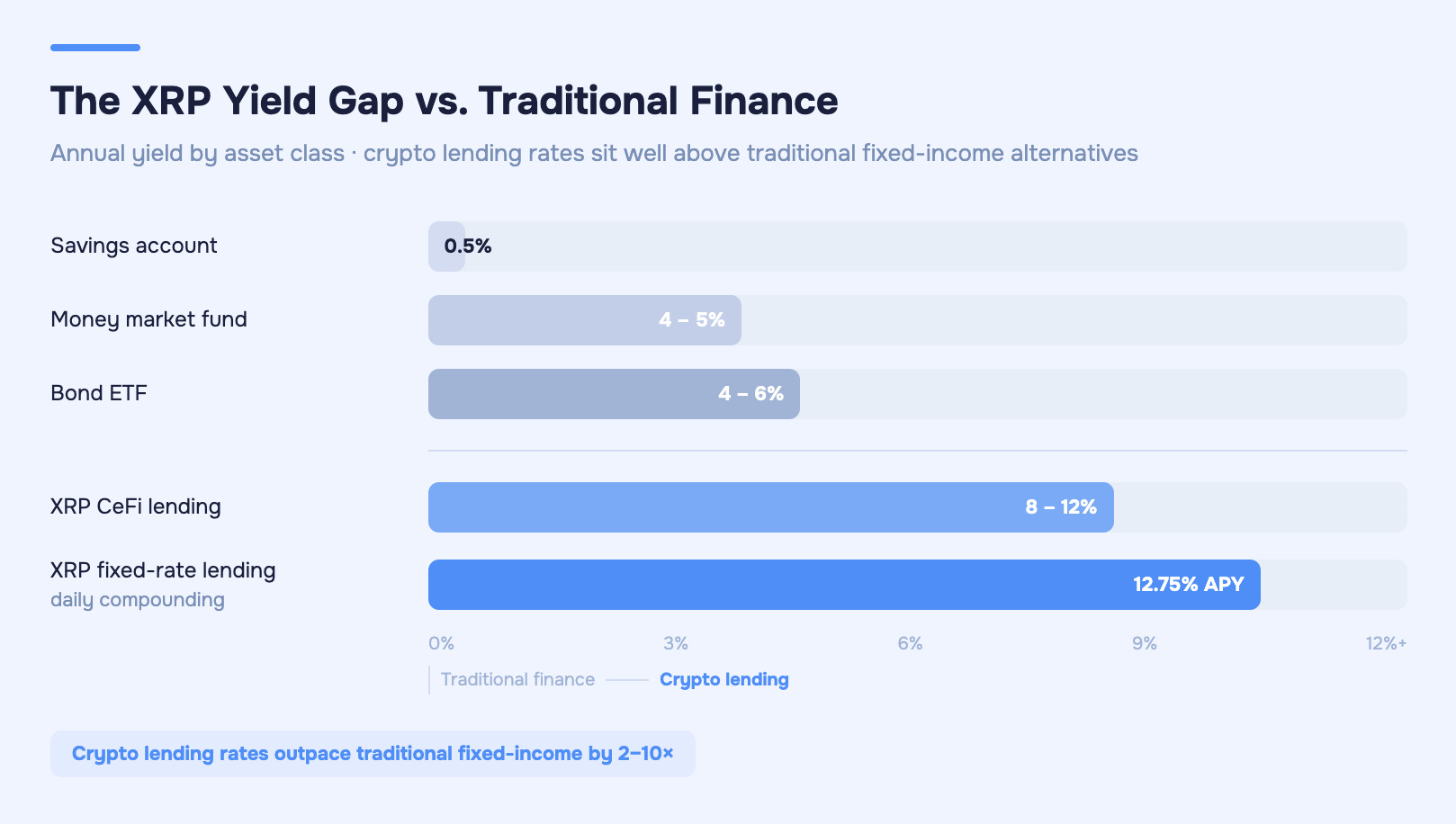
Exchange earn programs at major venues typically sit in the 1.5%–3% range for flexible XRP deposits, with tiered structures that often pay less on larger balances. Dedicated CeFi lending platforms reach 8%–12% APY, depending on custody model and risk structure.
The table below summarizes the current landscape:
| Platform / Method | XRP APY | Lock-up | Risk Model | Notes |
|---|---|---|---|---|
| Exchange flexible savings | 1.5%–3% | None | Platform risk | Tiered rates; larger deposits often earn less |
| CeFi lending (mid-tier) | 4%–8% | Varies | Platform risk | Some require native token holdings for top rates |
| CeFi lending (top-tier) | 8%–12% | Flexible | Platform risk | Weekly or daily payouts depending on platform |
| LendProtocol | 12% APR (~12.75% effective) | None | Platform absorbs default risk | Daily compounding; XRPL-native; fixed rate |
| Market-making yield products | Up to 5% | None | Platform risk | Yield from algorithmic strategies, not lending |
A few things this table doesn't show: some platforms require holding their native token to unlock top rates, which adds token price exposure to the yield calculation. Always check whether a quoted rate is conditional on additional product holdings.
XRP Staking Rates by Method
Exchange Earn Programs
The most accessible entry point. Platforms like Binance Earn and similar exchange products let users deposit XRP without lock-up and earn daily interest. The trade-off is rate — flexible exchange earn programs typically pay 1.5%–3% APY on XRP, with rates that adjust frequently based on borrowing demand and platform conditions.
These are low-friction and suitable for holders who want some yield without complexity, but the XRP APY is on the lower end of what's available.
CeFi Lending Platforms
Platforms like Nexo and YouHodler take XRP deposits, lend to institutional borrowers, and distribute a share of interest to depositors. Rates here are more competitive — 8%–12% APY depending on product structure and tier. The trade-off is custody: your XRP sits in a centralized platform's control, creating counterparty exposure.
Some platforms condition their highest rates on holding a platform-native token, which changes the effective risk profile of the yield.
XRPL-Native Lending
LendProtocol operates directly on the XRP Ledger, offering 12% APR with daily compounding — producing approximately 12.75% effective annual yield. One structural distinction worth noting: LendProtocol acts as principal between lenders and borrowers rather than simply as infrastructure. Borrowers must post 120% collateral, and if a borrower defaults, LendProtocol absorbs the loss rather than passing it to depositors. There is no lock-up period.
Market-Making and DeFi Alternatives
Some platforms generate yield through algorithmic market-making rather than direct lending, typically returning 3%–5% APY on XRP. Others allow bridging XRP to Ethereum-compatible networks to access DeFi lending protocols — at the cost of additional steps, smart contract exposure, and bridge risk.
What Makes XRP Staking Rewards Different From ETH or SOL
To understand the risk profile of XRP yield, it helps to compare it with networks that do have native staking:
| Factor | Ethereum / Solana Staking | XRP "Staking" (Lending/Yield) |
|---|---|---|
| Yield source | Protocol-level block rewards | Platform operations: lending, market-making |
| Slashing risk | Yes — validator penalties possible | No — no consensus participation |
| Smart contract risk | Liquid staking involves contracts | Varies by platform |
| Lock-up | Unbonding periods common | Usually flexible |
| Default risk | None (protocol-backed) | Platform/borrower default |
| Yield type | Native token rewards | Interest income |
XRP staking rewards don't come from the protocol — they come from what the platform does with your funds. Which platform and which strategy determine both the rate and the risk
RLUSD: XRP Ecosystem Yield Without Price Exposure
One option that often gets overlooked: earning yield on RLUSD rather than XRP itself. RLUSD is Ripple's regulated, fully-backed USD stablecoin native to the XRP Ledger. For holders who want access to XRP ecosystem yield rates without taking on XRP's price volatility, RLUSD-denominated yield is worth considering.
LendProtocol accepts RLUSD deposits alongside XRP, paying the same 12% APR on both. For institutional treasury teams or risk-averse depositors, 12% on a USD-pegged asset is a different proposition than 12% on XRP — the yield is identical, the underlying price risk is not.
Key Risks to Understand Before Earning on XRP
No XRP yield product is risk-free. The main risks:
- Platform risk. Most XRP yield comes from centralized platforms. If a platform fails — as several high-profile CeFi lenders demonstrated in 2022 — depositor assets are at risk. Transparent reserves, clear custody disclosures, and cold storage practices matter.
- Rate variability. Most exchange earn programs post variable rates that shift with market conditions. Fixed-rate products, like LendProtocol's 12% APR, stand out partly because the alternative for most platforms is a floating rate with no floor.
- Lock-up risk. Some higher-rate products require funds to be locked for a fixed term. If you need liquidity, a no-lock-up product may be worth accepting a lower rate.
- Token dependency. Several CeFi platforms condition their best rates on holding a platform-native token, adding token price exposure to any yield calculation.
- Collateral and default risk. On lending platforms, the quality of borrower collateral and how the platform handles defaults determines how protected your principal actually is.
The Bottom Line
XRP staking rewards are real, but they're lending income — not protocol rewards. The range available in 2026 runs from roughly 1.5% at exchange earn programs to 12%+ on dedicated lending platforms. The gap between those figures reflects a corresponding gap in risk structure, lock-up conditions, and platform transparency.
The most useful question isn't "what's the highest XRP APY?" — it's whether the yield source, custody model, and risk structure fit your situation. A 12% fixed rate with daily payouts and no lock-up sounds better than 3% with lock-up, but understanding what backs the higher rate is what separates informed yield decisions from chasing numbers.
XRP holders have real options now. Knowing what each option actually is — mechanically, structurally, and in terms of risk — is where the analysis starts.
This article is for informational purposes only and does not constitute financial advice. Cryptocurrency products involve risk. Always verify platform terms, security practices, and regulatory status in your jurisdiction before depositing funds.
FAQ
Can you actually stake XRP natively?
No. The XRP Ledger does not use Proof-of-Stake, so there is no native mechanism for validators or token holders to earn staking rewards from the protocol itself. All XRP staking rewards currently come from platform-run yield programs — lending, market-making, or savings products — not from the XRP protocol.
What is a realistic XRP APY in 2026?
Depending on the platform and method, anywhere from 1.5% to 12.75%. Exchange earn programs sit at the low end (1.5%–3%); dedicated CeFi lending platforms with overcollateralized borrower models sit at the top of the range. The spread reflects genuine differences in risk structure, not just marketing.
Is XRP staking the same as lending?
Functionally, yes. When a platform advertises XRP staking, they're typically running a lending or market-making yield program. Your XRP is deployed to generate returns, and the platform passes a portion back to you. Understanding how the yield is generated is the most important step in evaluating any XRP staking rates offer.
Does XRP staking have slashing risk?
No. Slashing is a Proof-of-Stake mechanism that penalizes validators for protocol violations. Since XRP doesn't use PoS, there's no slashing. The relevant risks for XRP yield are platform risk, borrower default risk, and rate variability — not validator penalties.
What's the difference between XRP APR and XRP APY?
APR (Annual Percentage Rate) is the stated rate without compounding. APY (Annual Percentage Yield) accounts for compounding frequency. Daily compounding on a 12% APR product produces approximately 12.75% APY — a meaningful difference over time. When comparing XRP staking rates across platforms, confirm whether the figure quoted is APR or APY.
Can I earn yield on XRP without leaving the XRPL ecosystem?
Yes. LendProtocol is built natively on the XRP Ledger, so XRP and RLUSD deposits settle on-chain without bridging to another network. For XRP holders who prefer to stay within the XRPL ecosystem, this is the primary option for earning fixed-rate yield without cross-chain exposure.