XRP Lending Platforms Compared: What to Look For
The right XRP lending platform comes down to five things: rate type, who absorbs default losses, lock-up, custody, and whether you leave the XRP Ledger. Here is how four platforms compare.
The right XRP lending platform comes down to five things: whether the rate is fixed or variable, who absorbs the loss if a borrower defaults, whether funds are locked, how assets are stored, and whether you need to leave the XRP Ledger to earn at all. This article applies those five checks to four platforms across the XRP yield market.
Why XRP Can't Be Staked
XRP cannot be staked. The XRP Ledger runs on Federated Byzantine Agreement (fBFT), a consensus model where trusted validators agree on transaction order without locking up any tokens. Without a lockup mechanism, there is no protocol-level reward. The XRP Ledger was designed this way deliberately: settlement speed and finality took priority over validator incentives.
That means every XRP yield product is a workaround, not a native feature. Some are custodial lending programs. Some are liquidity pools on the XRPL's native AMM, which launched in 2024. Some bridge XRP to another chain entirely. Each category has different mechanics, custody arrangements, and risk. Knowing which category you're in before depositing matters more than any headline rate.
What to Check Before You Compare Rates
The rate is the last thing to compare, not the first. Before that: Is the rate fixed or variable? Who takes the loss when a borrower defaults? Are funds locked up? Are assets in cold storage or a hot wallet? A variable rate with pooled default risk and a 90-day lock-up reads very differently from a fixed rate with no lock-up and platform-absorbed losses, even if the numbers look close.
How They Compare
| LendProtocol | Nexo | YouHodler | Moonwell (cbXRP) | |
|---|---|---|---|---|
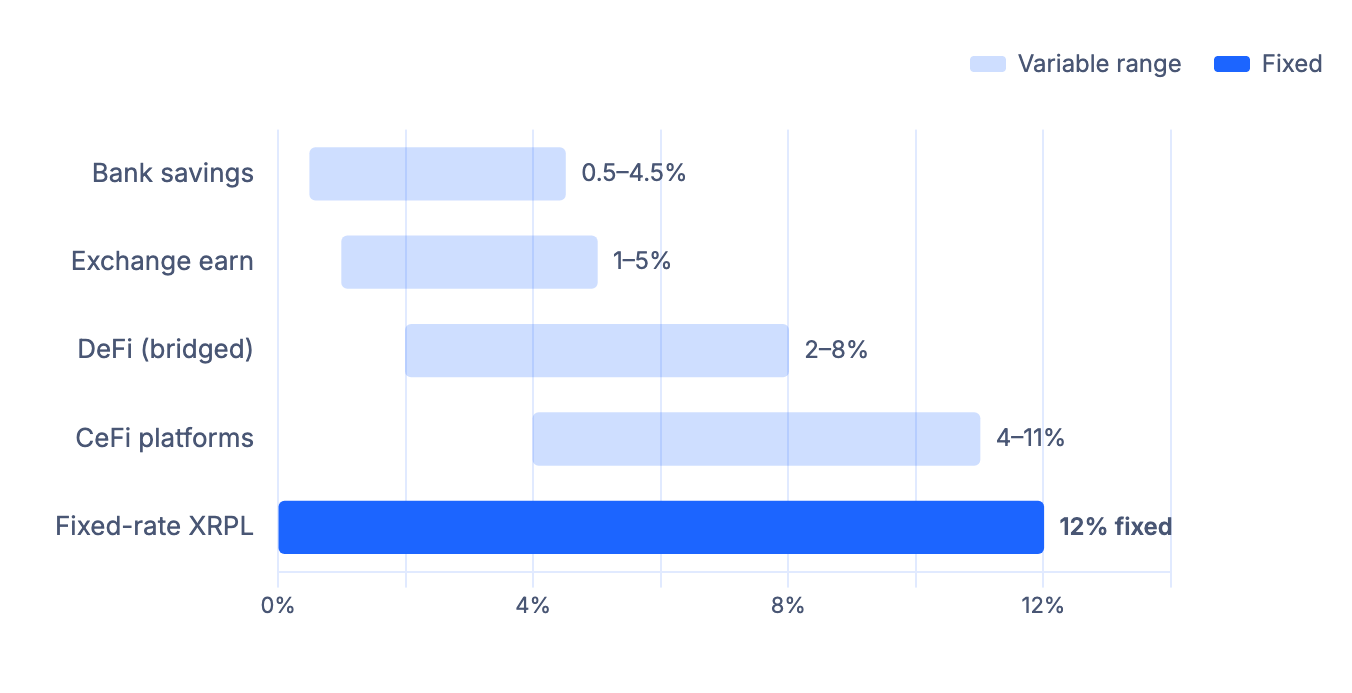
| Rate | 12% APR | Up to 8.25% APY | Up to ~11% APY | Typically 2–5% APY |
| Rate type | Fixed | Variable | Variable | Variable |
| Default risk | Platform | Platform | Platform | Depositors (pooled) |
| Payout | Daily | Daily / at maturity | Weekly | Continuous |
| Lock-up | None | Optional | None | Pool-dependent |
| Custody | Cold storage | Exchange | Ledger Vault | Smart contract |
1. LendProtocol — 12% APR, fixed
Key benefits:
- Fixed 12% APR regardless of market conditions, loyalty tier, or deposit size
- Platform absorbs all default risk; depositors are never exposed to borrower losses
- No lock-up — withdraw anytime, including the same day
- Daily compounding produces ~12.75% effective annual yield
- XRPL-native — no bridging, no wrapped assets, no smart contract exposure
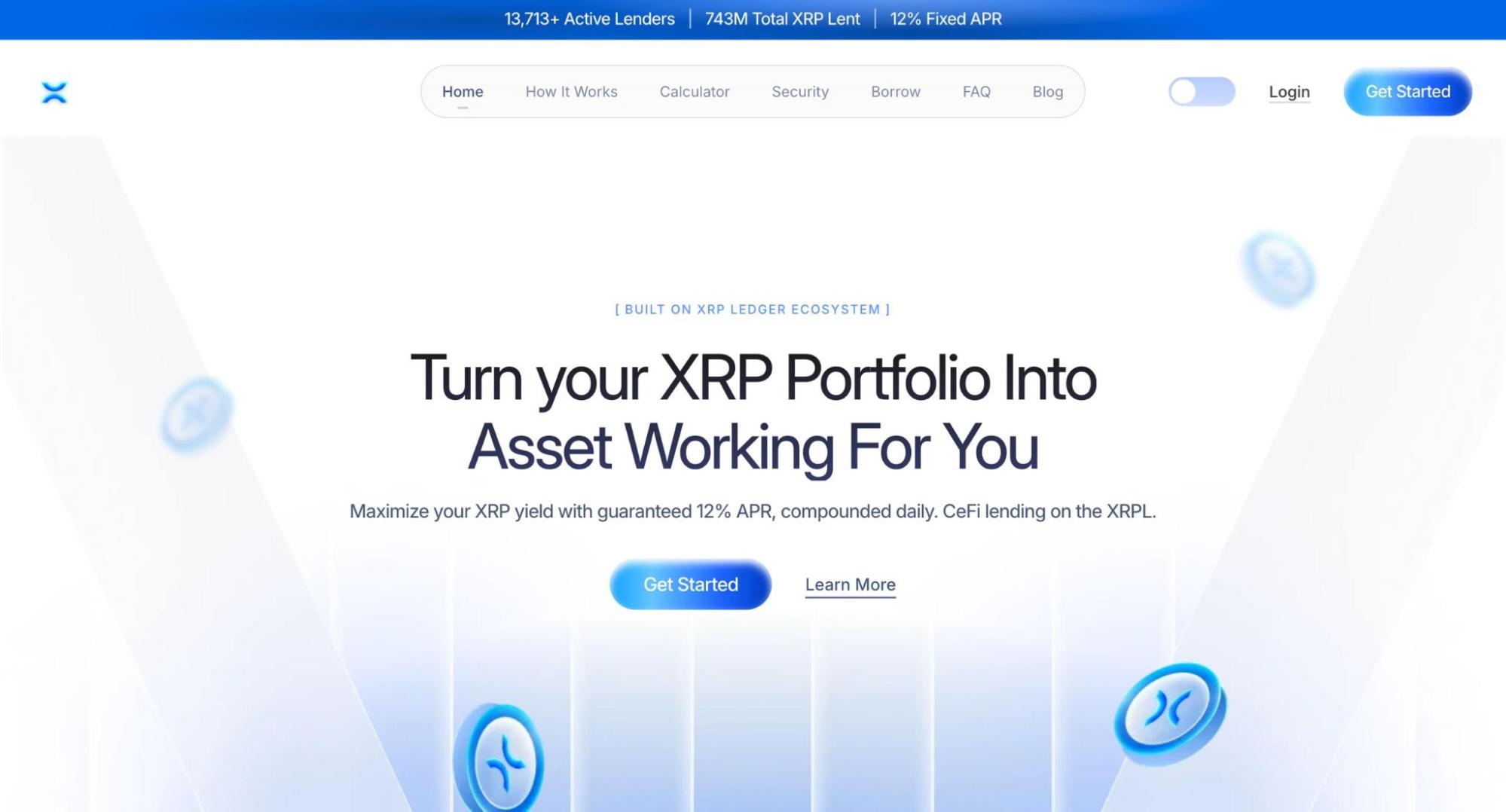
LendProtocol is the benchmark for this comparison. It is the only XRP lending platform here that combines a fixed rate, platform-absorbed default risk, daily compounding, no lock-up, and XRPL-native cold storage custody in a single product. As a CeFi XRP lending platform built on the XRP Ledger, it offers a stated 12% APR on XRP and RLUSD deposits. The rate is not tier-dependent: every depositor receives the same stated rate regardless of deposit size, without holding a platform token or meeting any loyalty threshold.
Borrowers post 120% collateral per loan — BTC, ETH, SOL, XRP, RLUSD, or USDT — and the platform assumes all default risk itself, distributing none of it across the depositor base. The disclosed spread between the borrower rate (12.7%) and the lender rate (12%) funds platform operations. As of current reporting, 13,713+ active lenders have deployed 743 million XRP on the platform.
RLUSD is also accepted as a deposit asset at the same 12% rate, allowing holders to earn yield in dollar terms without XRP price exposure — relevant for institutional treasury teams or risk-averse depositors who want predictable income without volatility.
Best for: XRP and RLUSD holders who want a fixed, predictable yield with daily compounding, no lock-up, and default risk held by the platform.
2. Nexo — up to 8.25% APY, variable
Key benefits:
- Platform absorbs default risk — depositors don't share loan losses
- Flexible Savings: daily payouts with no lock-up required
- Multi-asset custodial account — consolidate XRP alongside other holdings
- Fixed-term option available for a marginally higher rate
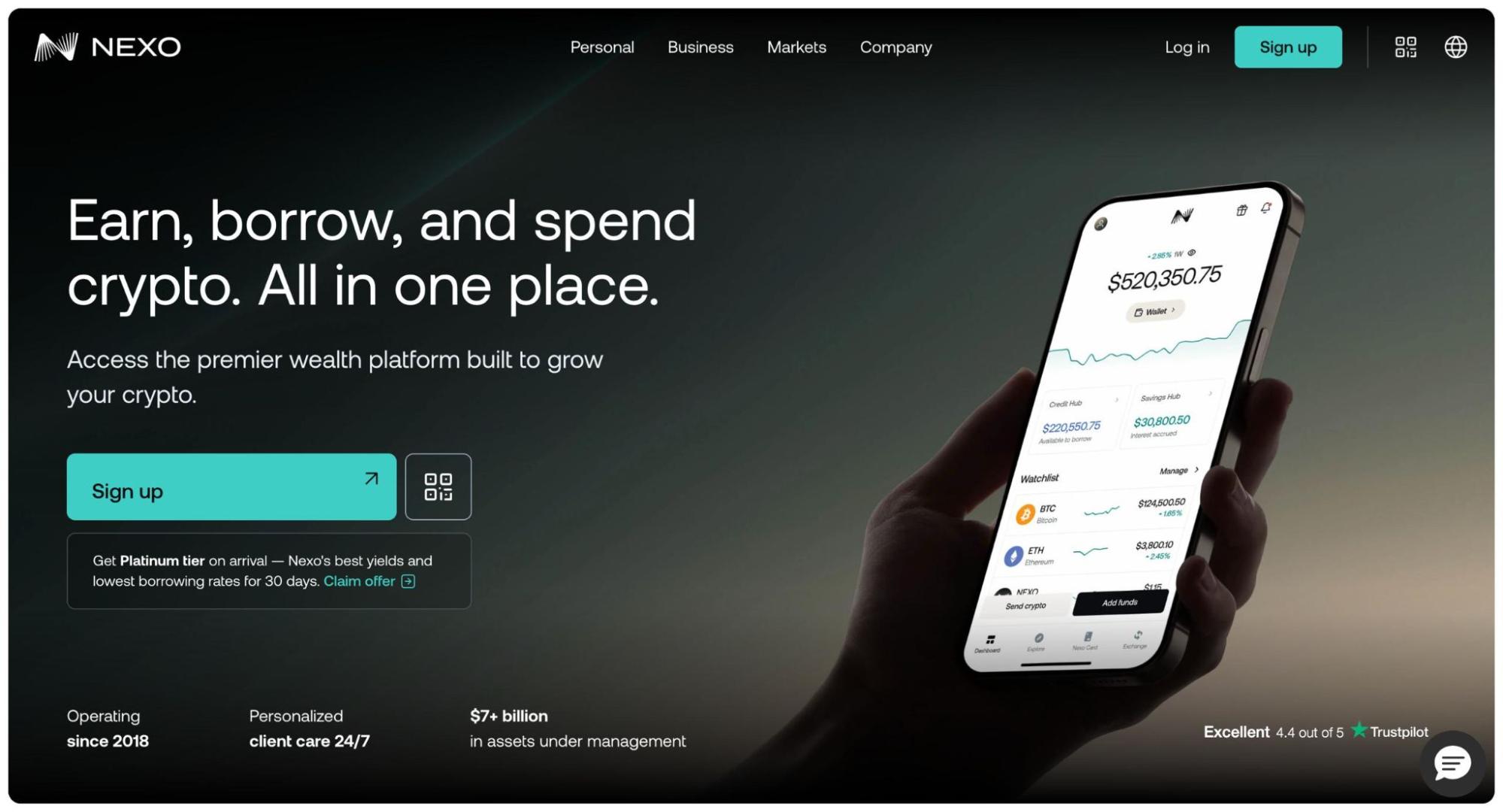
Nexo is one of the most established CeFi lenders in the market. XRP yield tops out at 8.25% APY, but that figure is loyalty-tier-dependent: reaching the headline rate requires holding NEXO tokens at a set ratio to your total portfolio balance. Most depositors earn a lower rate than the advertised ceiling.
Two product modes are available. Flexible Savings pays daily with no lock-up. Fixed-term Savings locks XRP for a set period and pays accumulated interest at term's end. In both cases, Nexo acts as the direct counterparty and absorbs default risk, so depositors don't share loan losses. The variability is the primary limitation: the rate reflects market conditions and platform policy rather than a fixed contractual commitment.
Best for: Holders who already use Nexo for other assets and want to consolidate XRP into one custodial account.
3. YouHodler — up to ~11% APY, variable
Key benefits:
- Highest variable rate among named CeFi XRP lending platforms, up to ~11% APY
- Institutional-grade custody through Ledger Vault
- No lock-up required on any deposit
- Platform absorbs default risk, not depositors
YouHodler offers the highest headline XRP rate in the variable CeFi category at around 11% APY. Like Nexo, the rate shifts with market conditions. Unlike Nexo, assets are held through Ledger Vault, a qualified institutional custodian — a distinction that matters to depositors who weigh custody transparency closely. The platform absorbs default risk rather than distributing it across depositors.
Payouts land weekly rather than daily. No lock-up is required. The 11% figure is a ceiling, not a floor, and can contract in lower-demand markets. For depositors who need daily liquidity or a fixed return, the payout cadence and rate variability are meaningful trade-offs against the higher ceiling.
Best for: XRP holders who prioritize rate ceiling over payout frequency and want platform-absorbed default risk with institutional-grade custody.
4. Moonwell (cbXRP) — typically 2–5% APY, variable
Key benefits:
- Non-custodial — no company holds your XRP; you retain control via a self-custody wallet
- cbXRP is 1:1 backed and issued by Coinbase, redeemable for native XRP
- Permissionless access — no platform account or approval process required
- Continuous yield accrual directly on-chain
Moonwell is a DeFi lending protocol on Base, Coinbase's Ethereum Layer-2 network. XRP holders convert their holdings to cbXRP — Coinbase Wrapped XRP, a 1:1-backed token redeemable for native XRP — and supply it to Moonwell's lending markets to earn yield. No centralized lender holds your XRP; the wrapped asset interacts directly with smart contracts, and you maintain custody through a non-custodial wallet.
The trade-off is the risk model: default exposure pools across all depositors on Moonwell, so a wave of borrower defaults reduces balances for everyone in the pool simultaneously. Rates are also lower than the CeFi XRP lending platforms above and fluctuate with on-chain supply and demand. Getting started requires converting XRP to cbXRP via Coinbase, bridging to Base, and connecting a non-custodial wallet — meaningful setup friction for holders new to DeFi.
Best for: Technically comfortable XRP holders who want non-custodial, on-chain yield and are willing to accept a lower, variable rate in exchange for direct protocol access without a centralized intermediary.
What the Rate Number Actually Means
A fixed 12% APR paid and compounded daily produces roughly 12.75% effective annual yield — more than the headline number implies. Interest credited on day one earns its own interest from day two onward. Over a full year, that compounding effect adds approximately 0.75 percentage points to total return.
Variable XRP lending platforms sometimes post higher headline numbers. Whether those hold depends on borrower demand and market conditions. Pick a fixed rate to know your return in advance; pick variable if you're willing to trade certainty for potential upside.
One metric worth tracking on any XRP lending platform is the spread: the margin between what borrowers pay and what lenders receive. A disclosed, narrow spread indicates the platform runs on interest income rather than opacity. Wider spreads can fund legitimate operations, but the disclosure matters as much as the number.
Final Thoughts
Of the four XRP lending platforms above, Moonwell offers non-custodial on-chain access at a lower variable rate. Nexo and YouHodler sit in the accessible CeFi tier with platform-absorbed default risk but variable yields that can shift. Fixed-rate XRP lending on LendProtocol stands apart from all three: the rate is fixed, the default risk stays with the platform, payouts compound daily, and no bridging, wrapped assets, or tiered loyalty program is required.
FAQ
Can you stake XRP?
No, not natively. The XRP Ledger uses Federated Byzantine Agreement, not proof-of-stake, so there is no protocol-level staking mechanism and no native staking reward. Products marketed as "XRP staking" are lending programs, custodial yield accounts, or liquidity pools. The label is a simplification, not a technical description.
What's the difference between CeFi and DeFi XRP lending?
In CeFi, a company holds your funds and manages loans on your behalf. You rely on the platform's solvency, security practices, and loan management. In DeFi, your funds interact with smart contracts — no company in the middle, but smart contract bugs, bridge failures, and shared default risk become your problem directly. Neither is inherently safer; they distribute risk differently.
What should I look for in a fixed-rate XRP lending platform?
Start with who absorbs default risk, not the rate itself. Then check: are assets in cold storage? Is there a lock-up? Can you withdraw on demand? What's the collateral ratio on borrower loans? A 12% fixed rate with daily payouts, no lock-up, and platform-backed default coverage tells you considerably more than the yield number alone.
What is RLUSD and why does it appear on some XRP lending platforms?
RLUSD is Ripple's fully-backed, regulated USD stablecoin on the XRP Ledger. Some platforms accept RLUSD deposits alongside XRP, allowing holders to earn yield in dollar terms without XRP price exposure. For risk-averse depositors or institutional treasury teams holding idle RLUSD balances, that's a separate product decision from XRP lending, even when both options sit on the same platform.
How does daily compounding work in practice?
Daily payout means interest is credited once per 24 hours. That credit then earns its own interest from the next day onward. A 12% APR with daily compounding produces approximately 12.75% effective annual yield. The difference grows with time and deposit size.