Stake XRP: The Complete 2026 Guide
XRP has no native staking. Here's every real way to earn yield on XRP in 2026 — including 12% APR with daily payouts and no lock-up.
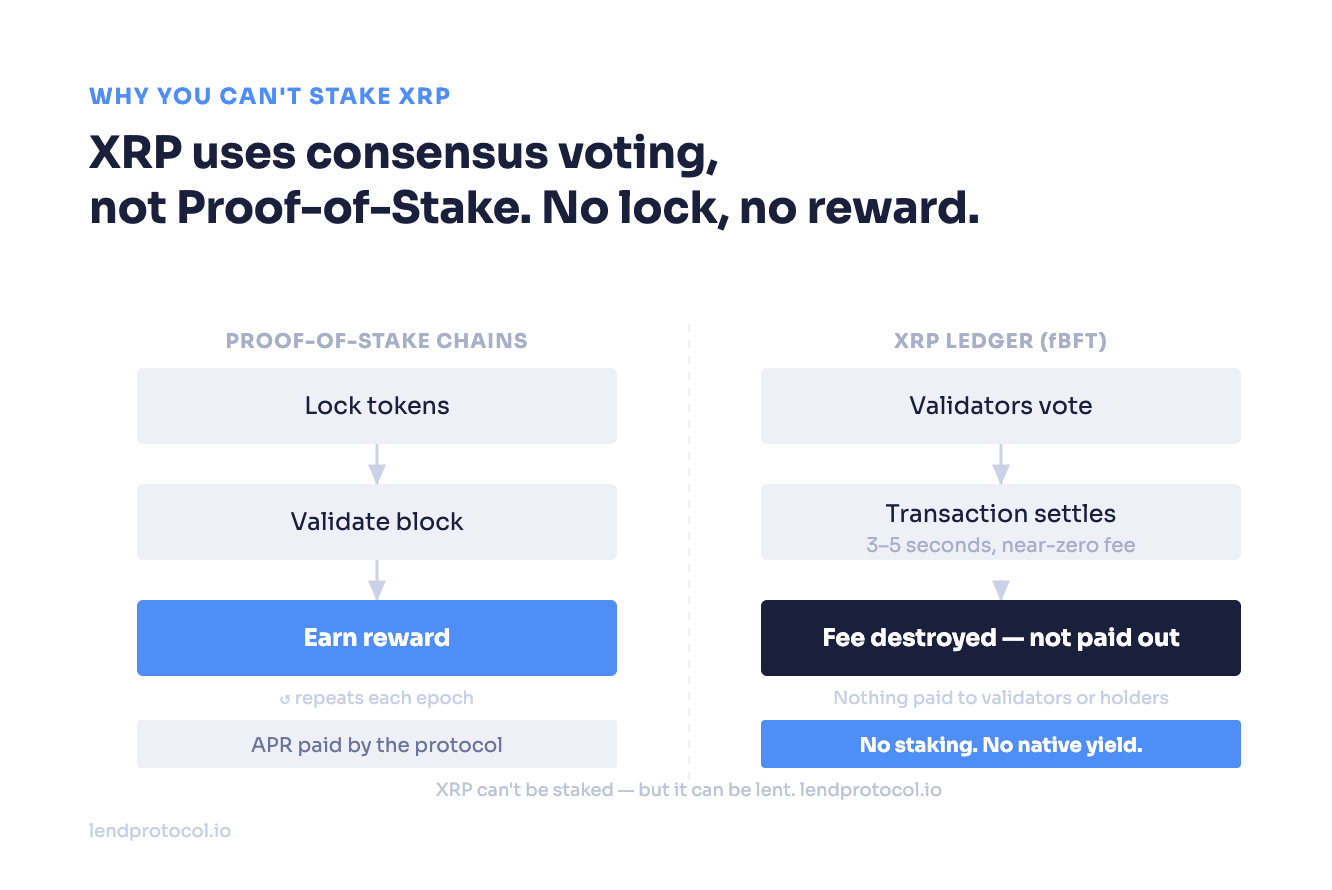
If you've spent any time researching XRP yield, you've probably hit the same wall. Every "staking" page either redirects you to an exchange earn product or buries the real answer in paragraph eight. So here it is upfront: you cannot stake XRP in the traditional sense. The XRP Ledger doesn't use Proof-of-Stake. There is no protocol-level reward for holding or locking XRP, and there never has been.
But the rest of the story is more interesting. XRP holders in 2026 have more XRP yield options than they did two years ago — and some of those options pay rates that would make most staking chains look slow. The XRP Ledger now has a live native AMM, a native lending protocol working through governance, and CeFi platforms built specifically to fill the yield gap XRP's consensus model leaves open.
This guide explains which methods actually work, what they cost you in risk, and how to choose the one that fits your situation.
Can You Stake XRP?
No — XRP cannot be staked natively on the XRP Ledger. There is no protocol-level reward for holding or locking XRP. When an exchange or app advertises "XRP staking," they are describing a yield product they operate themselves — lending, market-making, or a proprietary earn program — not on-chain staking in any technical sense.
This distinction matters because the source of yield determines your actual risk exposure. Real staking rewards come from a blockchain protocol compensating validators. XRP "staking" rewards come from whoever runs the product and whatever they do with your funds behind the scenes.
Why XRP Has No Native Staking
The XRP Ledger settles transactions through Federated Byzantine Agreement (fBFT) — a consensus model built around independent validators who agree on transaction order through successive rounds of voting.
No one locks up XRP to participate, and no one earns rewards for running a validator. The XRP spent on transaction fees isn't paid to anyone; it's destroyed permanently.
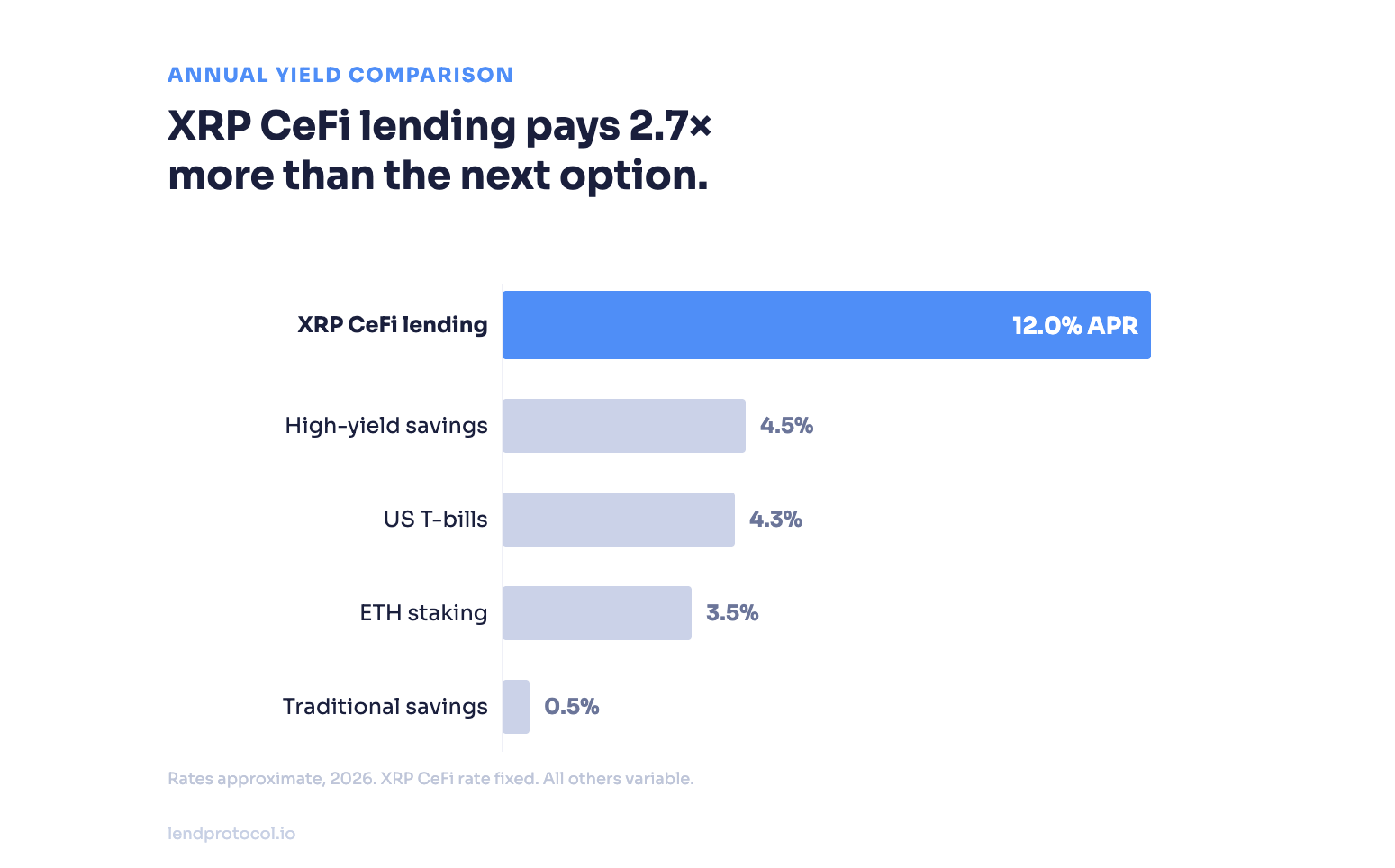
This is structurally different from how Ethereum, Solana, or Cardano work. In Proof-of-Stake systems, you lock tokens to gain validation rights, and the protocol compensates you for doing so. Ethereum holders can stake ETH natively for around 3–4% APY. Solana holders can stake SOL for around 6–7%. There is no equivalent option to stake XRP — the network has no mechanism to issue yield to holders. That mechanism simply doesn't exist on XRPL. The network was designed for speed and settlement efficiency — transactions confirm in 3–5 seconds with fees near zero — not for distributing passive income to holders.
The result is a fast, high-throughput payment rail with no built-in yield mechanism for passive holders. Which is exactly why people keep searching for workarounds.
What "XRP Staking" Actually Means in 2026
When you see "stake XRP" on a platform's marketing page, one of four things is happening:
- Custodial earn programs: The exchange holds your XRP and pays you a fixed or variable rate. Your funds sit on their books, and you're an unsecured creditor. Simple to use, lowest typical return.
- CeFi lending: A platform lends your XRP to borrowers against collateral and passes most of the interest back to you. More structured than custodial programs, with defined rates and risk models.
- XRPL AMM liquidity pools: You deposit XRP and a paired asset into the XRP Ledger's native Automated Market Maker and earn trading fees. Genuinely on-chain, but returns vary with trading volume and impermanent loss is real.
- Wrapped XRP on other chains: You bridge XRP to Ethereum or Flare as wXRP or FXRP and deploy it in DeFi. Higher potential returns, higher complexity, bridge risk, and smart contract exposure.
The word "staking" gets applied to all four of these categories interchangeably. Reading the product documentation — not the headline — is what separates an informed decision from a surprise.
One practical test: ask where the yield comes from. If the platform can't answer that clearly, or the answer involves vague references to "algorithmic strategies," treat it as a red flag. Legitimate products have a specific, verifiable income mechanism behind the rate they're advertising.
How to Earn 12% APR on XRP Without Staking
The most direct fixed-rate XRP yield product available right now is LendProtocol, a CeFi lending platform built on the XRP Ledger. It pays 12% APR on deposited XRP and RLUSD, distributed daily, with no lock-up. Daily compounding takes the effective annual yield to approximately 12.75%.
The mechanics are straightforward: depositors fund a lending pool; borrowers draw from that pool by posting overcollateralized collateral at 120% of the loan value in BTC, ETH, SOL, XRP, RLUSD, or USDT; borrowers pay 12.7% APR; the platform passes 12% to lenders and keeps the 0.7% spread as operating revenue.
The detail that separates this model from most alternatives is where the default risk sits. In typical DeFi and many CeFi structures, depositors absorb losses proportionally when borrowers default — your return and your principal both depend on how well the protocol handles bad debt. Here, the platform operates as a principal between lenders and borrowers. If a borrower defaults, the platform absorbs the loss, not the lender.
That's not a small distinction. It's what makes the product function closer to a structured deposit than a pooled investment.
Step-by-step: Earning XRP yield through LendProtocol
- Create an account at lendprotocol.io and complete identity verification
- Enable 2FA — mandatory for all accounts
- Deposit XRP or RLUSD to your platform wallet
- Interest starts accruing daily at 12% APR from your deposit date
- Withdraw anytime — there is no lock-up or exit delay
As of mid-2026, LendProtocol has over 13,700 active lenders with 743 million XRP deployed in its lending pool. Security infrastructure includes cold storage for the majority of assets, AES-256 GCM encryption, and mandatory 2FA on all accounts.
Your XRP Yield Options in 2026: How They Stack Up
Here's a clear-eyed comparison of the main paths available to XRP holders today.
| Method | Typical APY | Custody | Lock-up | Key Risk |
|---|---|---|---|---|
| CeFi lending (e.g. LendProtocol) | 12% fixed | Centralized platform | None | Platform counterparty risk |
| Exchange earn programs | 1–5% | Exchange (custodial) | Varies | Exchange insolvency |
| XRPL native AMM | Variable* | On-chain, non-custodial | None | Impermanent loss, variable yield |
| Wrapped XRP (Flare / Ethereum DeFi) | 2–8% variable | Smart contract | Varies | Bridge risk, smart contract exploits |
*AMM returns have no standard range — they depend on pool volume, asset pair, and fee tier. Returns can exceed or fall below 12% depending on conditions
A few things worth understanding about that table before you pick a column:
Exchange earn programs are the easiest entry point but the least rewarding. Platforms like Binance Earn or Nexo typically pay 1–5% APY on XRP, with rates that fluctuate and often depend on loyalty token holdings or term commitments. Your XRP sits in the exchange's wallet, which means exchange risk sits alongside it.
XRPL AMMs are the most technically native option — liquidity sits directly on the XRP Ledger itself, without a smart contract wrapper that could be exploited separately. The trade-off is impermanent loss: if XRP's price moves sharply while your funds are in a pool, you can end up with less XRP than you deposited, even if your dollar value increased.
CeFi lending offers fixed rates and predictable payouts.
The trade-off is trusting the platform's underwriting discipline, collateral management, and long-term solvency. The better platforms back that trust with verifiable security infrastructure and transparent risk models.
RLUSD: Earning Stable Yield on the XRP Ledger
If you want XRP Ledger yield without exposure to XRP price movements, RLUSD opens a parallel path. It answers a specific question: how do you earn income on the XRP Ledger if you can't stake XRP and don't want to hold a volatile asset?
RLUSD is Ripple's fully-backed, regulated USD stablecoin native to the XRP Ledger. The platform accepts RLUSD deposits at the same 12% APR available to XRP lenders — interest paid in RLUSD, stable and dollar-denominated, with no exposure to crypto price swings.
For institutional treasury teams holding RLUSD between operational settlements, this is the answer to a real problem: idle balances earning nothing on a ledger built for speed. For individual holders, it answers the question of how to earn on XRPL without holding a volatile asset at all.
The RLUSD option also matters for the broader XRP Ledger ecosystem. Yield-bearing RLUSD deposits give institutional holders a reason to keep balances on-chain rather than converting out between use cases, which contributes to RLUSD liquidity and market depth.
XLS-66: What the XRPL's Native Lending Protocol Actually Is
In 2026, the XLS-66 amendment moved into active validator governance on the XRP Ledger. All 34 XRPL validators began voting on whether to activate native lending directly on the ledger — introducing fixed loan terms, transparent on-chain settlement, and isolated risk design through Single Asset Vault structures aimed at institutional borrowers.
This is worth understanding clearly, because it's easy to conflate with consumer products.
XLS-66 is infrastructure: a protocol-level lending standard developed by Ripple and the XRPL community for credentialed institutional participants. It is not a yield product you can sign up for today. Consumer-facing platforms like LendProtocol use the XRP Ledger as their settlement and custody layer but operate independently of the XLS-66 protocol stack.
If XLS-66 activates, it will expand on-chain capital infrastructure for institutions. Consumer products built on XRPL continue to operate on their own terms alongside that layer.
Risks to Understand Before You Deposit
No yield product is without risk. That's true whether you're trying to stake XRP through a CeFi platform, provide AMM liquidity, or hold wrapped XRP in a DeFi protocol on another chain. Here is what each major option is actually asking you to accept:
CeFi lending risk. You trust the platform — its underwriting standards, its collateral management, and its long-term solvency. If the platform fails, recovery depends on how assets are held, which legal jurisdiction applies, and whether depositor funds are segregated from operating capital. The 120% collateral ratio and cold storage custody both reduce risk, but centralized operation is still a dependency.
Exchange earn risk. The exchange holds your XRP. If the exchange is hacked, becomes insolvent, or freezes withdrawals for any reason, you're in the creditor queue. The history of centralized exchange failures in crypto is not short, and the pattern tends to repeat.
XRPL AMM risk. Impermanent loss is the main concern. If XRP appreciates sharply while your position is in an XRP/stablecoin pool, the AMM automatically rebalances — you'll receive less XRP than you deposited. Your dollar value may still be higher, but your XRP balance will be lower. Returns also depend entirely on trading volume, which varies.
Bridge and wrapped XRP risk. Moving XRP to Ethereum or Flare requires passing through bridge smart contracts, which have historically been among the highest-value exploit targets in the entire crypto ecosystem. Several bridges have been drained for nine-figure sums. The technology continues to improve, but the risk category is real.
Tax considerations. In most jurisdictions, yield received on deposited crypto is taxable as ordinary income in the year it's received. A subsequent sale or exchange of XRP is typically a separate capital gains event. How yield is classified — lending interest, trading fee income, or something else — may vary depending on the product structure. Rules are also evolving rapidly. Consulting a tax professional familiar with crypto in your country is the right move before committing significant capital.
The Short Version
XRP can't be staked — but it can be lent, pooled, and put to work in several legitimate ways. The landscape in 2026 is meaningfully better than two years ago: the XRPL native AMM is live, XLS-66 is moving through governance, and fixed-rate CeFi products now offer competitive rates with clearly defined risk structures.
The most important step before depositing anywhere is understanding where the yield actually comes from and who holds your funds while it accrues. A 12% fixed APR paid daily on a platform that absorbs default risk is a categorically different product from an exchange account paying 2% on funds they could freeze tomorrow. The yield number is just one variable. Custody, risk structure, and liquidity terms are the others — and they matter just as much.
For holders who want the simplest path to put XRP to work without navigating wallets, bridges, or AMM mechanics, a fixed-rate CeFi lending product remains the most accessible starting point. For those comfortable with on-chain mechanics and variable returns, the XRPL AMM offers a genuinely non-custodial alternative that didn't exist a few years ago.
Read the documentation. Match the product structure to your real risk tolerance. And don't let the word "staking" do the work of actually understanding what you're signing up for.
FAQ
Can you stake XRP in 2026?
No. The XRP Ledger uses Federated Byzantine Agreement consensus, not Proof-of-Stake, so there are no protocol-level staking rewards for holding XRP. Products marketed as "XRP staking" are yield programs run by the platforms themselves — lending products, custodial earn accounts, or AMM liquidity positions. Understanding which type you're using is what determines your actual risk exposure.
What is the best way to earn yield on XRP?
It depends on your priorities. For a fixed rate with daily payouts and no lock-up, CeFi lending platforms offer the most structured approach. LendProtocol pays 12% APR on XRP and RLUSD, with the platform — not the depositor — absorbing borrower default risk. For non-custodial yield, the XRPL native AMM allows on-chain liquidity provision with instant withdrawal, though returns are variable and impermanent loss applies.
What is the difference between LendProtocol and XLS-66?
LendProtocol is a consumer-facing CeFi platform built on the XRP Ledger that pays depositors 12% APR on XRP and RLUSD. XLS-66 is a protocol-level lending standard developed by Ripple and the XRPL community for institutional borrowers with off-chain underwriting. They are separate products with different target users, risk models, and collateral structures — one is a commercial platform, the other is core blockchain infrastructure.
What collateral do borrowers post on LendProtocol?
Borrowers must post 120% of the loan value in accepted collateral: BTC, ETH, SOL, XRP, RLUSD, or USDT. The 20% overcollateralization buffer provides a cushion against collateral price volatility before a default becomes a net loss for the platform.
Can I withdraw my XRP at any time?
For CeFi lending on lendprotocol.io, yes — there is no lock-up period. XRPL AMM positions can also be exited instantly by burning LP tokens. Exchange earn products vary: some are fully flexible, others require a fixed term for higher rates. Check the redemption terms before depositing anywhere.