How to Stake XRP: What Actually Works in 2026
How to stake XRP compared: fixed lending at 12% APR, XRPL AMM pools, wrapped DeFi, and CeFi exchanges. No lock-up options included.
Every month, millions of investors search for "how to stake XRP" and land on guides built on a misconception. XRP cannot be staked — not because of a technical limitation that will be fixed eventually, but because of a deliberate architectural choice made when the XRP Ledger was designed. There is no validator reward mechanism. There is no Proof-of-Stake. There never will be.
But here's what those same guides rarely explain clearly: XRP holders can still earn regular, daily yield on their holdings. The mechanism is different from staking, but the practical result — income on a held asset — is functionally the same. This guide explains exactly why staking doesn't apply to XRP, what the alternatives actually are, and how to use them step by step.
Can You Stake XRP?
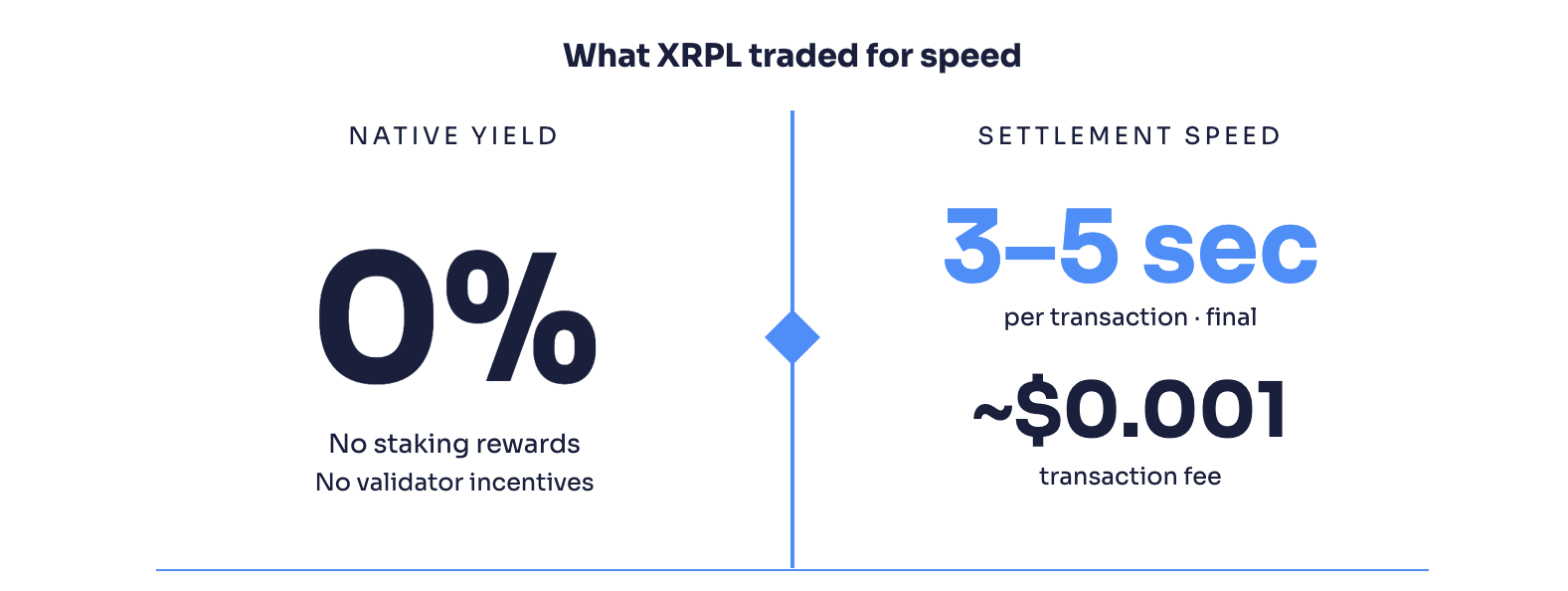
No. XRP cannot be staked on the XRP Ledger — the protocol has no staking mechanism, no validator rewards, and no planned change to this design. Unlike Ethereum or Solana, which distribute yield through Proof-of-Stake consensus, the XRP Ledger runs on Federated Byzantine Agreement (fBFT), a consensus model in which validators agree on transaction order through iterative voting rounds. Validators don't lock up tokens to participate. The protocol provides no financial incentive for holding XRP.
This creates a real problem for long-term XRP holders. Every other major crypto asset — Ethereum, Solana, Cardano, Polkadot — has some native yield mechanism. XRP has none. The upside is that XRP holders never face inflationary dilution from staking rewards. The downside is idle capital with zero return by default.
The practical answer is XRP lending: depositing XRP on a platform that lends it to overcollateralized borrowers and pays you interest. It's structurally different from staking, but the outcome is what most people searching how to stake XRP actually want — passive income on a held asset, paid regularly.
Why XRP Uses a Different Consensus Mechanism
The XRP Ledger was deliberately built without Proof-of-Stake because its design priority was settlement speed and finality, not token-based network security. Every 3–5 seconds, a network of trusted validators proposes, votes on, and reaches supermajority agreement on the next set of transactions. Once a ledger version closes, it's final — no reorganizations, no rollbacks, no waiting for confirmations.
Because validators don't need to stake anything to participate, there is no mechanism for staking rewards. The XRP Ledger Consensus Protocol uses reputation and operational incentives to maintain validator integrity, not financial collateral. This is a feature, not a gap — XRP holders are never diluted by inflation from staking emissions, and the network achieves finality faster than most PoS chains.
XRPL's native Automated Market Maker (AMM), which went live in 2024, did partially change the on-ledger yield picture. Holders can now deposit XRP directly into liquidity pools on the XRP Ledger and earn a share of trading fees — no wrapping or bridging required. But AMM returns vary with pool volume, depend on the asset pair, and carry impermanent loss exposure. For holders who want predictable, fixed-rate income rather than DeFi mechanics, lending is the cleaner path.
What "XRP Staking" Actually Means in Practice
When a platform advertises "XRP staking," it is offering one of four things, none of which are native staking. Understanding which you're looking at matters because the risks are genuinely different.
Collateral-backed lending is the closest functional equivalent. Your XRP is lent to borrowers who post crypto collateral — typically 120% of the loan value. You earn interest paid by the borrower, on a regular schedule. The platform manages credit risk. This is how fixed-rate XRP yield products work.
Custodial yield programs are exchange-run savings products. You deposit XRP with an exchange (Nexo, YouHodler, Binance Earn), and the platform uses it in its internal lending or trading operations, paying you a share of that return. Rates are variable and can change with market conditions. Your assets sit in the exchange's custody.
XRPL AMM liquidity provision lets you deposit XRP and a paired asset into a pool on the XRP Ledger's native DEX. You earn a portion of trading fees from that pool. Returns are unpredictable, good when volume is high and thin when it isn't. This avoids smart-contract risk since the AMM is built into the protocol, but impermanent loss is a real factor.
Wrapped XRP DeFi means bridging XRP to another blockchain — Ethereum, BNB Chain, Flare — as wXRP or FXRP, then deploying it into DeFi lending pools or liquidity farms. Potential returns can be higher, but you're layering bridge risk, smart contract exposure, and impermanent loss on top of your existing XRP position. For most retail holders, the added complexity isn't worth the incremental yield.
How to Stake XRP — Your Step-by-Step Options
Here is a practical, method-by-method walkthrough, ordered from simplest to most complex.
Option 1: Fixed-Rate XRP Lending (Lowest Complexity)
LendProtocol is a CeFi lending platform built on the XRP Ledger, offering a stated 12% APR on XRP deposits with daily payouts and no lock-up period. The model is straightforward: deposit XRP, the platform matches it with overcollateralized borrowers, yield accrues daily. If a borrower defaults, the platform — not the depositor — absorbs the loss.
Daily compounding brings the effective annual yield to approximately 12.75% — the difference between APR and effective yield from interest being added to principal every day.
Steps:
- Go to lendprotocol.io and create an account
- Complete KYC identity verification (required for all accounts)
- Enable two-factor authentication — the platform requires this before deposits can be made
- Transfer XRP to your account — include the correct destination tag when sending from an exchange (more on this below)
- Confirm your deposit — yield starts accruing from day one, paid daily
- Withdraw anytime — no lock-up period, no exit penalty
RLUSD — Ripple's fully-backed, regulated USD stablecoin native to the XRP Ledger — is also accepted at the same 12% APR. For holders who want yield without exposure to XRP price movements, RLUSD deposits are the practical alternative.
Option 2: Centralized Exchange Earn Programs (Easiest Onboarding)
Nexo and YouHodler are the most established CeFi platforms offering XRP earn products. Nexo currently advertises up to 8.25% APY on XRP; YouHodler publishes up to 11% APY. Both offer daily payouts and flexible withdrawal terms on their base-tier products.
The rates are variable — they shift with market conditions and may be tiered based on how much of the platform's native token you hold. Neither platform is available in all jurisdictions, and regional terms differ.
Steps:
- Create an account and complete KYC on the platform of your choice
- Navigate to the Earn or Savings section
- Choose between flexible (withdraw anytime, lower rate) or fixed-term (locked, higher rate) products
- Deposit XRP and confirm the position
- Monitor rates periodically — variable rates can change without advance notice
The main tradeoff: your assets sit on the exchange's balance sheet. Platform custody is the central risk.
Option 3: XRPL Native AMM Liquidity Provision (On-Ledger, Variable)
Since the XRPL AMM went live in 2024, XRP holders can provide liquidity directly on the XRP Ledger without leaving the ecosystem. You supply XRP and a paired asset to a pool and earn a share of trading fees.
Steps:
- Set up an XRPL-compatible wallet (Xumm/Xaman is widely used and has native AMM support)
- Fund the wallet with XRP and the asset you want to pair (a stablecoin like RLUSD or USDT is common)
- Connect to the XRPL DEX or an aggregator interface that supports AMM liquidity
- Select your pool and provide both assets in the required ratio
- Track your fee earnings and monitor for impermanent loss — if the price ratio between your two assets shifts significantly, your position may be worth less than if you had simply held both separately
This option has no custodial risk (you control the wallet keys) and no smart-contract risk (the AMM is native to the protocol). Returns depend entirely on trading volume in your pool.
Option 4: Wrapped XRP DeFi (Highest Complexity and Risk)
For holders already comfortable with DeFi, wrapping XRP unlocks access to lending protocols and liquidity farms on other blockchains. cbXRP (Coinbase-wrapped) runs on Base; FXRP runs on the Flare network; wXRP runs on Ethereum and BNB Chain.
Steps:
- Acquire XRP in a self-custody wallet
- Bridge to your target network using a reputable, audited bridging protocol (verify before using — bridge exploits have caused significant losses industry-wide)
- Connect a compatible DeFi wallet (MetaMask for Ethereum/Base, Bifrost for Flare) to the relevant network
- Deposit wrapped XRP into a lending pool or liquidity farm
- Track your rewards and understand the withdrawal process for each platform
Only use audited protocols. Check that any bridge you use has a clean public track record. Never put more capital into a bridge or unaudited smart contract than you can afford to lose entirely.
Comparing XRP Yield Options
| Method | Typical APR/APY | Rate type | Lock-up | Key risk |
|---|---|---|---|---|
| LendProtocol (XRP lending) | 12% APR | Fixed | None | Platform counterparty |
| CeFi exchanges (Nexo, YouHodler) | 1–11% | Variable | Optional | Custodial, platform risk |
| XRPL native AMM | Variable | Variable | None | Impermanent loss |
| Wrapped XRP DeFi (wXRP, FXRP) | 2–8% | Variable | None | Bridge, smart contract |
| Traditional bank savings (USD) | 0.5–4.5% | Variable | Varies | Low (deposit-insured) |
Two things stand out in this comparison. First, fixed rates are rare in XRP yield products — most platforms offer variable rates that shift with market conditions and can drop without warning. Second, most CeFi headline rates are tiered, requiring holders to lock capital, hold a platform token, or both to access the advertised rate. LendProtocol's 12% is its stated offer on standard flexible deposits with no token requirement.
What to Check Before Depositing on Any Platform
Before sending XRP to any yield platform, verify four things: custody model, encryption standards, account security, and the platform's operational track record.
For LendProtocol specifically: the majority of deposited assets are held in cold storage — offline and inaccessible to remote attackers. Hot wallet exposure is limited to operational liquidity. Encryption uses AES-256 GCM, the same standard used by banks and government institutions for data at rest. Two-factor authentication is enforced on all accounts. As of mid-2026, the platform reports 13,713+ active lenders and over 743 million XRP lent — meaningful operating scale for a niche-focused platform.
For any CeFi platform, review whether the company discloses where assets are held, what happens to depositor funds if the platform faces insolvency, and what their withdrawal processing time is. Platforms that don't answer these questions clearly deserve scrutiny.
One XRP-specific technical point: always include the correct destination tag when sending XRP to an exchange or CeFi platform. The destination tag is how the platform identifies your account. A missing or incorrect tag can result in funds being credited to the wrong account or lost entirely — some platforms cannot recover misrouted transactions. Verify the destination tag on the receiving platform before every transfer.
Additionally, each new XRP Ledger address requires a 10 XRP minimum reserve to activate. This reserve is not spent; it's locked as a network-level requirement and returned if you close the account. Budget for it when calculating how much XRP you intend to keep in a self-custody wallet.
Tax Basics: How XRP Yield Is Treated
In most jurisdictions, yield received from XRP lending or exchange earn programs is taxable as ordinary income, valued at the fair market price of XRP at the time of receipt. A separate capital gains event applies if you later sell or exchange the earned XRP — your cost basis for those tokens is typically their value when you received them.
Because the XRP Ledger doesn't use Proof-of-Stake, XRP yield from third-party platforms is generally classified as lending income or custodial program income — not staking rewards. The practical tax difference is minimal in most countries, but the classification matters for record-keeping. Keep logs of each yield payout, including the date, XRP amount, and XRP price on that date.
Tax rules for crypto yield vary significantly by jurisdiction and have been evolving. This is a factual overview, not tax advice — consult a qualified professional familiar with crypto taxation in your country before making decisions based on tax considerations.
Conclusion
XRP's design means the question "how to stake XRP" doesn't have a native answer. That's a feature of how the XRP Ledger was built — fast finality, no inflation, no validator staking requirement. The practical cost is that XRP earns nothing by sitting in a wallet.
The real question is what to do instead. Lending is the most direct path: deposit XRP, earn interest from collateralized borrowers, collect daily payouts. XRPL AMM liquidity provision gives on-ledger yield without custodial risk, at the cost of variable returns and impermanent loss exposure. Wrapped XRP DeFi opens broader markets with broader risks.
For most XRP holders — those who want regular, predictable income on their holdings without DeFi overhead or lock-up periods — fixed-rate lending is where the search for XRP staking alternatives ends. LendProtocol's 12% stated APR, daily payouts, no lock-up, and platform-absorbed default risk represent the most direct answer to the problem the XRP Ledger's design created.
XRP can't be staked. But it can be put to work.
FAQ
Can you stake XRP natively on the XRP Ledger?
No. The XRP Ledger uses Federated Byzantine Agreement, not Proof-of-Stake. There is no protocol-level staking mechanism, no validator rewards distributed to token holders, and no roadmap to add one. Any product marketed as "XRP staking" is a third-party lending program, custodial yield account, or liquidity provision product.
What is the best way to earn yield on XRP?
That depends on what you're optimizing for. For fixed, predictable income with no lock-up and no DeFi complexity, collateral-backed lending platforms offer a set rate regardless of market conditions. For higher potential returns with more complexity and risk, XRPL AMM liquidity or wrapped XRP DeFi strategies are options. Variable-rate CeFi platforms sit in the middle. No method is risk-free.
Is XRP lending safe?
Every yield product involves some form of risk. For CeFi lending, the primary risks are platform counterparty risk (the platform fails or freezes withdrawals) and, in models where depositors bear credit risk, borrower default. Look for platforms that use cold storage, enforce 2FA, publish their security practices, and have an operational track record. In DeFi, smart contract and bridge risk replace platform risk.
What is RLUSD, and can I earn yield on it?
RLUSD is Ripple's fully-backed, regulated USD stablecoin native to the XRP Ledger. Fixed-rate lending platforms that accept RLUSD pay the same yield as on XRP — 12% APR with daily payouts. Depositing RLUSD rather than XRP removes price volatility from the equation, which makes it a practical option for risk-averse depositors or institutional teams managing treasury balances.
What APR can I realistically expect from XRP yield products?
Variable-rate CeFi exchange programs typically range from 1–11% depending on the platform, tier, and market conditions. XRPL AMM returns vary with trading volume and can be well above or below that range depending on the pool. Fixed-rate lending platforms offer predictability — the rate is set regardless of what the market does — though the trade-off is reliance on a centralized operator.
Does XRP yield trigger a taxable event?
In most countries, yes — yield received is generally taxable as ordinary income when received. A capital gains event applies separately when you sell or exchange earned XRP. Consult a tax professional familiar with cryptocurrency in your jurisdiction for guidance specific to your situation.